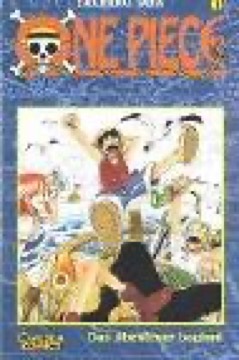
One Piece
ROMANCE DAWN —冒険の夜明け—
Eiichiro Oda's series, begun in 1997, following a crew of pirates searching for a legendary treasure. One of the longest continuously running narratives in any medium.
- First published
- 1997
- Publisher
- Glénat
- Pages
- 208
- Shelf
- Anime
- Level
- Entry
- ISBN-13
- 9789861125794
Record checked against
Only one source carried a publication date for this work, so the year is uncorroborated.
Catalogue note
- Reads as
- ReflectiveChanges how you see rather than what you do.
- Level
- Accessible / FoundationalNo prior reading assumed.
- Approach
- Theoretical
- Written for
- Readers of comics, and anyone curious how the form works, Newcomers to the subject
Saved in this browser only — no account, nothing sent anywhere. My library
Read this if
- You read for the writing as much as for the argument.
- You want a book that changes how you see things rather than what you do tomorrow.
- You are starting from scratch here and want a way in that assumes no prior reading.
What it is
Monkey D. Luffy, a boy whose body has become rubber after eating a cursed fruit, sets out to assemble a crew and find the treasure left by the former king of the pirates.
The series has run for more than a hundred volumes, adding crew members, islands, governments and historical layers, and is still in progress.
A hundred-plus volumes, still running, and the plot laid in volume one is still paying out.
Devmark’s reading — not a quotation from the book
Long-form planning
Oda has repeatedly demonstrated that details planted hundreds of chapters earlier were deliberate: throwaway background figures become central, and offhand remarks turn out to be load-bearing.
This is the series' most unusual quality. Very few serialised works sustain that degree of forward planning, and the payoffs are a substantial part of why readers commit to its length.
The crew
Each member joins after an arc devoted to their history, and each has a specific unfulfilled ambition that the series treats as seriously as the main quest.
The recruitment structure is the emotional engine. The reader accumulates attachments rather than following one protagonist, and the crew's mutual obligation is the closest thing the series has to a thesis.
Politics
Beneath the adventure is a consistent argument about a corrupt world government, slavery, colonial administration, and the manufacture of official history.
Several arcs are explicitly about occupation and resistance, and the series is considerably more political than its cheerful surface suggests. The Ohara and Fish-Man Island material in particular is unambiguous.
Oda's drawing
The style is cartoonish, dense and highly individual: enormously varied character designs, crowded panels, and an obvious pleasure in inventing creatures and places.
The pages are busy to the point of being hard to read at speed, and the density is deliberate. Background detail routinely contains information that matters later.
Tone
It alternates between broad comedy and genuine tragedy, frequently within a single chapter, and the transitions are abrupt by design.
The emotional register is unembarrassed. Characters weep, make speeches and declare their intentions, and the series treats sincerity as a virtue rather than as something to be undercut.
Arc structure
Each island supplies a self-contained story with its own antagonist, culture and political situation, connected by an overarching narrative that advances slowly.
This makes the series more approachable than its length suggests: an arc is typically eight to fifteen volumes and functions as a novel in itself.
The pacing problem
Some arcs run considerably longer than their material supports, and the weekly serialisation shows in stretches where very little advances.
The animated adaptation is substantially worse in this respect, and readers who find the anime slow frequently get on much better with the manga. Readers are generally advised to read in volume form rather than weekly, since the chapter breaks are where the slackness is most obvious.
Freedom as the subject
The series returns constantly to the difference between freedom and power, and Luffy's ambition is specifically to be the freest person alive rather than the strongest or the richest.
That distinction is maintained with real consistency across a hundred volumes, and it is what keeps a pirate adventure from being simply about acquisition.
Its commercial scale
It is among the best-selling comic series ever produced in any country, and the property supports films, games and a live-action adaptation.
The scale is relevant to reading it: the series has had the freedom to run at whatever length Oda wants, which accounts for both its ambition and its slackness.
Where to start and how
There is no shortcut; the series begins at volume one and the early volumes are noticeably rougher in drawing and simpler in plotting than what follows.
Most readers report that the series becomes properly compelling somewhere in the second major arc. Three-in-one omnibus editions make the early stretch considerably less daunting to acquire.
Who it is for
Readers willing to make a very large commitment to a work that rewards patience, and readers who enjoy world-building that accumulates rather than being delivered.
It is emphatically not for readers who want economy. It is the most generous, most sprawling and most sincere thing in this section, and those qualities are inseparable from its length.
What to take away
- 01Planting that pays out decades laterBackground figures and offhand remarks from early volumes become load-bearing hundreds of chapters on.
- 02Recruitment as emotional structureEach crew member arrives after an arc about their history and keeps an unfulfilled ambition the series takes seriously.
- 03A political argument under the adventureCorrupt world government, slavery and manufactured official history are treated explicitly across several arcs.
- 04Freedom distinguished from powerLuffy wants to be the freest person alive rather than the strongest, and the distinction is held for a hundred volumes.
- 05Islands as novelsEach arc is a self-contained story of eight to fifteen volumes, which makes the whole more approachable than its length suggests.
- 06Density that carries informationThe crowded panels are deliberate; background detail routinely contains material that matters much later.