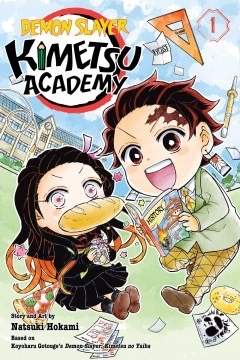
Demon Slayer
Kimetsu no Yaiba, Vol. 10
Koyoharu Gotouge's series, begun in 2016, about a boy whose family is killed by a demon and whose sister becomes one. A traditional structure executed with unusual emotional directness.
- First published
- 2016
- Publisher
- Viz Media
- Pages
- not established
- Shelf
- Anime
- Level
- Entry
- ISBN-13
- 9781974736027
Record checked against
No page count is recorded, so no reading estimate is shown for the book itself.
Catalogue note
- Reads as
- ReflectiveChanges how you see rather than what you do.
- Level
- Accessible / FoundationalNo prior reading assumed.
- Approach
- Theoretical
- Written for
- Readers of comics, and anyone curious how the form works, Newcomers to the subject
Saved in this browser only — no account, nothing sent anywhere. My library
Read this if
- You read for the writing as much as for the argument.
- You want a life told honestly, at full length.
- You want a book that changes how you see things rather than what you do tomorrow.
- You are starting from scratch here and want a way in that assumes no prior reading.
What it is
Tanjiro Kamado returns home to find his family killed and his sister Nezuko transformed into a demon that has nevertheless retained some of herself.
He joins the Demon Slayer Corps, an organisation outside the state that hunts demons with specially forged swords, hoping to find a way to make his sister human again.
His family is dead and his sister is the thing that killed them, and he is not prepared to give her up.
Devmark’s reading — not a quotation from the book
Conventional by design
Structurally it is orthodox shōnen: a training arc, a ranked organisation, escalating opponents, named techniques and a final confrontation with an originating villain.
The series does not innovate structurally and does not attempt to. Its distinction is entirely in execution and in emotional register. Readers looking for the structural invention of Hunter x Hunter will not find it, and the series is untroubled by that.
Sympathy for the antagonists
Almost every demon is given a flashback establishing the human circumstances that produced it — poverty, abuse, illness, despair — delivered at the moment of its death.
The device is repeated so consistently that it becomes the series' governing statement: the monsters are people something was done to, and Tanjiro's compassion for them is treated as strength rather than naivety.
Tanjiro
He is kind, diligent, physically unremarkable and succeeds through effort and attentiveness rather than through latent power.
His defining trait is that he keeps noticing other people's suffering, including his enemies', and the series never treats this as a weakness to be outgrown. He is also unusually polite, and the contrast between his manners and the violence around him is a consistent source of both comedy and unease.
Breathing styles
Combat is organised around breathing techniques that produce named forms, each associated with an element and visualised with elaborate imagery.
The system is more decorative than rigorous — it does not generate puzzles the way Nen or Stands do — but it supplies strong visual identity and clear differentiation between fighters.
The art
Gotouge's drawing is distinctive rather than polished: expressive, slightly scratchy, with strong character silhouettes and a real facility for grotesque demon design.
Action pages are sometimes hard to follow, which is the most common technical criticism. The emotional panels are consistently the strongest. Gotouge's demon designs in particular are genuinely inventive, drawing on Japanese folk imagery rather than on Western monster convention.
Pace and length
Twenty-three volumes, which is short for a series of its commercial scale, and it moves briskly with very little filler.
Gotouge ended it at the height of its success rather than extending it, which is unusual and which readers who have been burned by longer series consistently appreciate.
The Taishō setting
The early twentieth-century Japanese setting supplies visual texture — clothing, architecture, the arrival of electricity and rail — and a sense of a world about to change.
The period is atmosphere rather than argument. The series does not engage with the politics of the era, which is a missed opportunity rather than a flaw.
The Mugen Train material
The arc involving a senior swordsman on a train is the series' emotional peak and was adapted into a film that became one of the highest-grossing releases in Japanese history.
The arc's power comes from a character introduced only shortly before, which is a considerable technical achievement.
Nezuko
The sister is a demon who does not eat people and communicates largely without speech, which limits her as a character while making her the series' emotional anchor.
Criticism that she is more object than person is reasonable. Her function is to be the thing Tanjiro will not abandon, and the series asks relatively little else of her.
The adaptation
The animated series by Ufotable is visually spectacular and is responsible for a substantial part of the property's success, with a scale of production unusual even for major series.
Readers frequently arrive from the animation and find the manga sparer. Both are complete, and the manga is considerably faster.
Who it is for
Readers who want a complete, emotionally direct action series without a large commitment, and who do not require structural novelty.
It is one of the easiest recommendations in this section for a reader new to shōnen manga: short, finished, warm, and entirely legible without any background in the genre.
What to take away
- 01Execution over inventionThe structure is entirely orthodox; the distinction is in emotional register and in how consistently it is sustained.
- 02A flashback at every deathEach demon is given the human circumstances that produced it, which becomes the series' governing moral statement.
- 03Compassion as strengthTanjiro's attention to his enemies' suffering is never framed as naivety to be outgrown.
- 04Decorative rather than rigorousBreathing styles supply visual identity and differentiation without generating the puzzles that stricter systems do.
- 05Ended at its peakTwenty-three volumes with little filler, concluded at the height of its commercial success rather than extended.
- 06An anchor rather than a characterNezuko functions as the thing the protagonist will not abandon, and the series asks little else of her.