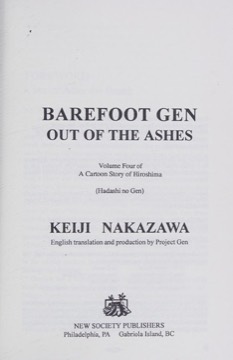
Barefoot Gen
Keiji Nakazawa's series, begun in 1973, drawing on his own survival of the Hiroshima bombing at the age of six. The central work of atomic-bomb literature in comics.
- First published
- 1973
- Publisher
- Last Gasp
- Pages
- 293
- Shelf
- Anime
- Level
- Core
- ISBN-13
- 9780867194531
Record checked against
Catalogue note
- Reads as
- ReflectiveChanges how you see rather than what you do.
- Level
- Core / BuildingAssumes general familiarity with the subject.
- Approach
- Theoretical
- Written for
- Readers of comics, and anyone curious how the form works, Readers with some grounding
Saved in this browser only — no account, nothing sent anywhere. My library
Read this if
- You read for the writing as much as for the argument.
- You want to know how we got here.
- You want a life told honestly, at full length.
- You want a book that changes how you see things rather than what you do tomorrow.
- You know roughly how the subject works and want the fuller account.
What it is
Gen Nakaoka is six years old in Hiroshima in 1945. The early chapters establish his family under wartime conditions: food shortages, neighbourhood surveillance, and a father who openly opposes the war and is beaten for it.
The bombing occurs in the first volume. The remaining nine follow Gen and his mother through the immediate aftermath, the occupation, and the years of illness, poverty and discrimination that followed.
The bomb falls in volume one. The other nine volumes are what came after.
Devmark’s reading — not a quotation from the book
Autobiography
Nakazawa was six and in Hiroshima on 6 August 1945, shielded by a wall when the bomb detonated. He lost his father, his sister and a brother in the collapse and fire.
The series is not literally his life but the central experiences are his, and he wrote it after his mother's death, when her cremation left almost no bone — which he attributed to radiation and described as the moment he decided to write.
The depiction of the bombing
The bombing sequence is explicit: people with skin detaching, eyes displaced, children burning, and bodies in the rivers.
Nakazawa refuses euphemism deliberately and at length. He believed the event had been consistently sanitised in Japanese public memory, and he drew it to be difficult rather than bearable — the sequence runs for many pages and does not cut away from anything.
The anti-war argument
The series is as hostile to the Japanese wartime government as to the United States, and Gen's father is presented as heroic specifically for opposing his own country's war.
This is the book's most distinctive position. It refuses to treat Hiroshima as an event that happened to an innocent nation, and the neighbourhood's treatment of the family before the bombing is given as much weight as the bombing itself.
The aftermath
Much of the series concerns discrimination against survivors: refusal of employment, broken engagements, the belief that radiation sickness was contagious or hereditary, and the absence of medical support.
This material is less known than the bombing itself and is the series' most valuable contribution — the argument that the event did not end in 1945.
Tone
It is drawn in a cartoon style with slapstick, running jokes and broad characterisation, sitting directly alongside atrocity.
The juxtaposition is deeply disorienting and is not accidental. Nakazawa was writing for a children's weekly, and the comic register is what allowed the material to reach the audience he wanted.
Gen as a figure
He is loud, resilient, frequently violent, and not especially likeable — the opposite of a passive victim.
Nakazawa insisted on this throughout. Gen survives by being difficult, by stealing and by shouting, and the series is explicit that survival in those conditions rewarded aggression rather than virtue. A gentler protagonist would have made the argument dishonest.
Historical detail
Rationing, the neighbourhood associations, black markets, the occupation's censorship of bomb reporting, and the Korean minority's position in Hiroshima are all treated specifically.
The Korean material is notable: Nakazawa includes Korean forced labourers and their treatment at a time when Japanese popular culture generally did not.
Publication and reach
It was serialised in a mainstream boys' weekly, later moved between several magazines, and became one of the first manga translated into English, initially by a volunteer peace group.
It has been widely used in Japanese schools, and periodic attempts to restrict that access have themselves become news.
The art
Simple, round figures with heavy black shadows, and a willingness to hold on an image of a burned body for a full panel without dialogue.
The drawing is not technically sophisticated and does not need to be. The directness is the effect, and a more accomplished style would probably have aestheticised the material.
Length
Ten volumes, and the quality varies. The first four are the strongest and the later volumes become more episodic and more didactic.
Readers who want the core experience can stop after the fourth volume without missing the argument, though the later material on discrimination is the part least available elsewhere.
Why it is read
It is the most widely read first-hand account of the bombing in any medium, and its insistence on both the atrocity and the responsibility of the government that preceded it remains unusual.
It is difficult and it is meant to be. Readers should expect to be upset and should not expect the comic style to soften anything.
What to take away
- 01Nine volumes of aftermathThe bombing occurs early; most of the series is about illness, poverty and discrimination in the years that followed.
- 02Hostile to both governmentsGen's father is heroic for opposing Japan's war, and the neighbourhood's treatment of the family is weighted as heavily as the bomb.
- 03Deliberate refusal of euphemismNakazawa drew the bombing explicitly because he believed public memory had sanitised it.
- 04Cartoon style as accessSlapstick sits beside atrocity because the series ran in a children's weekly, and that register is what reached the audience.
- 05A survivor who is not gentleGen is loud, aggressive and unlikeable, because the series argues those were the traits that survived.
- 06Written after a cremationNakazawa decided to write it when his mother's remains contained almost no bone, which he attributed to radiation.