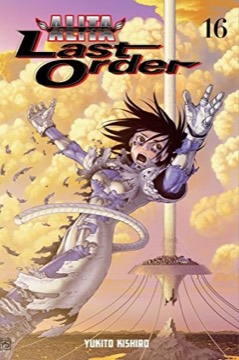
Battle Angel Alita
Yukito Kishiro's series, begun in 1990, about a cyborg found in a scrapheap with no memory, in a city built beneath a floating one. Foundational cyberpunk manga.
- First published
- 1990
- Publisher
- Kodansha Comics
- Pages
- 216
- Shelf
- Anime
- Level
- Core
- ISBN-13
- 9781612622972
Record checked against
Catalogue note
- Reads as
- ReflectiveChanges how you see rather than what you do.
- Level
- Core / BuildingAssumes general familiarity with the subject.
- Approach
- Theoretical
- Written for
- Readers of comics, and anyone curious how the form works, Readers with some grounding
Saved in this browser only — no account, nothing sent anywhere. My library
Read this if
- You read for the writing as much as for the argument.
- You want a thought experiment you can live inside for a while.
- You want to examine an assumption you have never examined.
- You want a book that changes how you see things rather than what you do tomorrow.
- You know roughly how the subject works and want the fuller account.
What it is
A cybernetics doctor finds a functioning cyborg head in the scrap that falls from Tiphares, the city suspended above. He rebuilds her, names her Alita, and discovers that her body remembers a martial art she cannot recall learning.
She becomes a bounty hunter in the Scrapyard below, and the series follows her through several distinct phases of life and several bodies.
Her memory is gone. Her body still knows how to fight.
Devmark’s reading — not a quotation from the book
The two cities
Tiphares floats above and discards its waste downward; the Scrapyard below lives on what falls. Nobody from below has ever gone up, and the arrangement is never seriously challenged.
The class geography is blunt and effective, and the eventual revelation about what Tiphares does to its own citizens is the series' strongest single idea.
Body and identity
Alita changes bodies repeatedly, losing and gaining capabilities, and the series treats the question of whether she remains the same person as genuinely open.
The cyberpunk convention of the replaceable body is here given unusual attention: each new frame changes how she moves, fights and is treated by others.
The fighting
Combat is drawn with real anatomical and mechanical specificity, and the martial art Alita practises is given a consistent internal logic across the series.
Kishiro's action is legible and weighty, and the Motorball sequences — a brutal cyborg racing sport — are among the best sustained action in 1990s manga.
Structure
Nine volumes in the original run, divided into distinct arcs — bounty hunting, Motorball, a war — with substantial changes of setting and supporting cast between them.
The episodic reinvention keeps the series fresh and makes the whole slightly incoherent. Several arcs could be read independently with little loss.
Ido and the fathers
The doctor who rebuilds her occupies an unstable position between father, creator and something more uncomfortable, and the series is aware of the discomfort.
Kishiro returns repeatedly to men who make or remake women and then claim authority over the result, and Alita's resistance to that is a consistent thread.
The art
Detailed mechanical design with a strong sense of weight, combined with expressive faces that retain conventional manga proportions.
The contrast between engineered bodies and cartoon expressions is handled deliberately, and Alita's face remains the most human thing in most panels. Kishiro's panel layouts are conventional and his machinery is not, and the combination keeps a very strange series readable throughout.
The original ending
The first run concluded in a way Kishiro later disowned, and he subsequently produced an alternative continuation, Last Order, which restarts from an earlier point.
This leaves the series with two incompatible endings. Readers should decide in advance which they are reading, since the divergence is substantial.
Themes of purpose
Alita repeatedly seeks something worth being made for — a cause, a person, a discipline — and the series is sceptical about each in turn.
The recurring answer is that purpose supplied by someone else is a form of ownership, which connects the body material to the political material directly.
Influence
It was among the manga that established cyberpunk as a dominant register in the medium, and its influence on subsequent action and science fiction comics is substantial.
A 2019 live-action film adapts roughly the first three volumes and keeps the Motorball material while simplifying the politics considerably.
Editions
A deluxe hardcover edition collects the original series at larger size with colour pages restored, which suits Kishiro's mechanical detail.
The original English release was retitled and slightly altered; later editions are closer to the Japanese text and use the original naming. Readers starting now should look for the deluxe hardcovers, which restore both the original names and the colour openings.
Who it is for
Readers who want cyberpunk with real action craft and a genuine interest in embodiment, and who do not mind a series that changes shape several times.
Readers who want a single coherent narrative should know that the work is structurally episodic and that its ending situation is genuinely complicated.
What to take away
- 01A body that remembersAlita's technique survives the loss of her memory, which sets up the series' question about where a person is located.
- 02Blunt class geographyA floating city discards its waste onto the one below, and nobody from below has ever gone up.
- 03Each frame changes herSuccessive bodies alter how she moves, fights and is treated, giving the replaceable-body convention unusual attention.
- 04Men who remake womenThe doctor's position between father and creator recurs across the series, and Alita's resistance is a consistent thread.
- 05Purpose as ownershipThe series is sceptical of every cause offered to her, on the grounds that a supplied purpose is a claim on the person.
- 06Two incompatible endingsKishiro disowned his original conclusion and restarted from an earlier point, so readers must choose which series they are reading.