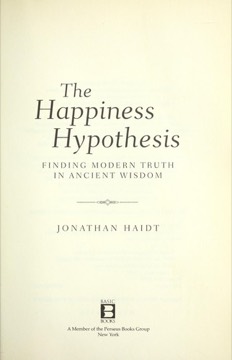
The Happiness Hypothesis
finding modern truth in ancient wisdom
Haidt's earlier book, testing ten ideas about happiness drawn from ancient philosophical and religious traditions against what modern psychology has found — and reporting honestly where the ancients were right, wrong, or asking a different question.
- First published
- 2006
- Publisher
- Basic Books
- Pages
- 317
- Shelf
- Mind
- Level
- Core
- ISBN-13
- 9780465028023
Record checked against
Catalogue note
- Reads as
- ConceptualExplains how something works before what to do about it.
- Level
- Core / BuildingAssumes general familiarity with the subject.
- Approach
- Theoretical
- Written for
- Curious general readers, Readers with some grounding
- Ideas
Saved in this browser only — no account, nothing sent anywhere. My library
Read this if
- You want evidence about why people behave as they do, not folklore.
- You want to examine an assumption you have never examined.
- You want to understand how it works before deciding what to do about it.
- You know roughly how the subject works and want the fuller account.
The method
Each chapter takes a proposition that recurs across traditions — the divided self, reciprocity, hypocrisy, the sources of happiness, adversity, virtue, divinity — and examines what psychological research says about it.
The approach is unusual and productive: rather than dismissing old wisdom or accepting it, Haidt treats each claim as a hypothesis that can be partially confirmed, partially refuted, and usefully refined.
The ancients are treated as making testable claims. Some hold, some do not, and the pattern is interesting.
Devmark’s reading — not a quotation from the book
The divided self
His opening framework, which he later reused: the rider and the elephant. Controlled processing is small and articulate; automatic processing is vast and does most of the work.
He connects this to the ancient observation — in Plato, Paul, Buddha — that the self seems to contain something that will not obey it, and argues the ancients described the phenomenon accurately while misdescribing the mechanism.
The happiness formula
His summary of the research: happiness is a function of a biological set point, the conditions of your life, and voluntary activities.
The set point is substantial and largely heritable, which is why lottery winners and accident victims both return toward baseline. His practical argument is about which conditions and activities actually move the needle rather than about attitude.
What conditions actually matter
His careful finding is that most circumstances adapt away — income above a threshold, possessions, cosmetic improvements — but a few do not.
Noise, commuting, lack of control and poor relationships resist adaptation, which means they are worth spending money and effort to change. This is one of the most actionable findings in happiness research and is frequently buried under the adaptation story.
Love and attachment
His chapter on relationships argues against both the romantic ideal of a completing other and the Buddhist counsel of non-attachment.
Drawing on attachment research, his position is that humans are built for strong bonds, that the ancient advice to avoid attachment mistakes a protective strategy for wisdom, and that relationships are the single largest condition-level determinant of wellbeing.
The ancient counsel against attachment mistakes a defensive strategy for wisdom. We are built for the bonds.
Devmark’s reading — not a quotation from the book
Adversity, honestly assessed
He examines the claim that suffering produces growth, and gives it a qualified verdict: post-traumatic growth is real, but it is not universal, not proportional to suffering, and depends heavily on timing and support.
His observation that adversity in the twenties produces growth more reliably than adversity in childhood is the kind of specificity the popular version of this idea lacks entirely.
Virtue and its narrowing
His argument that modern ethics narrowed to questions of harm and rights, abandoning the older project of character cultivation — and that something was lost in the move.
He is careful to name what was gained too. The chapter is an argument for recovering a practice of virtue without recovering the moralism that accompanied it, which he treats as genuinely difficult.
Divinity and elevation
The chapter most likely to surprise a secular reader. Haidt argues that a third dimension of social space — vertical, running from degradation to elevation — is widely experienced and largely absent from modern secular accounts of the mind.
His research on elevation, the warm response to witnessing moral beauty, is a genuine contribution, and he makes the case that dismissing this dimension leaves something unexplained rather than explained away.
Where it is dated
Published in 2006, and several of the psychological findings it reports have been affected by the replication debates — particularly in the positive psychology literature it draws on.
A reader should treat specific study results with more caution than the book's register implies, while noting that its central findings on adaptation, relationships and set point have held up comparatively well.
Why it is his best book
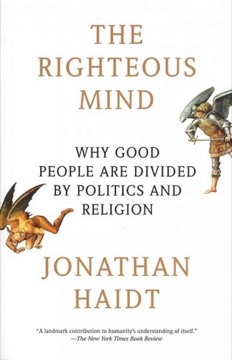
It is more careful than *The Righteous Mind* and less politically charged, and the method — testing old claims rather than championing or dismissing them — produces genuine surprises in both directions.
It is also the rare book in this area that reports where the research disappoints the thesis, which makes the places it confirms considerably more credible.
What to take away
- 01Some conditions never adapt awayNoise, commuting, lack of control and bad relationships resist habituation, so they are worth paying to fix.
- 02Set point is substantialWhich is why both lottery winners and accident victims drift back toward baseline.
- 03Non-attachment is a defensive strategyPresented as wisdom, but humans are built for strong bonds and relationships dominate the conditions that matter.
- 04Growth from adversity is conditionalReal, but not universal, not proportional to suffering, and heavily dependent on timing and support.
- 05Test the old claims rather than sorting themThe method finds the ancients right about phenomena and wrong about mechanisms, repeatedly.