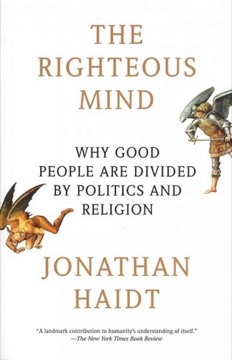
The Righteous Mind
Jonathan Haidt's account of moral psychology, arguing that moral judgement is made intuitively and justified afterwards, that it rests on more foundations than liberal societies recognise, and that morality binds groups together while blinding them to each other.
- First published
- 2012
- Publisher
- Pantheon Books
- Pages
- 493
- Shelf
- Mind
- Level
- Deep
- ISBN-13
- 9789025908362
Record checked against
Catalogue note
- Reads as
- ConceptualExplains how something works before what to do about it.
- Level
- Advanced / AdvancedAssumes you have read around the subject already.
- Approach
- Theoretical
- Written for
- Curious general readers, Specialists and serious readers
Saved in this browser only — no account, nothing sent anywhere. My library
Read this if
- You want evidence about why people behave as they do, not folklore.
- You want to understand how power is taken, kept and lost.
- You want to understand how it works before deciding what to do about it.
- You have read around this already and want a book that assumes it.
Intuitions come first
Haidt's opening claim, supported by his own experimental work on moral dumbfounding: people reach moral conclusions rapidly and intuitively, then construct reasons for them.
His demonstration is scenarios that violate strong intuitions while being carefully constructed to cause no harm. Participants condemn them immediately and then struggle, often failing, to produce a justification — while remaining certain of the verdict.
People reach the verdict first and then hunt for reasons. When the reasons fail, the verdict does not move.
Devmark’s reading — not a quotation from the book
The rider and the elephant
His metaphor for the relationship: intuition is a large elephant, reasoning is a small rider on top. The rider does not steer so much as serve — acting as press secretary, generating justifications for wherever the elephant is already going.
The practical implication is that arguing with someone's reasoning rarely changes a moral position, because the reasoning was never what produced it.
Moral Foundations Theory
His second claim: moral judgement draws on several distinct foundations — care/harm, fairness/cheating, loyalty/betrayal, authority/subversion, sanctity/degradation, and later liberty/oppression.
His research finding is that political liberals rely primarily on the first two, while conservatives draw on all of them more evenly. He argues this asymmetry explains why each side finds the other's positions not merely wrong but incomprehensible.
Morality binds and blinds
His third claim, and the one he considers most important. Moral systems create cohesive groups capable of cooperation at scale — and the same mechanism makes members unable to see the moral content of other groups' positions.
He draws on group-selection arguments to propose that humans are mostly self-interested but capable of switching into a group-oriented mode, a claim that remains contested among evolutionary biologists.
What he is actually arguing for
The book's purpose, stated in the last section, is not to adjudicate between political positions but to make cross-partisan understanding possible.
His conclusion is that each side is perceiving something real that the other is not — and that the useful move is to ask what moral foundation is being engaged rather than to assume bad faith.
Each side is detecting something real the other cannot see. That is the book's actual conclusion.
Devmark’s reading — not a quotation from the book
The methodological criticisms
These are substantial. Moral Foundations Theory's factor structure has been challenged, several of the foundations do not separate cleanly in replication, and the instrument has been criticised for wording that may favour conservative framings.
The group-selection argument is also a minority position in evolutionary biology, and Haidt presents it more confidently than the state of the debate supports.
The political criticisms
Critics from the left argue the framework treats moral foundations as symmetrically valid, which obscures that some appeals to loyalty, authority and sanctity have historically justified serious harm.
Haidt's response is that describing a foundation is not endorsing every use of it. The disagreement is genuine and readers should encounter it rather than take the book as settled.
What holds up best
The intuition-first finding is well supported and connects to a broad literature on motivated reasoning. The moral dumbfounding experiments are robust and genuinely unsettling to experience.
The observation that political disagreement frequently involves different moral vocabularies rather than different facts is useful regardless of whether the specific six-foundation model survives.
How it reads
Unusually well. Haidt structures the book as an intellectual autobiography, introducing each idea through the research that changed his own mind, which makes a technical subject readable.
He is also scrupulously fair to positions he disagrees with, which is rare in writing about politics and is a large part of why the book reached readers across the spectrum.
What to take from it
The practical move is the one he recommends: when you find a position incomprehensible, ask which moral foundation it is engaging rather than assuming stupidity or malice.
And the humbling observation about your own reasoning — that the confident justification you produced arrived after the verdict, and would have arrived whatever the verdict was.
What to take away
- 01Reasoning serves the verdictIt arrives after the intuition and would have arrived equally for the opposite conclusion.
- 02Arguing the logic rarely worksThe logic was not what produced the position, so dismantling it changes very little.
- 03Disagreement is often about vocabularyDifferent moral foundations produce positions each side finds not wrong but unintelligible.
- 04Binding and blinding are the same mechanismWhat makes a group capable of cooperation is what makes it unable to see another's moral content.
- 05The model itself is contestedThe factor structure has been challenged and the group-selection argument is a minority position.