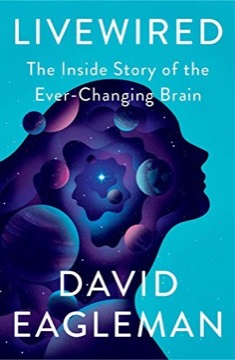
Livewired
David Eagleman's account of the brain as continuously self-reconfiguring hardware — not plastic in the limited sense but rewiring itself around whatever input it receives.
- First published
- 2020
- Publisher
- Pantheon
- Pages
- 320
- Shelf
- Science
- Level
- Core
- ISBN-13
- 9781838850968
Record checked against
Catalogue note
- Reads as
- ConceptualExplains how something works before what to do about it.
- Level
- Core / BuildingAssumes general familiarity with the subject.
- Approach
- Theoretical
- Written for
- Curious general readers, Readers with some grounding
Saved in this browser only — no account, nothing sent anywhere. My library
Read this if
- You are curious what is actually happening in the brain.
- You want to understand living things by how they came to be.
- You want to understand how it works before deciding what to do about it.
- You know roughly how the subject works and want the fuller account.
The argument
Eagleman's term livewired is meant to replace plasticity, which he considers too weak: the brain is not a fixed structure with some flexibility but a system that dynamically reallocates territory according to use.
The visual cortex of a blind person is taken over for touch and hearing within days. Cortical maps redraw after amputation. The brain, on his account, does not care what the input is — only that it arrives.
The brain does not care which sense the data comes from. It cares that data arrives.
Devmark’s reading — not a quotation from the book
Sensory substitution
The most striking material is his own lab's work on feeding novel data streams into the body — a vest that translates sound into vibration for deaf users, and experiments delivering stock market data or drone telemetry as touch.
The claim is that the brain will make sense of any consistently structured input given enough exposure, which would make the senses we happen to have an accident rather than a limit.
Where it is strong and weak
The clinical and developmental evidence — critical periods, hemispherectomy outcomes, cortical remapping — is well established and impressively assembled.
The speculative sections on future sensory expansion are exactly that, and Eagleman's confidence occasionally runs ahead of the demonstrations. The distinction is usually but not always signalled.
The neuroscience is established; the sensory-expansion futurism is a research programme, not a result.
Devmark’s reading — not a quotation from the book
How it reads
Written for a general reader with short chapters and vivid cases. It is the more accessible companion to the technical literature on neuroplasticity.
Read it for the principle and the clinical evidence; treat the forecasting as a statement of intent.
Eagleman is a working neuroscientist rather than a journalist, and the strongest sections are the ones describing his own laboratory's results, where the confidence is earned rather than borrowed.
The brain as a general-purpose device
Eagleman's organising image is a machine that does not care what kind of data it receives: attach a novel sensor to the body, deliver its output as a pattern, and the cortex will eventually extract structure from it. The argument is that evolution did not have to design a visual system and an auditory system separately so much as a system that works out whatever is plugged into it.
Rewiring an animal's senses
The strongest experimental support comes from work in which developing animals' visual input was routed to the auditory part of the cortex, which then reorganised and processed vision. It is the cleanest demonstration that cortical tissue is not pre-committed to a modality, and it does most of the load-bearing work for everything else Eagleman claims.
The tissue was not built for hearing. It was built for whatever arrived.
Devmark’s reading — not a quotation from the book
What happens when half is removed
Hemispherectomy in children — removing or disconnecting an entire hemisphere to stop intractable seizures — produces outcomes that are startling given the scale of the loss, with the remaining hemisphere taking on functions it would not normally hold. Eagleman uses it as the upper bound of reorganisation, and notes that the same operation in an adult goes very differently.
Why it gets harder
The chapter on critical periods supplies the necessary counterweight: the capacity for wholesale reorganisation is not constant, and the windows for some systems close early and hard. This is the part that stops livewiring becoming a claim that anything is learnable at any age, and Eagleman is clearer about it than popular neuroplasticity writing usually is.
His hypothesis about dreams
One striking proposal is his own and should be read as such: that dreaming exists partly to keep the visual cortex occupied overnight, defending its territory against encroachment by other senses during hours with no visual input. It is ingenious and not established, and the book flags it less firmly than it might.
What sensory substitution has actually achieved
The practical results are real but modest, and worth stating precisely: devices delivering visual or auditory information through touch produce usable discrimination with training, not a new sense experienced as sight or hearing. The gap between what the technology does and what the book's framing suggests is where a sceptical reader should concentrate.
What to take from it
Take the central claim, which is well supported: the brain is continuously reshaped by what it receives, and territory follows input. Treat the speculative extensions — the dream hypothesis, the futurist final chapters — as the author thinking aloud rather than as reporting, which is how he half presents them.
What to take away
- 01Livewired, not plasticContinuous reallocation rather than limited flexibility.
- 02Territory follows inputCortex is taken over by whichever sense is supplying data.
- 03Sensory substitutionSound delivered as vibration, and the brain adapting to it.
- 04Critical periodsWhy the same rewiring is easier young and harder later.
- 05Futurism flaggedThe sensory-expansion chapters are a programme, not a finding.