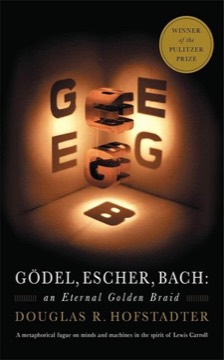
Gödel, Escher, Bach
an Eternal Golden Braid
Douglas Hofstadter's book about how meaning and consciousness could arise from meaningless components — built on an analogy between a logician's incompleteness proof, an artist's impossible structures and a composer's canons.
- First published
- 1979
- Publisher
- Basic Books
- Pages
- 777
- Shelf
- Science
- Level
- Deep
- ISBN-13
- 9780394756820
Record checked against
Catalogue note
- Reads as
- TechnicalAssumes and builds craft knowledge.
- Level
- Advanced / AdvancedAssumes you have read around the subject already.
- Approach
- Applied
- Written for
- Curious general readers, Specialists and serious readers
Saved in this browser only — no account, nothing sent anywhere. My library
Read this if
- You want to know how the universe is put together.
- You are curious what is actually happening in the brain.
- You work in this area and want depth rather than an overview.
- You have read around this already and want a book that assumes it.
What it is actually about
Hofstadter stated, with evident frustration at how it had been read, that the book is about how selves and souls arise out of matter that has no self in it. Everything else is machinery for that question.
The title's three figures are not the subject. They are three domains in which the same structure appears, and the structure — self-reference producing something that could not be produced otherwise — is the argument.
He said plainly that the book is about how a self arises from matter containing none. The three names are machinery.
Devmark’s reading — not a quotation from the book
The strange loop
His central concept: a hierarchy in which moving consistently in one direction unexpectedly returns you to where you started. Escher's stairs, a canon that modulates upward and arrives at its opening key, a formal system that produces a statement about itself.
His claim is that consciousness is a strange loop — a system complex enough to represent itself, whose self-representation is what we experience as an I.
Gödel's theorem, explained properly
His core technical achievement is making the incompleteness proof genuinely comprehensible: the arithmetisation of syntax, so that statements about a formal system become statements within it, and the construction of a sentence asserting its own unprovability.
He builds up through a toy formal system first, so the reader has handled the machinery before the real proof arrives. It is one of the best expositions of the result available to a non-mathematician.
The dialogues
Between every chapter is a dialogue, mostly between Achilles and the Tortoise borrowed from Lewis Carroll, which enacts the concept the next chapter will explain formally.
They are structured as the musical forms they are named after — crab canons that read the same backward, fugues with voices entering in sequence — so the form demonstrates the content. This is either delightful or exhausting and readers divide sharply.
Formal systems and meaning
His extended treatment of how symbols manipulated by rules can come to have meaning: isomorphism between a system's structure and something outside it.
His claim is that meaning is not added to a formal system from outside but arises when the system's internal structure maps onto another domain reliably enough that the correspondence does work.
Recursion everywhere
His demonstration of recursive structures across music, language, genetics, computation and visual art — pushing and popping stacks, nested sentences, self-reproducing programmes.
The recurring point is that recursion allows finite means to produce unlimited variety, which is his answer to how a bounded brain could generate unbounded thought.
Genetics as a formal system
His chapters mapping DNA onto his formal-systems framework: the genome as a string of symbols whose meaning is realised by machinery that the genome itself specifies.
The loop is the point. The instructions specify the interpreter that reads the instructions, which is precisely the self-referential structure he is tracking, and it arises in chemistry without anyone designing it.
The instructions specify the machine that reads them, and this arose in chemistry without a designer.
Devmark’s reading — not a quotation from the book
Artificial intelligence
His extended treatment of whether machines could think, written in the late 1970s and therefore before almost everything that has happened since.
His position — that intelligence requires the capacity for self-reference and for shifting between levels of description, not merely rule-following — remains philosophically interesting, and his specific predictions about what would be hard for computers have aged in instructive ways.
How to read it
Slowly, and not necessarily in order. It is very long, it makes real demands, and attempting to read it like a normal book defeats most people in the formal-systems chapters.
The dialogues can be read as a sequence on their own. The Gödel exposition can be read for itself. Many readers report several attempts over years before a successful one, which is unusual and worth knowing in advance.
Its standing
It won the Pulitzer Prize for general nonfiction and has remained in print for decades, with an unusual reputation as a book more often owned than finished.
Its influence on people who went into computer science, cognitive science and mathematics is large and well documented. Hofstadter's own later work, particularly on analogy as the core of cognition, develops the argument in a more direct form for anyone who wants the thesis without the architecture.
What to take away
- 01A strange loop is the selfA system complex enough to represent itself, whose self-representation is experienced as an I.
- 02Meaning comes from isomorphismSymbols acquire meaning when the system's structure maps reliably onto another domain.
- 03The genome specifies its own readerThe self-referential loop appears in chemistry without anyone designing it in.
- 04Recursion gives finite means unlimited rangeWhich is the answer to how a bounded brain produces unbounded thought.
- 05Read it out of orderThe dialogues, the Gödel exposition and the AI chapters each work alone, and most readers need several attempts.