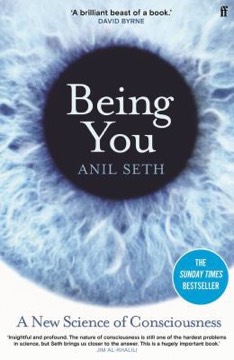
Being You
Anil Seth's account of consciousness as a controlled hallucination: perception as the brain's best prediction about its causes, continuously corrected by sensory data rather than built up from it.
- First published
- 2021
- Publisher
- Faber & Faber, Limited
- Pages
- 336
- Shelf
- Science
- Level
- Deep
- ISBN-13
- 9781524742874
Record checked against
Catalogue note
- Reads as
- ConceptualExplains how something works before what to do about it.
- Level
- Advanced / AdvancedAssumes you have read around the subject already.
- Approach
- Theoretical
- Written for
- Curious general readers, Specialists and serious readers
- Ideas
Saved in this browser only — no account, nothing sent anywhere. My library
Read this if
- You are curious what is actually happening in the brain.
- You want to understand how it works before deciding what to do about it.
- You have read around this already and want a book that assumes it.
The argument
Seth, a cognitive neuroscientist at Sussex, applies predictive processing to experience. The brain does not receive the world and assemble it; it generates predictions and uses sensory input to correct them.
His phrase for this is controlled hallucination: perception is an internally generated construction that happens to be tethered to reality, and when the tethering fails you get hallucination in the ordinary sense.
We are always hallucinating. Agreement about the hallucination is what we call reality.
Devmark’s reading — not a quotation from the book
The beast machine
His more distinctive contribution concerns selfhood. Seth argues that the experience of being a self is grounded in interoception — the brain's predictive regulation of the body's internal state — rather than in cognition.
On this account we are conscious not because we think but because we are living bodies that must keep themselves alive, which has direct consequences for what kinds of systems could be conscious.
His claim is that selfhood grows out of keeping a body alive, not out of thinking.
Devmark’s reading — not a quotation from the book
The measurement problem
The book covers the real experimental programme: integrated information theory, the perturbational complexity index used clinically to assess consciousness in unresponsive patients, and what these measures can and cannot establish.
Seth is careful about the hard problem — he neither dismisses it nor claims to have solved it, and is explicit that his programme is about correlating and explaining properties rather than dissolving the puzzle.
How it reads
Demanding but unusually clear, with the author's own experiments described first-hand including a Ganzfeld-style perceptual study he ran on festival audiences.
Among the best current popular accounts of consciousness science, and honest about the limits of what is known.
It repays slow reading. Seth builds his position cumulatively and the later chapters assume the earlier ones, so the book resists being sampled in the way that books of this kind usually permit.
The hard problem, set aside
Seth is explicit about method: rather than attempting to explain why there is experience at all, he works on the real problem — mapping which properties of experience correspond to which mechanisms — on the argument that this is how biology dissolved vitalism. The strategy is not a solution to the hard problem and he does not pretend it is.
Perception as prediction
His central claim inverts the intuitive picture. The brain is not receiving images from the world and assembling them; it is generating predictions about their causes and using sensory input to correct them. Perception is therefore a controlled hallucination that happens to be tethered — and when the tethering loosens, the hallucination is not new, only unchecked.
We are always hallucinating. When the prediction agrees with the world, we call it perception.
Devmark’s reading — not a quotation from the book
Free will, dissolved
Seth's treatment of volition avoids both the libertarian position and the wholly dismissive one. Voluntary action, on his account, is a real and distinguishable kind of process — one that reflects goals, could have gone otherwise given different reasons, and feels effortful — without requiring any uncaused cause anywhere in it. The experience of willing is itself a perceptual construction, which is why it can be disrupted and induced.
The feeling of deciding is not a report on the decision. It is another thing the brain constructs.
Devmark’s reading — not a quotation from the book
Taking the self apart
He separates components usually experienced as one: the bodily self, the perspectival self located behind the eyes, the volitional self that feels like it decides, the narrative self with a history, and the social self seen by others. Each can be disrupted independently in clinical cases, which is the evidence that they were never a single thing.
Measuring it
The book covers the genuine experimental programme — perturbing the brain and measuring the complexity of the response, and the theoretical claim that consciousness corresponds to integrated information. Seth is even-handed: these produce clinically useful measures for assessing awareness in unresponsive patients while remaining contested as theories.
What follows for machines
His conclusion on artificial consciousness is deflationary and follows directly from the beast-machine argument: if experience is grounded in the regulation of a living body, intelligence alone will not produce it, and the widespread assumption that a sufficiently capable system must be conscious rests on conflating two different things.
What to take from it
It is demanding and unusually clear, and it is the best current statement of what a neuroscience of consciousness can actually claim. Read it for the inversion — that experience is constructed outward from prediction rather than received inward from the world — which is the part that changes how you notice your own perception.
What to take away
- 01Controlled hallucinationPerception as prediction corrected by sensation, not built from it.
- 02The beast machineSelfhood grounded in bodily regulation rather than cognition.
- 03InteroceptionThe internal-state sense treated as the root of experience.
- 04Measuring consciousnessPerturbational complexity as a clinical instrument.
- 05Honest about the hard problemNeither solved nor dismissed.