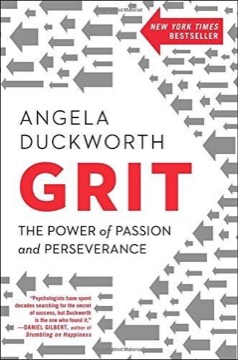
Grit
Angela Duckworth's research programme on grit — sustained passion and perseverance for long-term goals — and her argument that it predicts achievement in demanding settings beyond what talent measures alone explain.
- First published
- 2016
- Publisher
- Penguin Random House
- Pages
- 353
- Shelf
- Mind
- Level
- Entry
- ISBN-13
- 9781501111105
Record checked against
Only one source carried a publication date for this work, so the year is uncorroborated.
Catalogue note
- Reads as
- ConceptualExplains how something works before what to do about it.
- Level
- Accessible / FoundationalNo prior reading assumed.
- Approach
- Theoretical
- Written for
- Curious general readers, Newcomers to the subject
Saved in this browser only — no account, nothing sent anywhere. My library
Read this if
- You want to change what you do repeatedly, not just what you intend.
- You want to understand how it works before deciding what to do about it.
- You are starting from scratch here and want a way in that assumes no prior reading.
The question
Duckworth's work began with an observation from teaching and from studying demanding institutions: the people who succeeded were frequently not the most obviously talented, and the differentiator seemed to be whether they kept going.
Her research programme was an attempt to define that quality precisely enough to measure, which produced the Grit Scale and a body of predictive studies.
The question came from noticing that the most talented people were not reliably the ones who finished.
Devmark’s reading — not a quotation from the book
The two components
Grit as she defines it has two parts that are related but distinct: consistency of interest over long periods, and perseverance of effort.
The consistency half is the less discussed and, in her data, often the more predictive. Many people work hard; far fewer work hard on the same thing for years, and it is the sustained direction that compounds.
Effort counts twice
Her formulation of how achievement arises: talent times effort produces skill, and skill times effort produces achievement. Effort therefore enters the equation at both stages.
The argument is that talent determines the rate at which skill improves, and effort determines both how much skill is built and how much of it is converted into results — which is why talent alone predicts less than expected.
Why we overrate talent
Her research on the naturalness bias found that people say they value effort while actually preferring, in controlled comparisons, candidates described as naturals over candidates described as hard workers.
Her explanation is that attributing success to talent is more flattering to observers than attributing it to work they did not do, and that this preference is largely unconscious.
People say they value hard work and, in controlled comparisons, reliably prefer the natural. Usually without noticing.
Devmark’s reading — not a quotation from the book
How grit is built
Her developmental account has four stages: interest, which must be discovered rather than decided; practice, specifically the deliberate kind; purpose, meaning a connection to something beyond oneself; and hope, meaning the belief that effort can improve the situation.
The ordering is the useful part. She is explicit that purpose typically comes after interest rather than preceding it, which inverts the common advice to find your passion first.
Deliberate practice
She draws heavily on Anders Ericsson's work: practice that targets a specific weakness, at full concentration, with immediate feedback, and with repetition until the weakness resolves.
Her contribution is the observation that this is experienced as unpleasant, that gritty people do not enjoy it more than anyone else, and that the difference is their willingness to tolerate it.
Where the evidence is contested
This needs stating plainly. Meta-analyses have found grit's predictive power over and above conscientiousness to be small — the construct overlaps heavily with a personality dimension that was already well measured.
The perseverance component carries most of the predictive weight, and the consistency-of-interest component performs weakly in several analyses. Duckworth has engaged with this criticism and has acknowledged the overlap.
Where it is misused
The most serious misuse is in education policy, where grit has been invoked to place responsibility for outcomes on students in poorly resourced environments.
Duckworth has publicly objected to this application, and has argued against using grit measures for high-stakes assessment of students or schools. That objection is worth carrying alongside the concept.
What holds up
The naturalness-bias research is solid and interesting on its own. So is the observation that sustained direction matters more than intensity, and that purpose commonly follows interest rather than preceding it.
The deliberate-practice material is well founded, though Ericsson himself disputed some popularised versions of it, including the specific ten- thousand-hours framing.
How to hold it
As a well-communicated account of something real that has been measured less cleanly than the book implies. Perseverance predicts achievement; that this needed a new construct is more doubtful.
The practical content — pursue a long-term direction, practise deliberately, connect the work to something beyond yourself — is sound advice that does not depend on the measurement dispute being resolved.
What to take away
- 01Sustained direction beats intensityMany people work hard. Far fewer work hard on the same thing for years, and that is what compounds.
- 02Effort enters twiceIt builds skill from talent and converts skill into achievement, which is why talent predicts less than expected.
- 03The naturalness bias is realPeople say they value effort and reliably prefer the natural in controlled comparisons.
- 04Purpose usually follows interestWhich inverts the standard advice to identify your passion before beginning.
- 05It overlaps heavily with conscientiousnessMeta-analyses find little predictive power beyond a trait that was already well measured.