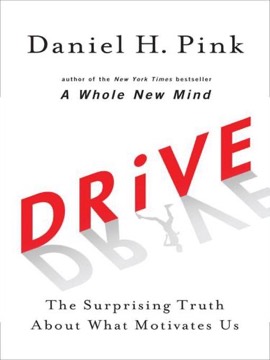
Drive
Daniel Pink's popularisation of self-determination theory, arguing that carrot-and-stick motivation suits routine work and actively damages performance on tasks requiring judgement, creativity or sustained attention.
- First published
- 2009
- Publisher
- Riverhead Hardcover
- Pages
- 249
- Shelf
- Mind
- Level
- Entry
- ISBN-13
- 9780143145080
Record checked against
Catalogue note
- Reads as
- ConceptualExplains how something works before what to do about it.
- Level
- Accessible / FoundationalNo prior reading assumed.
- Approach
- Theoretical
- Written for
- Curious general readers, Newcomers to the subject
Saved in this browser only — no account, nothing sent anywhere. My library
Read this if
- You want to change what you do repeatedly, not just what you intend.
- You are asking what you should be doing with your working life.
- You want to understand what makes people willing to follow a decision.
- You want to understand how it works before deciding what to do about it.
- You are starting from scratch here and want a way in that assumes no prior reading.
Motivation 3.0
His framing device: Motivation 1.0 is biological drive, 2.0 is external reward and punishment, and 3.0 is intrinsic — the drive to direct your own life, get better at things, and contribute to something beyond yourself.
His argument is that organisations run almost entirely on 2.0 while the work has shifted toward tasks where 2.0 performs badly, which is the mismatch the book exists to name.
The operating system is built for routine work. The work stopped being routine and nobody updated it.
Devmark’s reading — not a quotation from the book
When rewards backfire
The evidence he leans on most: contingent rewards reliably improve performance on simple, rule-based tasks and reliably degrade it on tasks requiring even rudimentary conceptual thinking.
His candle-problem illustration — where offering money for speed made participants slower at a task requiring an insight — is the memorable version, and the underlying finding has been replicated in several forms.
The seven deadly flaws
His catalogue of what extrinsic motivators do: extinguish intrinsic motivation, diminish performance, crush creativity, crowd out good behaviour, encourage cheating and shortcuts, become addictive, and foster short-term thinking.
The crowding-out effect is the best established — the day-care fine, the blood donation studies — and is the one with the most direct practical consequence for anyone designing an incentive.
Autonomy
The first element of his alternative. Autonomy over task, time, technique and team — and his argument that management is fundamentally a technology for compliance, which is the wrong technology for engagement.
His examples include results-only work environments and the practice of allocating a fraction of working time to self-directed projects, which he treats as autonomy mechanisms rather than perks.
Mastery
His second element, and the one where he draws on Csikszentmihalyi and Ericsson. Mastery is a mindset, it is painful, and it is asymptotic — never fully reached, which is what makes it sustaining.
The flow connection is the practical part: engagement is highest where challenge and capability are matched, which makes task assignment a motivational instrument rather than merely an operational one.
Mastery is asymptotic. You never arrive, which is precisely why it keeps pulling.
Devmark’s reading — not a quotation from the book
Purpose
His third element: the drive to contribute to something larger, which he argues organisations have historically treated as decoration rather than as a performance variable.
He distinguishes profit-maximising goals from purpose-maximising ones and notes the evidence that purely extrinsic life goals correlate with lower wellbeing even when achieved.
Type I and Type X
His behavioural shorthand: Type X behaviour is fuelled by extrinsic desires, Type I by intrinsic ones. He argues Type I is made rather than born, is renewable, and outperforms over the long run.
The typology is the least evidenced part of the book and functions more as a communication device than as a research finding.
Where the evidence is stronger and weaker
Self-determination theory is a substantial, well-supported research programme, and the core findings on autonomy, competence and relatedness have held up.
The undermining effect of rewards on intrinsic motivation is real but conditional — it depends on whether the reward is expected, contingent on performance quality, and perceived as controlling. Pink presents it more absolutely than the literature supports.
Where it is over-applied
The most common misuse is concluding that money does not matter. Pink is explicit that it does — his argument is that pay should be adequate and fair enough to take the issue off the table, and that beyond that point extrinsic motivators have diminishing and then negative returns.
Using the book to justify underpaying creative workers inverts it entirely.
What to take from it
The task-type distinction is the practical core: before designing an incentive, ask whether the work is algorithmic or heuristic, because the right answer is opposite in each case.
And the pay principle — get compensation adequate and fair, then stop using it as a lever and start working on autonomy, mastery and purpose instead.
What to take away
- 01Match the incentive to the task typeContingent rewards help on rule-based work and hurt on work requiring insight. The answer inverts.
- 02Extrinsic motivators crowd out intrinsic onesThe best-established finding, and the one with the most direct consequence for incentive design.
- 03Pay it off the table, then stopAdequate and fair compensation removes the issue; beyond that, money is a weak and then negative lever.
- 04Mastery never arrivesThe asymptote is the mechanism — it is what keeps the pull sustained.
- 05The undermining effect is conditionalIt depends on whether the reward is expected, contingent and perceived as controlling.