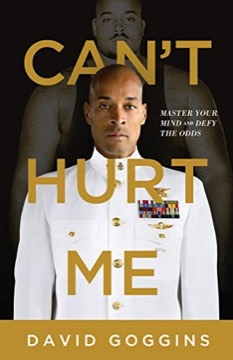
Can't Hurt Me
David Goggins's account of moving from an abusive childhood and a job spraying for cockroaches to Navy SEAL training, ultramarathons and pull-up records, structured around ten challenges to the reader.
- First published
- 2018
- Publisher
- Lioncrest pubblishing
- Pages
- 364
- Shelf
- Habits
- Level
- Entry
- ISBN-13
- 9781544529127
Record checked against
Catalogue note
- Reads as
- ReflectiveChanges how you see rather than what you do.
- Level
- Accessible / FoundationalNo prior reading assumed.
- Approach
- Theoretical
- Written for
- Anyone changing how they work, Newcomers to the subject
Saved in this browser only — no account, nothing sent anywhere. My library
Read this if
- You want a life told honestly, at full length.
- You want to change what you do repeatedly, not just what you intend.
- You want a book that changes how you see things rather than what you do tomorrow.
- You are starting from scratch here and want a way in that assumes no prior reading.
What it covers
Goggins describes a childhood of severe abuse, a learning disability, racism in small-town Indiana, weighing close to three hundred pounds at twenty-four, and a decision to attempt SEAL training that he had no physical basis for.
He completed Hell Week three times, became a SEAL, then an Army Ranger, then an ultra-endurance athlete, breaking a pull-up world record while substantially injured.
The distance between the first chapter and the last is the entire argument of the book.
Devmark’s reading — not a quotation from the book
The central ideas
The accountability mirror: writing your actual failures on notes and facing them daily rather than managing self-image. The forty percent rule: his claim that the point at which a person believes they are finished is roughly forty percent of capacity. Callusing the mind: deliberately seeking discomfort so that difficulty stops being informative.
Each chapter ends with a challenge, which makes it a workbook as much as a memoir.
The forty percent rule is his, not physiology's, and it should be read as a heuristic rather than a finding.
Devmark’s reading — not a quotation from the book
What to be careful about
The forty percent figure has no research basis and Goggins does not claim one. The approach is explicitly extreme: he describes training through serious injury and reports lasting physical damage.
This is one person's method, generalised with considerable confidence. For some readers it is genuinely galvanising; for others, particularly anyone prone to overtraining or self-punishment, it is actively harmful advice.
How it reads
Unusually structured: each chapter ends with a section in Goggins's conversational voice, transcribed, commenting on what was just narrated.
The prose is blunt and the register is relentless. It is a book with one setting, and whether that works depends entirely on the reader.
The audiobook is the form most readers recommend, because the commentary sections were recorded as conversation and the written transcription loses some of their force.
The cookie jar
Goggins's technique for the point of failure is a deliberately maintained mental inventory of things already survived, assembled in advance and drawn on when the current effort has stopped being sustainable by reasoning. It is a crude device and it is also the most transferable thing in the book, because it requires no fitness and no equipment.
Callusing the mind
His central metaphor is physical: the mind toughens the way skin does, through repeated abrasion, and comfort therefore removes the mechanism. The programme that follows is to seek out the specific activity you are avoiding rather than any hard thing, on the grounds that avoidance marks the location of the useful work.
The thing you keep declining is not an obstacle to the training. It is the training.
Devmark’s reading — not a quotation from the book
Taking souls
A term from his SEAL training for the moment in a shared ordeal when you continue past the point at which the people imposing it expected you to stop, and the psychological advantage transfers. It is the book's most confrontational idea and it is honest about its own source: an environment designed around domination.
The record he failed twice
The pull-up record attempt is the book's most instructive episode precisely because the first two attempts failed publicly and painfully, with torn hands and a body that would not complete the task. He describes the failures in detail before the success, and it is the closest the book comes to acknowledging that the method does not simply work on demand.
What it actually cost
The physical toll is documented rather than hidden: stress fractures, kidney damage, repeated surgeries, and a congenital heart defect discovered late after years of extreme exertion. Any reader tempted to follow the programme should weigh that the author has been hospitalised repeatedly for doing what he is recommending.
Who it is not for
This is one man's response to an extreme history, generalised with total confidence into a universal method. It has no evidence base — the forty percent figure is a motivational device rather than a finding — and the approach is contraindicated for anyone with an eating disorder, an injury history, or a tendency to treat self-punishment as virtue.
What to take from it
Read it as a document rather than a manual. What it supplies that gentler books do not is a demonstration that the ceiling most people assume is physical is frequently negotiable, delivered by someone who tested it to destruction. Take the cookie jar and the accountability mirror; leave the mileage.
What to take away
- 01The accountability mirrorFailures written down and faced daily rather than managed.
- 02The forty percent ruleHis heuristic about perceived limits; not a research finding.
- 03Callusing the mindDeliberate discomfort so that difficulty stops being a signal.
- 04Real physical costHe reports lasting damage; the method is not risk-free.
- 05One settingRelentless throughout, which works for some readers and not others.