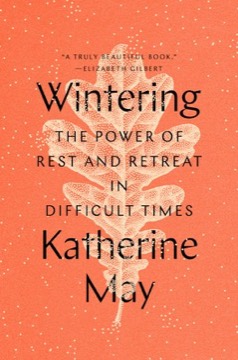
Wintering
Katherine May's book about fallow periods — illness, loss, breakdown, the times when ordinary functioning stops — and the argument that these are cyclical and survivable rather than failures.
- First published
- 2020
- Publisher
- Cengage Gale
- Pages
- 288
- Shelf
- Habits
- Level
- Entry
- ISBN-13
- 9781846045998
Record checked against
Only one source carried a publication date for this work, so the year is uncorroborated.
Catalogue note
- Reads as
- ReflectiveChanges how you see rather than what you do.
- Level
- Accessible / FoundationalNo prior reading assumed.
- Approach
- Theoretical
- Written for
- Anyone changing how they work, Newcomers to the subject
- Ideas
Saved in this browser only — no account, nothing sent anywhere. My library
Read this if
- You want a life told honestly, at full length.
- You want to understand a place, or what we are doing to one.
- You want a book that changes how you see things rather than what you do tomorrow.
- You are starting from scratch here and want a way in that assumes no prior reading.
The idea
May uses winter as a literal and figurative frame: the season, and the periods in a life when a person is effectively out of season. Her premise is that modern life treats such periods as malfunctions to be minimised, and that this makes them worse.
The alternative she proposes is to treat them as something to be done properly — prepared for, attended to, and allowed their length.
Her claim is that fallow periods are a phase to be done well, not a failure to be shortened.
Devmark’s reading — not a quotation from the book
How it is written
The structure follows one winter, from her husband's sudden illness and her own resignation from a job, through the season, and out the other side.
Around it she gathers reporting: Stonehenge at the solstice, the Northern Lights, saunas in Finland, cold-water swimming, dormice and the biology of hibernation. The natural history is doing argumentative work rather than providing texture.
What it is useful for
Its most practical contribution is permission. May is specific about small things — heat, light, sleep, food, ritual — that make a bad period more survivable without pretending to shorten it.
It is a gentle book and does not attempt to be a clinical one. For a reader in a genuinely acute state it is companionship rather than treatment, and it is honest about that.
It offers company rather than treatment, and does not confuse the two.
Devmark’s reading — not a quotation from the book
What set it off
The book begins with a cluster of collapses rather than one: her husband's sudden and serious illness, her own decision to leave a job, and her son's refusal to go to school. May does not present these as a narrative arc to be resolved but as the conditions under which the rest of the book is written, which is part of why it avoids the recovery-memoir shape.
Where she goes
The structure is partly travel. She follows winter to places that have more of it and have had to develop a relationship with it — the far north, its light and its darkness — and she looks at midwinter customs, solstice observance and the rituals cultures build at the year's low point. The argument underneath is that societies with real winters evolved practices for them, and that a culture that has abolished the season has also lost the practices.
What she takes from biology
May reaches repeatedly for wintering in the natural world: animals that slow their metabolism rather than fleeing, insects that overwinter, trees that are not dead in January. The point of the analogy is precise rather than decorative — these are not failures of summer behaviour but a different mode with its own function, and the organism is not broken while it is in one.
A tree in January is not a failed tree. It is a tree doing the other half of its work.
Devmark’s reading — not a quotation from the book
Cold water and the body
The sea swimming that runs through the book is the place where its argument becomes physical. May is good on what deliberately entering cold water does to attention: it forecloses rumination by making the present unavoidable, and it supplies a small, chosen, survivable hardship at a time when the unchosen ones are not survivable on demand.
The shape of the writing
It is essayistic and associative rather than argued, moving between memoir, reportage and natural history within a chapter. Readers who want a thesis defended will find it frustrating; the form is doing deliberate work, since a book that marshalled evidence for slowing down would be contradicting itself in its own structure.
Where it is limited
May's winter is cushioned in ways she does not always foreground: she can leave a job, travel, and take time. The book offers little to someone whose fallow period comes with no financial slack, and it is a literary consolation rather than a clinical one — it should not be mistaken for treatment for depression, which it does not claim to be.
What to take from it
Its contribution is a frame rather than a method: that bad periods are recurrent and phased rather than evidence of personal failure, and that they can be equipped for. The concrete residue is unglamorous and real — warmth, light, sleep, ritual, company, and the permission to do less for a while without calling it defeat.
What to take away
- 01Winter as a phaseFallow periods treated as cyclical and expected.
- 02Done properlyPrepared for and given its length rather than compressed.
- 03Hibernation biologyNatural history used as argument rather than decoration.
- 04Small practical thingsHeat, light, sleep and ritual, specified.
- 05Company, not clinicalHonest about being companionship rather than treatment.