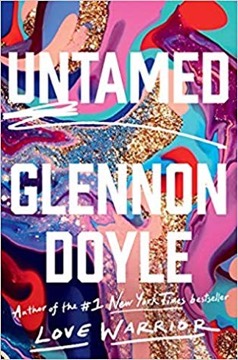
Untamed
Glennon Doyle's memoir-manifesto about leaving a marriage after falling in love with a woman, and about the training that had made her mistake self-erasure for goodness.
- First published
- 2020
- Publisher
- Random House Audio
- Pages
- 352
- Shelf
- Habits
- Level
- Entry
- ISBN-13
- 9781984801265
Record checked against
Catalogue note
- Reads as
- ReflectiveChanges how you see rather than what you do.
- Level
- Accessible / FoundationalNo prior reading assumed.
- Approach
- Theoretical
- Written for
- Anyone changing how they work, Newcomers to the subject
Saved in this browser only — no account, nothing sent anywhere. My library
Read this if
- You want a life told honestly, at full length.
- You want to think about how gender shapes a life, including your own.
- You want a book that changes how you see things rather than what you do tomorrow.
- You are starting from scratch here and want a way in that assumes no prior reading.
What it is
Doyle was a Christian mommy-blogger with a bestselling memoir about rebuilding her marriage after her husband's infidelity. Then, at a book conference, she saw the footballer Abby Wambach and recognised something she had spent her life not looking at.
The book is the account of leaving, and a broader argument about the instructions women absorb: be pleasing, be small, be responsible for everyone's comfort.
The cheetah in the opening chapter, running laps of a zoo enclosure, is the book's controlling image.
Devmark’s reading — not a quotation from the book
How it is written
Short chapters, each nearly standalone, moving between memoir, essay and direct address. It is closer to a collection than a continuous narrative, which suits the register and makes it easy to read in fragments.
The voice is confessional and emphatic. Readers who find that persuasive find the book transformative; readers who do not tend to find it overstated, and both reactions are common.
The religious thread
Doyle came out of evangelical Christian publishing, and the book is substantially about leaving that framework without leaving faith. Her account of being told that her marriage was a covenant to be endured is specific rather than generic, and it is the part of the argument with the most detail behind it.
That background also explains the register. The short declarative chapters, the direct address, the willingness to end on an instruction — these are the moves of someone who has spent years writing devotionally, turned to a different end.
What to expect
It is not a book of argument with evidence. It is a personal account making a general claim, and it works by identification rather than proof.
Its most substantial sections are the ones on divorce and on telling children the truth, where the specificity keeps the rhetoric anchored.
It persuades by recognition, not by demonstration, and it is worth knowing that going in.
Devmark’s reading — not a quotation from the book
The cheetah
The opening scene — a captive cheetah at a zoo chasing a soiled pink bunny on a mechanical lure, having been trained out of hunting — is the book's governing image and the source of its title. Doyle's point is about domestication rather than captivity: the animal has been taught to want the wrong thing and to perform contentment.
The cheetah has not been caged so much as retrained. She is chasing a stuffed rabbit and everyone applauds.
Devmark’s reading — not a quotation from the book
The Knowing
Her term for the internal signal she argues has been overwritten by instruction, approval-seeking and religion, and which she recommends consulting in preference to advice. It is the book's operating instruction and also its weakest point, since it supplies no way to distinguish a deep conviction from a strong impulse.
Leaving the marriage
The narrative spine is the end of her marriage after her husband's infidelity, her decision not to repair it, and falling in love with a woman she met at a book event. The material is unusually specific about the logistics and the cost, including the effect on her children, and she does not present it as tidy.
Religion
A sustained thread concerns her evangelical upbringing and her departure from it, and the book retains the register — testimony, revelation, a language of being called — while rejecting the doctrine. Readers who find that register alienating will struggle, and readers who grew up inside it frequently report it as the most useful part.
The form
It is a collection of short essays, some of them barely two pages long, arranged associatively rather than chronologically or by argument. The structure makes the book very easy to read in fragments and correspondingly hard to argue with, because each claim is asserted in isolation and then left behind before it can be developed or tested. That is a genuine trade-off rather than a flaw, and different readers will price it differently.
Who it is for
The intended audience is specific: women, frequently mothers, frequently some way into long-established lives they have never seriously examined, and the book's enormous commercial success came from that shock of recognition rather than from any argument it makes. Readers outside that description routinely find the identical passages self-dramatising and overwrought, and both responses are entirely reasonable ones to the same page.
What to take away
- 01The caged cheetahAn animal running laps it was trained into, used as the book's central figure.
- 02Goodness as trainingDoyle's argument is that self-erasure was taught to her as virtue.
- 03Short, standalone chaptersCloser to essays than to a continuous memoir.
- 04Identification, not evidenceThe book persuades by recognition; it makes no empirical claim.
- 05Strongest when specificThe divorce and the conversations with her children carry the most weight.