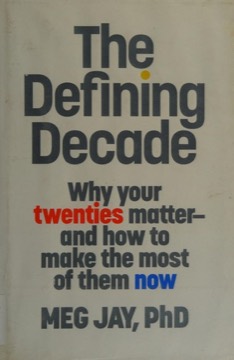
The Defining Decade
Meg Jay's argument that the twenties are not a developmental holding pattern but the period in which the largest share of adult life is determined, and that treating them as extended adolescence is expensive.
- First published
- 2012
- Publisher
- Hachette Audio and Blackstone Audio
- Pages
- 272
- Shelf
- Habits
- Level
- Entry
- ISBN-13
- 9781805302520
Record checked against
Catalogue note
- Reads as
- PracticalWritten to be applied, not only understood.
- Level
- Accessible / FoundationalNo prior reading assumed.
- Approach
- Practical
- Written for
- Anyone changing how they work, Newcomers to the subject
Saved in this browser only — no account, nothing sent anywhere. My library
Read this if
- You are asking what you should be doing with your working life.
- You want to think about how gender shapes a life, including your own.
- You want evidence about why people behave as they do, not folklore.
- You want something to apply, not only something to think about.
- You are starting from scratch here and want a way in that assumes no prior reading.
The argument
Jay, a clinical psychologist working with twenty-somethings, writes against the cultural framing of the decade as a time to postpone. Her case is developmental: eighty percent of life's defining moments occur by thirty-five, the brain's final maturation happens in this window, and fertility and career trajectories both have real timelines.
Her objection is not to exploration but to exploration without commitment, which she argues produces the identity crisis it was meant to avoid.
Her target is not exploration. It is exploration that never resolves into anything.
Devmark’s reading — not a quotation from the book
Identity capital
Her central construct: the accumulated set of experiences, credentials and relationships that constitute what you have to offer, built through choices that close options rather than preserve them.
Related is her argument for weak ties — that new opportunities arrive overwhelmingly through acquaintances rather than close friends, and that insulating yourself in a tight group of similar people has a cost.
On relationships
The chapters on cohabitation are the most contested. Jay argues that sliding into living together without deciding produces worse outcomes than choosing it, a position drawn from the research on cohabitation effect.
That literature has moved since publication, and the effect is now understood as smaller and more cohort-dependent than the book implies. The underlying advice — decide rather than drift — survives the correction.
The cohabitation research has weakened since publication; the advice to decide rather than drift has not.
Devmark’s reading — not a quotation from the book
How to take it
It is written from clinical practice with case material, and Jay is direct in a way some readers find bracing and others find pressuring.
It is most useful to someone in their early twenties who feels no urgency, and least useful to someone already anxious about the same questions.
Weak ties
Jay leans on the sociological finding that new opportunities arrive disproportionately through acquaintances rather than close friends, because close friends share your information and your networks while acquaintances do not. Her practical point is that the urban tribe of similar friends is emotionally excellent and informationally useless, and that most twenty-somethings invest exclusively in it.
The unthought known
A borrowed clinical term for something a person knows about themselves and has never articulated — a preference, a fear, a direction — that shapes decisions while remaining unavailable for examination. Jay's argument is that much of what looks like being undecided in the twenties is actually knowing and not saying, and that the work is retrieval rather than discovery.
Sliding versus deciding
Her most-quoted distinction concerns how people end up in relationships: not by choosing at a moment but by accumulating small conveniences until leaving becomes expensive — shared furniture, a joint lease, a dog. The constraint-based version of commitment is weaker than the dedication-based one, and she argues the twenties are when the difference between them is easiest to ignore.
Nobody decided. The lease decided, then the sofa, then the dog.
Devmark’s reading — not a quotation from the book
What later research did to that argument
The cohabitation chapter needs an update the book cannot supply. The association between living together before engagement and later marital instability, which was solid when Jay wrote, has substantially weakened in subsequent cohorts as cohabitation became normative. The sliding-versus- deciding distinction still holds; the specific statistical warning attached to it has not aged well.
The brain and the timetable
The third section argues that the twenties are a final period of elevated plasticity in the systems governing planning, emotional regulation and judgement, which makes them disproportionately formative. She pairs this with frank chapters on fertility timelines that some readers experience as necessary information and others as pressure delivered as biology.
Where it presses too hard
Jay writes from clinical practice with a particular clientele — educated, mobile, mostly American, mostly with options — and the advice assumes that set of choices exists. The urgency that makes the book useful to a drifting reader lands very differently on one with constrained options, for whom the message can read as blame.
What to take from it
The transferable core is that the twenties are cumulative rather than provisional, and that small deliberate choices compound in a way that identical accidental ones do not. Take identity capital and weak ties, which are well supported and immediately actionable, and treat the timelines as one clinician's emphasis rather than a schedule.
What to take away
- 01Not a holding patternThe decade in which the largest share of adult life is set.
- 02Identity capitalBuilt by choices that close options, not by keeping them open.
- 03Weak tiesOpportunity arrives through acquaintances, not close friends.
- 04Decide, do not driftThe durable advice, separable from the contested research.
- 05Bracing or pressuringThe register divides readers sharply by their starting state.