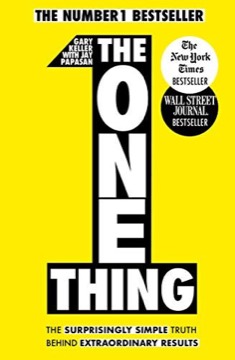
The One Thing
Gary Keller and Jay Papasan's argument for extreme prioritisation, organised around a single focusing question and the claim that extraordinary results come from narrowing rather than from balancing.
- First published
- 2013
- Publisher
- AGUILAR
- Pages
- 296
- Shelf
- Habits
- Level
- Entry
- ISBN-13
- 9789862418437
Record checked against
Catalogue note
- Reads as
- PracticalWritten to be applied, not only understood.
- Level
- Accessible / FoundationalNo prior reading assumed.
- Approach
- Practical
- Written for
- Anyone changing how they work, Newcomers to the subject
- Ideas
Saved in this browser only — no account, nothing sent anywhere. My library
Read this if
- You are losing your attention to things you did not choose.
- You want something to apply, not only something to think about.
- You are starting from scratch here and want a way in that assumes no prior reading.
The Focusing Question
The book's entire method in one sentence: what is the one thing I can do, such that by doing it everything else becomes easier or unnecessary?
The construction is doing careful work. It asks for one rather than several, demands a leverage claim rather than mere importance, and can be scoped to a life, a year, a week or the next hour — which is what makes it usable at different altitudes.
One thing, such that doing it makes everything else easier or unnecessary. The leverage clause is the whole question.
Devmark’s reading — not a quotation from the book
The domino image
Their organising metaphor: a domino can topple another roughly one and a half times its size, so a sequence of correctly ordered dominoes escalates from trivial to enormous.
The point is about sequence rather than effort — that outcomes come from lining things up in the right order and knocking over the first, not from pushing on everything simultaneously.
Six lies they attack
Their list of beliefs they consider obstacles: that everything matters equally, that multitasking works, that success requires a disciplined life, that willpower is always available, that a balanced life is achievable, and that big is bad.
The multitasking and willpower material is conventional and well supported. The discipline argument is more interesting — they claim success requires selected habits rather than general discipline, which is a considerably more achievable target.
Against balance
Their most contested position. They argue that balance is a myth and that extraordinary results require going out of balance deliberately — with the qualification that the imbalance should be counterweighted over time rather than permanent.
Their distinction between personal life, where they recommend short counterbalancing cycles, and professional life, where they recommend longer ones, is a real qualification that most summaries drop.
Time blocking
Their principal practical mechanism: block four hours daily for the one thing, place it first in the day, and defend it as an unbreakable appointment.
Their insistence that it goes first is the operative detail. Anything scheduled after the reactive work will be consumed by it, which is the mechanism by which important work never happens.
It goes first or it does not happen. Anything scheduled after the reactive work gets eaten by it.
Devmark’s reading — not a quotation from the book
Purpose, priority, productivity
Their vertical structure: productivity flows from priority, which flows from purpose. Working on the wrong thing efficiently is the failure they are most concerned with.
The sequencing is sound and unoriginal — it is essentially the same argument Covey makes about Quadrant II — but the focusing question gives it a sharper operational form.
Where it is repetitive
It is a single idea delivered across two hundred and forty pages, and the repetition is heavy even by the standards of the genre.
The core content could be a long article, and the book's structure — lies, truths, results — pads it considerably with restatement and anecdote.
Where the evidence is thin
The supporting material is anecdotal and drawn from selected high performers, with the usual survivorship problem and no counter-examples.
Several research claims are loosely cited, including a frequently repeated figure about how long habits take to form that is presented with more precision than the underlying study supports.
Where the advice breaks down
The four-hour daily block assumes a job with substantial autonomy. For reactive roles it is unavailable, and the book does not engage with that.
The anti-balance position also lands differently depending on circumstances. Deliberate professional imbalance is a choice available to someone without caring responsibilities and is not advice for everyone.
What to take from it
The Focusing Question is genuinely good and costs nothing. Asking it about the current week, with the leverage clause taken seriously, usually produces a different answer from a normal priority list.
And the first-thing discipline for the block. Both survive independently of the book's more contestable positions about balance and discipline.
What to take away
- 01Ask for the leverage, not the importanceThe question demands one thing that makes the rest easier or unnecessary, which is a much harder test.
- 02Sequence beats simultaneous effortLining dominoes up in the right order and toppling the first, rather than pushing on all of them.
- 03Selected habits, not general disciplineA considerably more achievable target than becoming a disciplined person.
- 04Put the block firstAnything scheduled after the reactive work will be consumed by it.
- 05Counterbalance rather than balanceTheir real position is deliberate imbalance with correction cycles, not permanent imbalance.