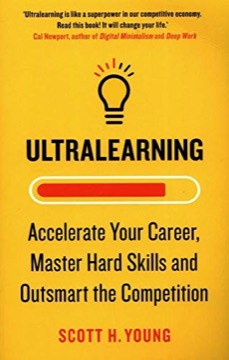
Ultralearning
Master Hard Skills, Outsmart the Competition, and Accelerate Your Career
Scott Young's method for aggressive self-directed skill acquisition, drawn from his own projects and from the learning research — nine principles for compressing what would conventionally take years.
- First published
- 2019
- Publisher
- Conecta
- Pages
- 304
- Shelf
- Habits
- Level
- Core
- ISBN-13
- 9780062852748
Record checked against
Only one source carried a publication date for this work, so the year is uncorroborated.
Catalogue note
- Reads as
- PracticalWritten to be applied, not only understood.
- Level
- Core / BuildingAssumes general familiarity with the subject.
- Approach
- Practical
- Written for
- Anyone changing how they work, Readers with some grounding
- Ideas
Saved in this browser only — no account, nothing sent anywhere. My library
Read this if
- You want to learn things that stay learned.
- You want something to apply, not only something to think about.
- You know roughly how the subject works and want the fuller account.
What ultralearning means
His definition: a strategy for acquiring skills and knowledge that is self-directed and intense. Self-directed means you make the decisions about what and how; intense means the approach prioritises effectiveness over comfort.
His own projects — completing a computer science curriculum's material in a year, learning several languages in quick succession — are the evidence, and he is reasonably clear that they are demonstrations rather than proof.
Self-directed and intense. He is clear his own projects are demonstrations rather than evidence.
Devmark’s reading — not a quotation from the book
Metalearning: draw the map first
His first principle and the one he considers most important. Before learning, research how the skill is structured, what the components are, how others have learned it, and what the standard failure modes are.
His rule of thumb is to spend roughly ten per cent of the total project time on this, on the reasoning that learning the wrong material efficiently is the most expensive error available.
Directness
His most useful single principle: learn by doing the thing you actually want to be able to do, in the context you want to do it.
His argument is that transfer between contexts is far weaker than people assume — studying a language from a textbook transfers poorly to conversation, and studying management theory transfers poorly to managing. The remedy is to make the practice resemble the target situation.
Drill: attack the weakest point
His treatment of isolating components: identify the rate-limiting part of the skill and practise it separately at higher intensity than the whole activity would allow.
He pairs this with a warning — drilling is only useful if the component is then reintegrated, because isolated competence that never returns to the real task is the classic failure of academic practice.
Retrieval over review
His most research-supported principle. Testing yourself produces substantially better retention than re-reading, even when the testing feels less productive and even before you have learned the material properly.
The counter-intuitive finding he emphasises is that attempting to retrieve something you cannot yet recall improves subsequent learning of it, which means testing can precede study rather than following it.
Trying and failing to recall something improves how well you later learn it. Testing can come before studying.
Devmark’s reading — not a quotation from the book
Feedback, and its kinds
He separates outcome feedback (you did badly), informational feedback (here is what went wrong), and corrective feedback (here is what to do instead) — arguing the third is rare, most valuable, and usually requires a person.
His practical advice is to aggressively seek the uncomfortable kind, and his observation that people optimise for feedback that is pleasant rather than informative is well made.
Retention, intuition and experimentation
His later principles cover spacing and the forgetting curve, building deep intuition by insisting on explaining things in plain terms rather than memorising, and eventually moving from following methods to designing your own.
The Feynman technique — explain it simply and notice exactly where you stall — is the most immediately usable tool in this section.
Where it is limited
The evidence is a mixture of solid learning science — retrieval practice, spacing, interleaving are well established — and the author's own project reports, which are compelling and uncontrolled.
The method also demands time availability and a tolerance for discomfort that most people cannot sustain alongside employment, which the book acknowledges only briefly.
Where it overlaps
Substantial overlap with *Make It Stick* on the cognitive science and with Ericsson on deliberate practice. Young's contribution is packaging these into a project methodology rather than discovering anything.
If you want the research, read *Make It Stick*. If you want a procedure for running a self-directed learning project, this is the better book.
What to take from it
Directness is the highest-value principle and the most commonly violated: check whether your practice resembles the situation you are preparing for, and if it does not, change the practice rather than doing more of it.
And retrieval over review, which is the best-supported finding in learning science and the one almost nobody applies because re-reading feels productive and testing does not.
What to take away
- 01Draw the map before startingRoughly a tenth of the project time spent on structure, because learning the wrong material efficiently is the worst error.
- 02Practise the actual thingTransfer between contexts is far weaker than assumed; make the practice resemble the target situation.
- 03Test instead of re-readingThe best-supported finding in learning science and the one almost nobody uses, because it feels unproductive.
- 04Failed retrieval still helpsAttempting to recall something you do not yet know improves how well you subsequently learn it.
- 05Seek corrective feedbackNot 'that was bad' but 'do this instead' — the rarest kind and the only one that changes performance.