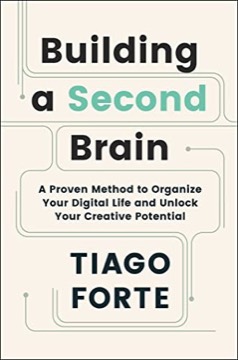
Building a Second Brain
Tiago Forte's system for capturing and organising digital information — a more accessible and more consumer-oriented relative of the Zettelkasten tradition, built around four steps and a project-based filing scheme.
- First published
- 2022
- Publisher
- Atria Books
- Pages
- 240
- Shelf
- Habits
- Level
- Entry
- ISBN-13
- 9786555646610
Record checked against
Only one source carried a publication date for this work, so the year is uncorroborated.
Catalogue note
- Reads as
- PracticalWritten to be applied, not only understood.
- Level
- Accessible / FoundationalNo prior reading assumed.
- Approach
- Practical
- Written for
- Anyone changing how they work, Newcomers to the subject
- Ideas
Saved in this browser only — no account, nothing sent anywhere. My library
Read this if
- You want to learn things that stay learned.
- You want something to apply, not only something to think about.
- You are starting from scratch here and want a way in that assumes no prior reading.
The premise
Forte's argument is that knowledge workers consume far more information than they can retain, that most of it is lost, and that a systematic external store converts consumption into a compounding asset.
His framing of a second brain as infrastructure rather than as a filing cabinet is the useful part, and his emphasis on eventual output rather than storage distinguishes it from ordinary note-taking advice.
The store is only worth keeping if something comes out of it. Otherwise it is consumption with extra steps.
Devmark’s reading — not a quotation from the book
CODE
His four-step method. Capture what resonates. Organise for actionability. Distil to the essence. Express by producing something.
The sequence is the argument: most people do the first and stop, and Forte's insistence that the last step is what validates the first three is the book's central discipline.
Capture what resonates
His capture criterion is deliberately non-analytical: save what strikes you, not what seems objectively important, because the resonance signal is faster and more reliable than a judgement about future usefulness.
His warning against over-capture is equally important and frequently ignored — a store that collects everything is as unusable as no store at all.
PARA
His organising scheme: Projects with a deadline and an outcome, Areas of ongoing responsibility, Resources of general interest, and Archive for inactive items.
The insight is organising by actionability rather than by subject. Traditional topic-based filing requires deciding where something belongs, which is slow and frequently wrong; PARA asks only what this is currently for.
Progressive summarisation
His distillation technique: highlight a captured note in layers over time — bold the important passages on first return, highlight within the bold on the next, add a summary line if it becomes central.
The efficiency argument is that distillation happens only for material you actually revisit, so effort is spent in proportion to demonstrated usefulness rather than in advance.
Distil only what you return to. Effort follows demonstrated usefulness rather than being spent in advance.
Devmark’s reading — not a quotation from the book
Intermediate packets
His most useful concept for working practice: break work into reusable components — a summary, an outline, a set of notes, a diagram — that can be finished independently and recombined later.
The benefits are real. Work becomes resumable after interruption, it can be shared for feedback earlier, and previous projects become raw material rather than finished artefacts.
Where it differs from Zettelkasten
Forte's system is more permissive and more pragmatic. Notes need not be atomic, need not be in your own words, and organisation is by project rather than by link.
The trade-off is explicit: it is much easier to start and much less effective as a thinking tool. Ahrens's method produces ideas; Forte's produces retrievable material. Readers should choose by which problem they actually have.
Where it is weak
The evidence is the author's consulting practice and the enthusiasm of his course students, with no independent assessment.
The book also drifts toward the productivity-industry register — grand claims about transformation, heavy branding of ordinary ideas — and the acronyms do more marketing work than analytical work.
The collection trap
The failure mode the book warns about and does not fully defend against: capture is enjoyable and expression is not, so systems tend to accumulate and never produce.
Forte's remedy is the express step, but a reader should notice that the method's low friction at the capture end and high friction at the output end makes the imbalance structurally likely.
What to take from it
PARA is genuinely useful and can be adopted in an hour regardless of the rest — organising by actionability rather than subject removes most filing decisions.
And intermediate packets, which change how work is structured rather than how it is stored, and which survive independently of any note system.
What to take away
- 01Output validates the systemA store that never produces anything is consumption with extra administrative steps.
- 02Capture what resonatesThe felt signal is faster and more reliable than a judgement about future usefulness.
- 03Organise by actionabilityPARA asks what something is currently for, which removes almost all filing decisions.
- 04Distil what you revisitLayered highlighting spends effort in proportion to demonstrated usefulness.
- 05Build intermediate packetsReusable components make work resumable, shareable earlier, and raw material for later projects.