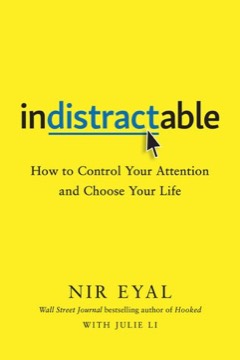
Indistractable
How to Control Your Attention and Choose Your Life
Nir Eyal's argument that distraction is driven from within rather than by technology — and his four-part method for addressing it, written partly as a correction to how his earlier book on habit-forming products was received.
- First published
- 2019
- Publisher
- Benbella Books
- Pages
- 336
- Shelf
- Habits
- Level
- Entry
- ISBN-13
- 9781526610201
Record checked against
Only one source carried a publication date for this work, so the year is uncorroborated.
Catalogue note
- Reads as
- PracticalWritten to be applied, not only understood.
- Level
- Accessible / FoundationalNo prior reading assumed.
- Approach
- Practical
- Written for
- Anyone changing how they work, Newcomers to the subject
Saved in this browser only — no account, nothing sent anywhere. My library
Read this if
- You are losing your attention to things you did not choose.
- You want to understand what technology is doing to how we live.
- You want to change what you do repeatedly, not just what you intend.
- You want something to apply, not only something to think about.
- You are starting from scratch here and want a way in that assumes no prior reading.
Traction and distraction
His framing definition: the opposite of distraction is not focus but traction — any action that pulls you toward what you intended. Distraction is any action that pulls you away.
The reframe matters because it makes the test intention rather than activity. Reading a book can be distraction; scrolling a feed can be traction. What determines which is whether you planned it.
The opposite of distraction is not focus. It is having planned what you are doing.
Devmark’s reading — not a quotation from the book
Distraction starts from within
His central claim and the book's main contribution: external triggers are the smaller half. Most distraction begins as an internal discomfort — boredom, anxiety, uncertainty, loneliness — that the behaviour relieves.
His conclusion is that removing the app without addressing the discomfort relocates the behaviour rather than ending it, which is why blocking tools so often fail.
Mastering internal triggers
His first step: identify the discomfort preceding a distraction, write it down, and explore the sensation rather than acting on it.
His most practical technique is the ten-minute rule — allowing yourself the distraction in ten minutes, which he argues usually dissolves the urge because urges are waves rather than states. He calls this surfing the urge, and it is drawn from established addiction practice.
Make time for traction
His second step, and the one most readers underuse: schedule your values rather than your tasks, using a timeboxed calendar that accounts for every hour.
His test for whether you were distracted is precise and unusual — you were distracted if you did not do what you said you would do at the time you said. Under this definition, unplanned time cannot be distraction, which removes a great deal of unnecessary guilt.
Hack back external triggers
His third step covers the conventional material — notifications, meetings, email, group chat, desk interruptions — with the useful test applied to each: does this trigger serve me, or do I serve it?
His treatment of meetings is the sharpest: require an agenda and a pre-circulated brief, on the grounds that a meeting called to think is usually a meeting called to avoid thinking alone.
Ask of each trigger: does this serve me, or do I serve it? Almost none survive the question unchanged.
Devmark’s reading — not a quotation from the book
Prevent with pacts
His fourth step: precommitment devices that make distraction harder after the other three are in place. Effort pacts, price pacts and identity pacts.
The identity pact is the one he considers strongest — describing yourself as indistractable changes subsequent behaviour more reliably than any blocking tool, which is the same mechanism Clear builds his book on.
The Hooked problem
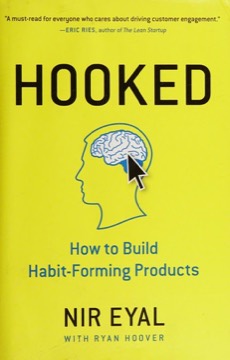
This book exists partly in tension with his earlier one, which taught product teams to build habit-forming experiences using variable reward and internal triggers.
Critics have argued the pairing is uncomfortable — teaching the mechanism and then selling the remedy — and Eyal's response, that the techniques are neutral and the ethics lie in application, is a reasonable position that does not fully dispose of the objection.
Where he pushes back on the consensus
Eyal explicitly opposes the technology-addiction framing, arguing it is overstated, that it removes agency, and that the evidence for population-level harm is weaker than commonly claimed.
This is a genuine and contested position. The research on screen time and wellbeing is disputed with small effect sizes, so he is not wrong about the evidence — but the framing also serves an author whose earlier work is implicated.
Where it is limited
The timeboxing prescription assumes considerable control over your calendar, which many jobs do not permit, and the book's later sections on workplaces and children generalise well beyond the evidence.
It is also longer than its argument requires, with the four-part structure padded by case material.
What to take from it
The internal-trigger insight is the durable contribution: before blocking anything, notice what discomfort the behaviour is relieving, because the discomfort will find another outlet.
And the redefinition of distraction as departure from your own plan, which is both more actionable and considerably kinder than measuring yourself against a category of activity.
What to take away
- 01Distraction is defined by intentionThe same activity is traction or distraction depending on whether you planned it.
- 02The trigger is usually internalBoredom, anxiety or uncertainty precedes the behaviour, so blocking the app relocates it rather than ending it.
- 03Surf the urgeUrges are waves rather than states; the ten-minute delay usually dissolves them.
- 04Timebox values, not tasksSchedule what matters and the test becomes whether you did what you said, at the time you said.
- 05Identity pacts beat blockersDescribing yourself as indistractable changes behaviour more reliably than any software does.