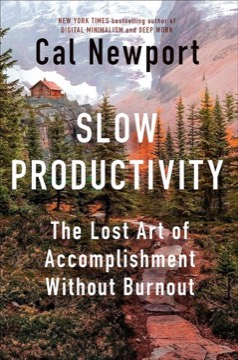
Slow Productivity
The Lost Art of Accomplishment Without Burnout
Cal Newport's argument that knowledge work adopted a factory model of visible activity it was never suited to, and his proposal for an alternative: fewer things, a natural pace, and an obsession with quality.
- First published
- 2024
- Publisher
- Penguin
- Pages
- 256
- Shelf
- Habits
- Level
- Entry
- ISBN-13
- 9780593544860
Record checked against
Catalogue note
- Reads as
- PracticalWritten to be applied, not only understood.
- Level
- Accessible / FoundationalNo prior reading assumed.
- Approach
- Practical
- Written for
- Anyone changing how they work, Newcomers to the subject
Saved in this browser only — no account, nothing sent anywhere. My library
Read this if
- You are asking what you should be doing with your working life.
- You are losing your attention to things you did not choose.
- You want something to apply, not only something to think about.
- You are starting from scratch here and want a way in that assumes no prior reading.
Pseudo-productivity
His diagnosis and the book's most useful coinage. Because knowledge work has no clean output measure, organisations fell back on visible activity as a proxy — messages answered, meetings attended, availability demonstrated.
His argument is that this was always a poor proxy and that remote tools made it worse by making activity continuously observable, which intensified the performance of work relative to the doing of it.
With no clean output measure, visible activity became the proxy. Remote tools made the performance continuous.
Devmark’s reading — not a quotation from the book
Principle one: do fewer things
His first proposal, and the one he treats as foundational. The argument is about overhead: each active commitment carries a tax of meetings, messages and context-switching, and the tax scales faster than the work.
Past a threshold, adding a project reduces total output rather than increasing it — which means saying no is a throughput decision rather than a preference.
Managing the overhead tax
His practical mechanisms: limit projects in progress, work on one major initiative at a time, put a container around small tasks rather than letting them interleave, and make workload visible so that accepting something new visibly displaces something else.
The visibility point is the sharpest. Invisible workload is what allows organisations to keep adding without anyone being able to refuse.
Principle two: work at a natural pace
His second proposal, supported historically rather than experimentally: he examines how significant intellectual and creative work was actually produced, and finds long timelines with substantial variation in intensity.
His conclusion is that sustained uniform effort is a modern expectation rather than a natural one, and that the alternation of intense periods with fallow ones is the historical norm for good work.
Seasonality and the longer horizon
His concrete recommendations: plan on the scale of years rather than weeks, build quiet seasons deliberately, schedule projects with far more slack than feels comfortable, and accept that some months produce little.
He is candid that this is easier to prescribe than to implement in employment, and that his own position affords latitude most readers lack.
He is clear that his own job affords a latitude most readers do not have. The principle still holds; the freedom does not.
Devmark’s reading — not a quotation from the book
Principle three: obsess over quality
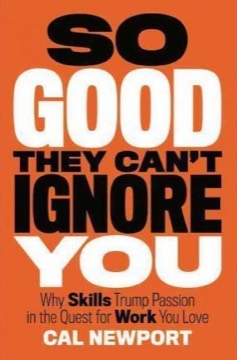
His third proposal, and the one that makes the first two affordable. Quality is what earns the leverage to do fewer things at a slower pace — the same career-capital argument from *So Good They Can't Ignore You*, applied to workload rather than to autonomy.
His practical instruction is to raise standards deliberately, which naturally forces fewer commitments because the standard cannot be met across many.
Where it is limited
The book is written for people with meaningful discretion over their workload, and Newport acknowledges this more than in his earlier work without really resolving it.
For salaried employees whose commitments are assigned, the advice describes a destination rather than a route, and the historical examples — mostly independent scholars, writers and scientists — reinforce that gap.
The evidence question
The historical method is illustrative rather than evidential. Selecting figures who produced important work and observing their pace does not establish that the pace caused the work.
The overhead-tax argument is more solid and connects to well-established findings on context switching and work-in-progress limits, which is where the book is strongest.
How it fits his other books
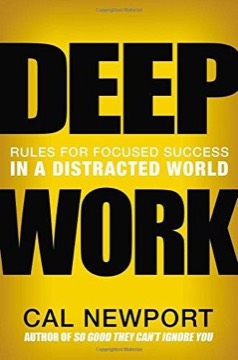
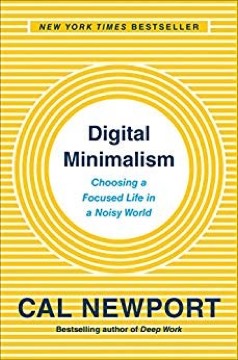
It completes an arc. *Deep Work* argued for concentration, *Digital Minimalism* for controlling the tools, *A World Without Email* for fixing the communication layer, and this for the workload itself.
Read alone it will seem to assume conditions the reader does not have. Read in sequence the argument is cumulative and the assumptions are more visible.
What to take from it
Pseudo-productivity as a name for what your organisation is actually measuring, which makes it discussable.
And the overhead-tax framing: before accepting something new, count the meetings and messages it will generate rather than the hours of work, since the first is what actually consumes the week.
What to take away
- 01Activity became the proxy for outputKnowledge work has no clean measure, so visible busyness stood in — and tooling made it continuous.
- 02Count the overhead, not the hoursEach commitment brings meetings and messages that scale faster than the work itself.
- 03Make workload visibleInvisible commitments are what let organisations keep adding without anyone able to refuse.
- 04Uniform intensity is a modern expectationHistorically, significant work came from long timelines with intense and fallow periods alternating.
- 05Quality buys the latitudeDoing fewer things slowly requires leverage, and leverage comes from being demonstrably good.