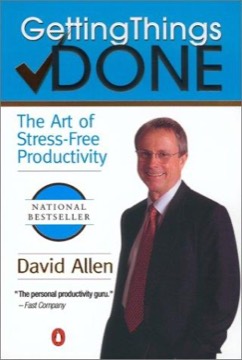
Getting Things Done
The Art of Stress-Free Productivity
David Allen's system for managing commitments — built on the premise that the mind is poor at storing open loops and that moving them into a trusted external system is what makes concentration possible.
- First published
- 2001
- Publisher
- Penguin Books
- Pages
- 279
- Shelf
- Habits
- Level
- Core
- ISBN-13
- 9781508215530
Record checked against
Catalogue note
- Reads as
- PracticalWritten to be applied, not only understood.
- Level
- Core / BuildingAssumes general familiarity with the subject.
- Approach
- Practical
- Written for
- Anyone changing how they work, Readers with some grounding
Saved in this browser only — no account, nothing sent anywhere. My library
Read this if
- You are losing your attention to things you did not choose.
- You keep fixing symptoms and want to see the structure producing them.
- You want something to apply, not only something to think about.
- You know roughly how the subject works and want the fuller account.
The psychological premise
Allen's foundational claim is that incomplete commitments occupy attention regardless of whether you are working on them, and that the mind will keep returning to them because it cannot tell whether they have been handled.
His conclusion is that the purpose of a system is not productivity but release: a mind that trusts its commitments are captured somewhere can stop tracking them and become available for actual work.
The system exists so the mind can stop holding the list. Productivity is a side effect of the release.
Devmark’s reading — not a quotation from the book
Capture everything
The first discipline: get every open loop out of your head and into collection points, without filtering, judging or organising at the moment of capture.
The completeness requirement is not perfectionism. A system that holds most of your commitments is not trustworthy, and an untrustworthy system is one the mind will keep shadowing — which defeats the entire purpose.
The next-action question
Allen's single most valuable contribution. For every item, ask what the very next physical, visible action is — not the project, not the outcome, but the specific next step.
Most procrastination, in his account, is not laziness but an undefined next action. "Sort out the insurance" cannot be done; "find the policy number in the filing drawer" can, and the reframing frequently dissolves the resistance entirely.
The two-minute rule
If a captured item can be done in under two minutes, do it immediately, because filing and tracking it costs more than doing it.
This is the most widely adopted piece of the system and the easiest to apply without the rest of it, which is why many people encounter GTD through this rule alone.
The five stages
Capture, clarify, organise, reflect, engage. Each is a distinct activity and Allen insists they must not be mixed — trying to organise while capturing, or decide while collecting, is what makes the process feel impossible.
The separation is the structural insight. Deciding what something means is a different cognitive mode from writing it down, and doing both at once is what makes inbox processing exhausting.
Capturing and deciding are different modes. Doing both at once is what makes processing an inbox exhausting.
Devmark’s reading — not a quotation from the book
Contexts and lists
His organising scheme: next actions sorted by the context required — location, tool, person available — so that at any moment you can see what is genuinely actionable.
This part has aged least well. Contexts made obvious sense when a call required a phone and a document required an office; they are considerably less meaningful when a laptop and a phone make almost everything available anywhere.
The weekly review
The system's maintenance requirement and the point at which most people fail. Clear the inboxes, update the lists, review projects, and reconnect with the higher horizons.
Allen is explicit that without it the system degrades into an untrusted pile within weeks, and that the review is the single non-negotiable component. It is also the one users most consistently abandon.
Horizons of focus
His six levels: current actions, current projects, areas of responsibility, one-to-two-year goals, three-to-five-year vision, and life purpose.
His unusual argument is to work from the ground up rather than the top down, because a mind cluttered with unprocessed commitments cannot think clearly about purpose. Most planning advice reverses this.
Where it is heavy
The full system has substantial overhead: multiple lists, a reference filing system, a tickler file, and a weekly review that takes real time.
For someone with a genuinely large volume of heterogeneous commitments this is proportionate. For someone with a small number of large projects it is machinery serving very little, and the book does not scale its prescriptions to the size of the problem.
What to take from it
The next-action question alone justifies the book and can be adopted with no other part of the system.
Then the capture discipline and the two-minute rule. The full apparatus is optional; the underlying insight — that open loops consume attention until they are captured and defined — is not.
What to take away
- 01Open loops consume attentionThe mind keeps returning to a commitment because it cannot verify it has been handled.
- 02Define the next physical actionMost procrastination is an undefined next step, and defining it frequently dissolves the resistance.
- 03Do not mix capture with decidingThey are different cognitive modes, and combining them is what makes processing feel impossible.
- 04Incomplete systems are untrusted systemsA system holding most of your commitments will be shadowed by the mind anyway, which defeats it.
- 05The weekly review is not optionalWithout it the system degrades to an untrusted pile in weeks. It is also what people abandon first.