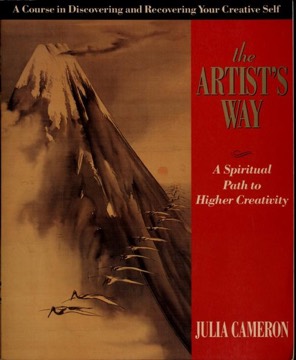
The Artist's Way
Julia Cameron's twelve-week course for recovering creative confidence, built around two daily practices. In print since 1992 and still the most widely used creative-unblocking programme.
- First published
- 1992
- Publisher
- Kuraldışı
- Pages
- 240
- Shelf
- Habits
- Level
- Entry
- ISBN-13
- 9781101173053
Record checked against
Catalogue note
- Reads as
- PracticalWritten to be applied, not only understood.
- Level
- Accessible / FoundationalNo prior reading assumed.
- Approach
- Practical
- Written for
- Anyone changing how they work, Newcomers to the subject
- Ideas
Saved in this browser only — no account, nothing sent anywhere. My library
Read this if
- You make things, and want to understand the work rather than wait for inspiration.
- You want something to apply, not only something to think about.
- You are starting from scratch here and want a way in that assumes no prior reading.
The two practices
Morning Pages: three pages of longhand, stream-of-consciousness writing, first thing, every day, not to be reread or shown to anyone. The purpose is not production; it is clearing the surface noise that sits between a person and their work.
The Artist Date: a weekly solo expedition to do something that fills the well — a museum, a hardware shop, a walk somewhere unfamiliar. Alone is the requirement people most often ignore and the one Cameron insists on.
Three pages by hand, every morning, never reread. That is the entire mechanism.
Devmark’s reading — not a quotation from the book
The course
Twelve weeks, each with a theme — safety, identity, power, abundance — plus exercises and a set of readings. It is designed to be worked through rather than read, and Cameron is firm that the reading without the doing achieves nothing.
Much of the material addresses what she calls creative injury: the teacher, parent or critic whose remark closed something down, and the specific work of separating that voice from your own judgement.
The spiritual framing
Cameron's language is explicitly spiritual and she refers to a creative force she sometimes calls God. A large number of readers find this the main obstacle, and she addresses it directly, suggesting the practice works if the terminology is substituted.
That is a fair accommodation. The two practices are behavioural and do not depend on the metaphysics around them.
You can run the programme and ignore the theology; the exercises are behavioural.
Devmark’s reading — not a quotation from the book
What the pages are actually for
The most common misreading is that Morning Pages are a writing exercise. Cameron's position is the opposite: they are not meant to be good, are not meant to be reread for months, and are not material. Their function is to clear the surface layer of complaint, anxiety and logistics that otherwise occupies the first hours, so that whatever is underneath has room.
They are not writing. They are what you do so that writing becomes possible.
Devmark’s reading — not a quotation from the book
The Artist Date
The second practice is a weekly solo expedition to something that interests you, taken alone and without a companion or a purpose. Cameron treats the solitude as non-negotiable and reports that this is the assignment people resist and skip. Her framing is economic: the pages are output, the dates are the only input, and a well that is drawn from continuously and never refilled runs dry.
Reading deprivation
Week four asks the reader to stop reading entirely for seven days, and it is the exercise that generates the most objection. Cameron's argument is that consumption is the most socially acceptable form of avoidance available to creative people, and that removing it forces the restlessness that has been successfully managed for years to surface and be used.
Crazymakers and shadow artists
Two of her terms have outlived the book. The crazymaker is the chaotic person whose emergencies reliably consume the time you had set aside for your own work, and whom you may be keeping nearby for exactly that reason. The shadow artist is someone who has arranged a life adjacent to the thing they wanted — supporting, teaching, representing, criticising — without ever attempting it.
The twelve-step scaffolding
The structure is openly borrowed from addiction recovery, and Cameron came to it through her own. That explains the shape: sequential weeks, daily practice, a language of blocks and recovery, and the insistence that the reader is recovering an original capacity rather than acquiring a new one. Knowing the source makes the register far more legible.
The theology, and whether it matters
Cameron addresses a creative force in explicitly spiritual terms and does not apologise for it. Readers who find that unusable can substitute their own term, which she says outright and which most secular readers do without damaging the exercises — the practices are behavioural and work independently of what a person believes about their source.
What to take from it
It is a course rather than a book and rewards being done rather than read. The two practices are the whole mechanism; everything else is support. If only one thing is attempted, make it the pages, every morning, for long enough that the novelty wears off — which is where Cameron says the useful material begins.
What to take away
- 01Morning PagesThree longhand pages daily, unread, to clear what sits between you and the work.
- 02The Artist DateA weekly solo outing to replenish material, and alone is non-negotiable.
- 03Creative injuryMuch of the course is separating an old critical voice from your own.
- 04A course, not a bookReading it without doing it is explicitly pointless.
- 05Skippable theologyThe spiritual framing is separable from the practices.