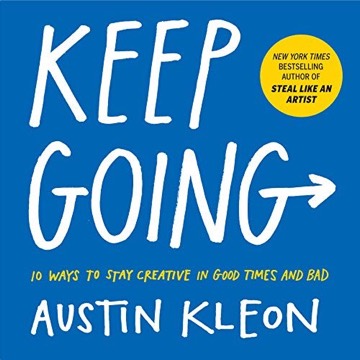
Keep Going
Austin Kleon's third short book on creative work, about sustaining a practice rather than starting one: ten rules for continuing when the work is going badly or the world is loud.
- First published
- 2019
- Publisher
- Workman Publishing Company, Incorporated
- Pages
- 224
- Shelf
- Habits
- Level
- Entry
- ISBN-13
- 9781523507863
Record checked against
Only one source carried a publication date for this work, so the year is uncorroborated.
Catalogue note
- Reads as
- PracticalWritten to be applied, not only understood.
- Level
- Accessible / FoundationalNo prior reading assumed.
- Approach
- Practical
- Written for
- Anyone changing how they work, Newcomers to the subject
- Ideas
Saved in this browser only — no account, nothing sent anywhere. My library
Read this if
- You make things, and want to understand the work rather than wait for inspiration.
- You want something to apply, not only something to think about.
- You are starting from scratch here and want a way in that assumes no prior reading.
The argument
Kleon's earlier books were about where ideas come from and about sharing work. This one addresses the harder problem, which is continuing across years when nothing in particular is happening.
His framing is that creative life is not a series of breakthroughs but a daily practice, and that the useful unit is the day rather than the project.
The unit is the day, not the project, and the book is about protecting the day.
Devmark’s reading — not a quotation from the book
The ten rules
Among them: every day is groundhog day, so build a routine rather than relying on momentum. Forget the noun, do the verb — be less concerned with being a writer and more with writing. Make gifts, not products. Slay the art monsters inside you. Demote your devices. Ordinary plus attention equals extraordinary.
The chapter on airplane mode, and on the specific damage of doing creative work in a state of constant alert, is the most practically useful.
What kind of book it is
Very short, heavily illustrated with Kleon's own blackout poems and drawings, and designed to be read in an hour and reread when needed.
There is no research and no argument that builds. It is a set of reminders, and its usefulness depends entirely on whether you are in a position to need them.
A set of reminders rather than an argument, and it is honest about that.
Devmark’s reading — not a quotation from the book
Where it sits
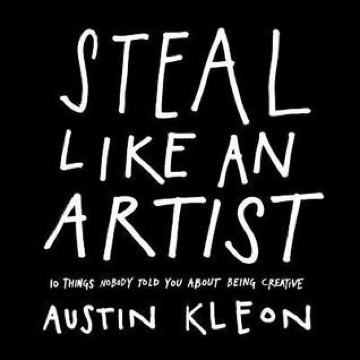
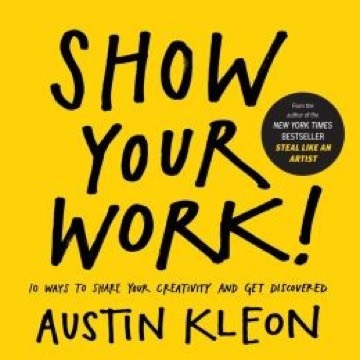
The third of a trilogy with Steal Like an Artist and Show Your Work, and readable independently.
It is aimed at someone already working who has lost the thread, rather than at someone deciding whether to begin.
Kleon writes a widely read newsletter and much of the material was tested there first, which explains the register: these are ideas that survived contact with an audience before reaching a page.
Written for the middle
Kleon's first book was about starting and his second about sharing; this one is about the years afterwards, when the work is established and the difficulty is continuing without novelty, external validation or a clear finish line. It is the least glamorous of the three problems and the one most people eventually have.
Every day is Groundhog Day
His first rule is to stop thinking in careers and think in days, because a day is the only unit anyone can actually control and it recurs regardless of how the previous one went. The practical consequence is a routine that does not depend on how you feel about the larger project.
A career cannot be worked on. A Tuesday can.
Devmark’s reading — not a quotation from the book
Build a bliss station
He argues for a place and a time where you are unreachable — no phone, no input, no obligation to respond — and is direct that this now requires deliberate construction because it will not occur by default. The idea is borrowed and credited, and it is the book's most actionable recommendation.
Forget the noun, do the verb
A recurring instruction is to abandon the identity and keep the activity: worry about writing rather than about being a writer. Kleon's argument is that the noun generates anxiety, comparison and the need for permission, while the verb can simply be done on a given afternoon without anyone's agreement.
The drawings
The book is illustrated throughout with his own blackout poetry, diagrams and hand-lettering, and the visual material is not decoration. It slows the reading, gives the aphorisms room, and demonstrates the working method the text is recommending, which is why the ideas land better here than in a straight prose version.
What it is not
It is short enough to read in an hour, aphoristic rather than argued, and supplies no evidence for anything. Read as a philosophy of creativity it is thin; read as a book to keep near the desk and open on a bad morning, which is explicitly how Kleon intends it, it does that job well.
What to take away
- 01Protect the dayThe unit of a creative life is daily, not project-shaped.
- 02Forget the nounDo the verb; identity follows practice rather than preceding it.
- 03Make giftsWork framed as a gift rather than a product.
- 04Airplane modeThe damage of creative work done under constant alert.
- 05For someone already workingAimed at continuing, not at starting.