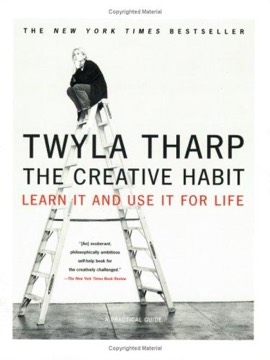
The Creative Habit
Twyla Tharp's account of creativity as a discipline, from a choreographer with a fifty-year body of work. Ritual, preparation and the boxes she keeps for every project.
- First published
- 2003
- Publisher
- Simon & Schuster
- Pages
- 256
- Shelf
- Design
- Level
- Entry
- ISBN-13
- 9780743235266
Record checked against
Only one source carried a publication date for this work, so the year is uncorroborated.
Catalogue note
- Reads as
- PracticalWritten to be applied, not only understood.
- Level
- Accessible / FoundationalNo prior reading assumed.
- Approach
- Practical
- Written for
- Designers and makers, Newcomers to the subject
Saved in this browser only — no account, nothing sent anywhere. My library
Read this if
- You make things, and want to understand the work rather than wait for inspiration.
- You want to learn things that stay learned.
- You want something to apply, not only something to think about.
- You are starting from scratch here and want a way in that assumes no prior reading.
The premise
Tharp's position is that creativity is a product of habit rather than inspiration, and she argues it from the position of someone who has had to produce work on schedule for decades.
Her own ritual is described precisely: waking at 5.30, taking a cab to the gym, and counting the ritual as complete when she tells the driver the destination, not when she finishes exercising.
The ritual is complete at the moment of commitment, not at the end of the work. That is the whole trick.
Devmark’s reading — not a quotation from the book
The box
Her most transferable device: for every project she starts a physical box, labelled with the project name, into which everything relevant goes — notes, music, photographs, objects, failed ideas.
The box does two things. It makes a project feel begun before anything good exists, and it means the raw material of every past project is retrievable.
What the book covers
Chapters on preparation, on identifying your creative DNA, on where ideas come from, and on what she calls the spine of a work — the single organising idea a piece is about, which she argues should be decided early and privately.
There are exercises throughout, and they are genuine exercises rather than prompts.
Every work has a spine. Knowing it early and telling nobody is her recommendation.
Devmark’s reading — not a quotation from the book
On failure
Tharp devotes a full chapter to her own failures, including a production she describes as an unambiguous disaster, and works through what she took from each. It is unusually specific for a book by a celebrated artist.
Her position is that a failure has to be diagnosed rather than absorbed — that the useful question is which of the five or six things that went wrong was the one that actually mattered, and that most people never run that analysis.
The ritual, not the discipline
Tharp's most precise observation concerns where the habit actually lives. Her morning routine is not the workout; it is the act of getting into the taxi, which she treats as the decision point. Once that is done everything else follows automatically, so the ritual she has built is deliberately placed at the smallest possible commitment rather than at the demanding part.
The habit is not the two hours. It is the thirty seconds in which the two hours become inevitable.
Devmark’s reading — not a quotation from the book
Scratching
Her term for the deliberate search for a starting point: reading widely, watching, revisiting old material, collecting fragments with no immediate purpose. She presents it as unglamorous, faintly desperate work that must be done before anything else is possible, and insists it is a phase of the process rather than a failure to have started.
The spine
Every project, in her account, needs a single organising idea that everything can be tested against — brief enough to state in a sentence, and known to the maker even if never visible to the audience. Her argument is that work without one accumulates good material that does not cohere, and that this is the most common way an ambitious project fails.
Creative DNA
She argues that each person has a limited set of preoccupations and characteristic moves they will return to for a whole career, and that identifying them early is more useful than trying to be limitlessly versatile. The exercise is to examine your own past work for what recurs rather than to decide in advance what you are.
Ruts and grooves
Her distinction between the two is practical: both are repetitions, but a groove is productive and a rut is the same motion producing nothing. She supplies concrete tests for telling them apart and specific tactics for getting out — changing one constraint, working in a different medium, deliberately reversing a habitual choice.
The failure chapter
She devotes a full chapter to her own failures, including a major production that went badly in front of audiences before being rebuilt. The value is in the specificity: she describes what she had got wrong structurally, what she did to diagnose it, and what the rescue actually cost, which is rarer in creative advice than the general encouragement to fail.
What to take from it
It is a professional's account, from someone whose living depends on producing to schedule, and it is impatient with waiting for inspiration. The two portable devices are the box, which externalises a project's material, and the spine, which gives you something to cut against. Both work outside choreography.
What to take away
- 01Habit over inspirationArgued by someone who has had to deliver on schedule for fifty years.
- 02The ritual ends at commitmentHers completes when she names the destination, not at the gym.
- 03The boxA physical container per project, started before anything good exists.
- 04The spineOne organising idea, decided early and kept private.
- 05Real exercisesPractical tasks rather than reflective prompts.