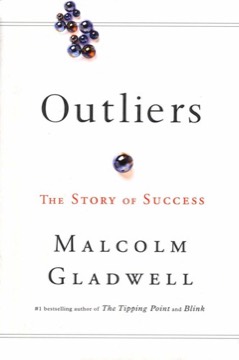
Outliers
Malcolm Gladwell's argument that exceptional success is better explained by circumstance — timing, culture, accumulated advantage and opportunity — than by individual talent or effort, and that we systematically tell the story the other way.
- First published
- 2008
- Publisher
- Little, Brown and Company
- Pages
- 320
- Shelf
- Habits
- Level
- Entry
- ISBN-13
- 9788575421188
Record checked against
Catalogue note
- Reads as
- PracticalWritten to be applied, not only understood.
- Level
- Accessible / FoundationalNo prior reading assumed.
- Approach
- Practical
- Written for
- Anyone changing how they work, Newcomers to the subject
Saved in this browser only — no account, nothing sent anywhere. My library
Read this if
- You are asking what you should be doing with your working life.
- You want to understand what technology is doing to how we live.
- You read for the writing as much as for the argument.
- You want something to apply, not only something to think about.
- You are starting from scratch here and want a way in that assumes no prior reading.
The thesis
Gladwell's claim is that the standard account of extraordinary achievement — intelligence, hard work, character — omits most of the explanation, and that the omitted part is circumstance.
His organising move is to take well-known successful people and show how much of their situation was unearned: birth date, birth year, family background, cultural inheritance and specific accidents of access.
The argument is not that effort does not matter. It is that we tell the story with the circumstances removed.
Devmark’s reading — not a quotation from the book
Accumulated advantage
His opening demonstration, from Canadian junior hockey: a disproportionate share of elite players were born in the first months of the year, because age-cutoff dates made them the oldest and largest in their cohort.
That small initial edge attracted better coaching and more ice time, which compounded into real superiority. It is the clearest illustration of an arbitrary starting difference becoming a genuine one.
The 10,000-hour rule
His best-known and most contested claim: that extraordinary expertise requires roughly ten thousand hours of practice, illustrated with musicians, programmers and musicians-turned-bands.
This has been substantially disputed. Ericsson, whose research Gladwell drew on, publicly objected that the number was an average with wide variation, that it described deliberate practice rather than time, and that no threshold was implied. Readers should treat the number as a popularisation rather than a finding.
Opportunity and timing
His stronger material: that being born in a narrow window allowed certain people access to a technology or an industry at the moment it became available, and that the same talent a decade earlier or later would have found nowhere to go.
The argument about access is well made and is the part of the book that holds up best — opportunity is unevenly distributed and arrives on a schedule nobody controls.
Cultural legacy
His second half turns to inherited cultural patterns — the argument that attitudes to authority, work and conflict persist across generations and affect outcomes in unexpected domains.
This is where the book is weakest. The airline-communication material and the mathematics-and-rice-paddies argument have both been criticised for relying on thin evidence and for edging toward cultural essentialism.
The cultural-legacy half is where the evidence thins and the argument edges toward essentialism.
Devmark’s reading — not a quotation from the book
The practical implication
Gladwell's constructive conclusion is about design: if success depends heavily on opportunity, then opportunities can be arranged more fairly.
His suggestions — multiple age cutoffs in youth sport, extended school years for disadvantaged students — follow from the analysis and are the book's most useful contribution, though they receive far less attention than the ten-thousand-hours line.
What the argument gets right
The core observation is sound and well supported by a broad literature: outcomes are substantially path-dependent, initial advantages compound, and the people who succeed are drawn disproportionately from those who had access.
The survivorship point is also correct — we study winners and infer causes from a sample with no failures in it.
What it gets wrong
Beyond the practice threshold, the book systematically understates individual variation. Its examples are selected to fit, the causal claims are asserted rather than tested, and several rest on single studies.
It also proves less than it claims. Showing that circumstance mattered in particular cases does not establish that talent and effort explain little in general.
The Gladwell method
This book is the clearest example of his approach: a counter-intuitive thesis, vivid cases, confident causal language, and minimal treatment of disconfirming evidence.
It is extremely effective as persuasion and should be read with that in mind. The ideas are worth encountering and none of them should be accepted on the book's authority alone.
What to take from it
The accumulated-advantage mechanism is real, well supported and widely applicable — look for arbitrary initial differences that subsequent systems amplify, because they are everywhere once you look.
And the design conclusion: if circumstance explains a great deal, then the useful response is arranging circumstances better rather than exhorting individuals harder.
What to take away
- 01Arbitrary edges compoundA birth-month advantage becomes real superiority once better coaching and more practice follow it.
- 02The hours number was a popularisationEricsson objected publicly: it was an average with wide variance, and described deliberate practice, not time.
- 03Opportunity arrives on a scheduleThe same ability a decade earlier or later would have had nowhere to go.
- 04Hold the cultural-legacy half looselyThin evidence and an argument that edges toward essentialism.
- 05The conclusion is about designIf circumstance explains much, arranging it better beats exhorting individuals harder.