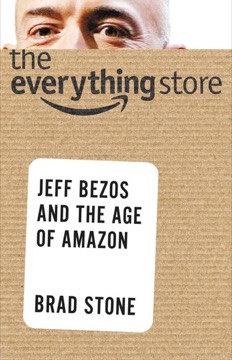
The Everything Store
Jeff Bezos and the Age of Amazon
Brad Stone's reported history of Amazon from its founding through roughly 2013 — an outside account, based on hundreds of interviews, of how a bookseller became infrastructure, and of the operating principles that made it possible.
- First published
- 2013
- Publisher
- Little, Brown and Company
- Pages
- 416
- Shelf
- Business
- Level
- Entry
- ISBN-13
- 9781619690295
Record checked against
Only one source carried a publication date for this work, so the year is uncorroborated.
Catalogue note
- Reads as
- StrategicAbout choosing between options under uncertainty.
- Level
- Accessible / FoundationalNo prior reading assumed.
- Approach
- Applied
- Written for
- Founders and operators, Newcomers to the subject
Saved in this browser only — no account, nothing sent anywhere. My library
Read this if
- You are starting or growing a company and want the unglamorous parts.
- You want to understand what technology is doing to how we live.
- You read for the writing as much as for the argument.
- You are weighing options and want a way to think about the trade-offs.
- You are starting from scratch here and want a way in that assumes no prior reading.
What kind of book this is
Journalism, not a memoir or an authorised history. Stone interviewed hundreds of current and former employees and had limited access to Bezos himself, and the book was not endorsed by the company.
That distance is its value. Stone is free to report the parts a company history would omit, and he does — though a reader should note that most sources are former employees, which carries its own selection.
An outside account, mostly from former employees. That is both why it is candid and what to read it against.
Devmark’s reading — not a quotation from the book
The founding logic
Stone's account of the origin is more analytical than the usual telling. Bezos worked through which category was best suited to online retail and chose books for specific structural reasons: an enormous catalogue no physical store could hold, a commodity product needing no inspection, and an existing distribution infrastructure.
The name and the ambition were never about books. The plan from early on was the store that sells everything, which is where the title comes from.
Get Big Fast
The early operating principle, and the origin of much of what followed: prioritise growth and market share over profitability, on the reasoning that scale would produce cost advantages and network effects competitors could not match.
Stone traces the consequences honestly. It funded the infrastructure that made everything else possible, and it also produced the sustained pressure on costs, on suppliers and on working conditions that has defined the company's public criticism.
Customer obsession and the empty chair
The principle Stone treats as genuinely operative rather than decorative: start from the customer and work backwards, and the frequently repeated practice of leaving an empty chair in meetings to represent the customer.
He also documents the mechanisms that enforce it — the six-page narrative memo replacing slide presentations, the requirement to write the press release before building the product, and metrics reviews that Stone describes as brutal.
The flywheel
The self-reinforcing loop Amazon has run on: lower prices bring more customers, which brings more third-party sellers, which brings better selection, which brings more customers, which produces scale, which lowers the cost structure, which enables lower prices.
Stone's contribution is showing it as an operating decision rather than an observation — a commitment to push on one part of the loop whenever there was a choice, sustained across two decades.
The flywheel was not a description of what happened. It was an instruction about where to push.
Devmark’s reading — not a quotation from the book
AWS, and why it was not obvious
Stone's account of cloud computing's origin corrects a persistent myth. It did not come from selling spare capacity; it came from an internal problem — that teams could not build anything without waiting on infrastructure — and from the decision to expose internal services through hardened interfaces.
The strategic insight was recognising that a solution to an internal constraint was a product. It is the clearest case in the book of the company's willingness to invest for a long time before any return.
The parts that are hard to read
Stone reports at length on working conditions in fulfilment centres, including heat in warehouses, productivity monitoring, and turnover, and on the treatment of publishers and third-party sellers — including the internal programme reportedly aimed at pressuring small publishers.
He also documents a demanding internal culture and the personal cost described by many of his sources. None of this is presented as an indictment; it is reported alongside the achievements, which makes it more effective than a polemic.
Where it is limited
It ends around 2013, which means it predates Amazon's expansion into advertising, the current scale of AWS, the Whole Foods acquisition, the labour organising of recent years, and the regulatory attention the company now attracts.
Bezos's own perspective is also thinly represented, and the book's famous epilogue — concerning Bezos's biological father — was controversial and is the part most often criticised as gratuitous.
How it reads
Briskly, and structured chronologically with thematic chapters. Stone is a clear writer and handles the technical and financial material without either dumbing down or losing the general reader.
It is also long, and the middle section on retail expansion is the least compelling stretch — the founding and the AWS chapters are where the book is strongest.
What to take from it
Three operating ideas transfer. Working backwards from a written press release forces clarity about the customer before any commitment is made. The narrative memo exposes thinking that slides can conceal. And the flywheel is a genuinely useful way to ask which single variable, pushed consistently, compounds.
The fourth thing is not an operating idea: it is the evidence that these methods produced both the achievement and the costs, and that separating them is harder than most business writing admits.
What to take away
- 01Choose the category for structural reasonsBooks were selected for catalogue size, commodity status and existing distribution — not for love of books.
- 02Write the press release firstForcing clarity about the customer benefit before building anything is the most portable practice here.
- 03Narrative memos expose the thinkingSix pages of prose cannot hide the reasoning gaps that a slide deck can.
- 04The flywheel is an instructionIt names which variable to push whenever there is a choice, which is different from describing what happened.
- 05The costs came from the same methodsThe book's real value is refusing to separate the achievements from what produced them.