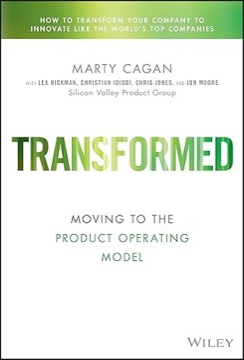
Transformed
Moving to the Product Operating Model
Marty Cagan's book about the harder problem behind his earlier work — not how a good product company operates, but how an existing company that does not operate that way changes into one that does.
- First published
- 2024
- Publisher
- Wiley
- Pages
- not established
- Shelf
- Leadership
- Level
- Core
- ISBN-13
- 9781119697336
Record checked against
Only one source carried a publication date for this work, so the year is uncorroborated. No page count is recorded, so no reading estimate is shown for the book itself.
Catalogue note
- Reads as
- StrategicAbout choosing between options under uncertainty.
- Level
- Core / BuildingAssumes general familiarity with the subject.
- Approach
- Applied
- Written for
- Managers, Readers with some grounding
Saved in this browser only — no account, nothing sent anywhere. My library
Read this if
- You are building something new and want to know why most new things fail.
- You have to choose what not to do, and want a way to think about it.
- You are responsible for other people's work as well as your own.
- You are weighing options and want a way to think about the trade-offs.
- You know roughly how the subject works and want the fuller account.
The problem it addresses
Cagan's earlier books describe how strong product organisations work. The obvious question that follows is what a company should do if it is not one, and this book is the attempt at that answer.
His framing is that the gap is not knowledge but operating model — the combination of how a company builds, how it solves problems, and how it decides what to work on — and that changing it is organisational rather than procedural.
Everyone can read how good product companies work. The hard question is what to do if you are not one.
Devmark’s reading — not a quotation from the book
The feature team problem
His central diagnosis: most companies have feature teams, which are given solutions to build and are measured on delivery, rather than product teams, which are given problems to solve and are measured on outcomes.
His claim is that this single structural difference accounts for most of the gap in results, and that no amount of process improvement inside a feature team model produces the behaviour of a product team.
The three competencies
His model of what has to change: how you build, how you solve problems, and how you decide which problems to solve.
The ordering matters. Companies typically attempt the first — agile practices, delivery improvement — and stop there, which produces faster delivery of the same poorly chosen work. The second and third are where the outcome difference sits.
Empowered product teams
His definition, which is demanding: a durable team of a product manager, a designer and engineers, given a problem to solve and the authority to decide how, held accountable for a measurable outcome.
Each clause is load-bearing. A team missing the designer, or given a solution rather than a problem, or reassigned every quarter, is not this, however it is labelled.
Product strategy
His treatment of the third competency, and the one he considers most commonly missing: deciding which few problems matter most, which requires focus, insight, and a willingness to say no to things that are individually reasonable.
His criticism of the roadmap as usually practised — a list of features with dates, produced by collecting requests — is that it removes the need to choose, which is exactly what strategy is for.
A roadmap assembled from requests removes the need to choose, which is the only thing strategy does.
Devmark’s reading — not a quotation from the book
The transformation itself
His practical guidance on changing an existing company: start with a small number of teams rather than announcing a reorganisation, demonstrate results, and expand from evidence.
His insistence that this requires sustained executive sponsorship, and that transformations without it reliably revert, is the least comfortable and most accurate part of the book.
The role of leadership
His argument that the constraint is usually leadership behaviour rather than team capability: executives who assign solutions, demand delivery dates for unvalidated work, and treat product teams as implementation capacity will produce feature teams regardless of what the teams are called.
This is the book's most direct challenge and the reason it is uncomfortable reading for its likely audience.
Where it is limited
The evidence is Cagan's consulting practice and the case studies are supplied by companies willing to be featured, with the usual selection problem and no failures examined in detail.
The model also assumes a product-led software business. Companies where the product is not software, or where regulation or enterprise contracts constrain what teams can decide, will find the prescriptions harder to apply than the book suggests.
How it relates to the others
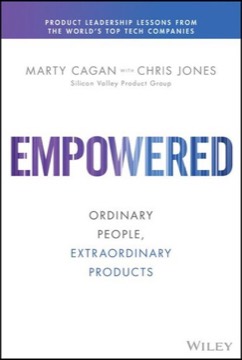
*Inspired* describes the practices, *Empowered* describes what leaders must do, and this describes how to get from a company that does neither to one that does both.
There is substantial repetition across the three, and a reader starting now could read this one and go back to the others selectively rather than working through all three.
What to take from it
The feature-team versus product-team distinction, applied honestly to your own organisation: are teams given problems or solutions, and what are they actually measured on?
And the ordering of the three competencies, which explains why so many agile transformations produce faster delivery of work that should not have been built.
What to take away
- 01Problems, not solutionsA team handed a solution and measured on delivery is a feature team whatever it is called.
- 02Fix the order of the three competenciesImproving delivery first produces faster shipping of poorly chosen work, which is where most transformations stop.
- 03Every clause of the definition is load-bearingDurable team, designer included, problem not solution, accountable for outcome. Drop one and it is not the thing.
- 04A request-driven roadmap is not strategyIt removes the need to choose, which is the only function strategy performs.
- 05Leadership behaviour is usually the constraintExecutives who assign solutions will produce feature teams regardless of team structure.