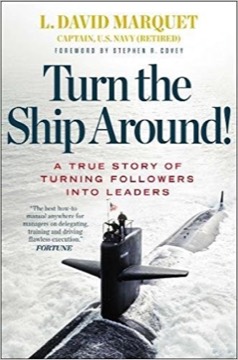
Turn the Ship Around!
David Marquet's account of taking command of a poorly performing US Navy submarine and replacing the conventional leader-follower model with one in which authority was pushed to the people with the information.
- First published
- 2001
- Publisher
- Penguin Publishing Group
- Pages
- 236
- Shelf
- Leadership
- Level
- Entry
- ISBN-13
- 9780241250952
Record checked against
Only one source carried a publication date for this work, so the year is uncorroborated.
Catalogue note
- Reads as
- PracticalWritten to be applied, not only understood.
- Level
- Accessible / FoundationalNo prior reading assumed.
- Approach
- Practical
- Written for
- Managers, Newcomers to the subject
Saved in this browser only — no account, nothing sent anywhere. My library
Read this if
- You want to understand what makes people willing to follow a decision.
- You read for the writing as much as for the argument.
- You want something to apply, not only something to think about.
- You are starting from scratch here and want a way in that assumes no prior reading.
The originating problem
Marquet was assigned to a submarine he had not trained for, arriving with no detailed knowledge of its systems — which removed his ability to run the ship by giving informed orders.
His account of realising this, after issuing an order that was impossible on that class of vessel and watching the crew begin to execute it anyway, is the book's founding incident and the clearest statement of the problem.
He gave an impossible order and the crew started to carry it out. That is the failure mode, in one scene.
Devmark’s reading — not a quotation from the book
Leader-leader instead of leader-follower
His alternative model: rather than one person thinking and everyone else executing, authority is distributed to the level where the information actually is.
His claim is that the conventional model wastes the intelligence of everyone below the top, and becomes actively dangerous when the person at the top lacks the specific knowledge — which, on a technical vessel, is frequently.
I intend to
His signature mechanism, and the most transferable thing in the book. Instead of asking permission, subordinates state their intention: "I intend to submerge the ship."
The change is small and the effects are structural. The person stating the intention must have thought it through, must own it, and the superior's role becomes assent rather than instruction. Passive requests become active commitments.
Control requires competence and clarity
His crucial qualification, which distinguishes this from generic empowerment writing. Pushing authority downward only works if two other things are raised alongside it.
Competence: people must actually know how to make the decision. Clarity: they must understand the organisation's purpose well enough to decide in line with it. Delegating without either produces worse outcomes, not better ones.
Deliberate action
His mechanism for reducing error: before any operational act, the person pauses, vocalises and gestures at what they are about to do.
The purpose is to create a moment in which an automatic action becomes deliberate, and in which anyone nearby can intervene. It is simple, cheap, and addresses the specific class of errors that come from competent people operating on autopilot.
A deliberate pause before an automatic action creates the only moment in which someone else can stop it.
Devmark’s reading — not a quotation from the book
Thinking out loud
His practice of requiring people to narrate their reasoning aloud, including uncertainty.
His argument is informational: in a hierarchy, the reasoning behind a decision is usually invisible, so nobody can correct a flawed premise. Made audible, the premise becomes checkable by anyone who knows better — regardless of rank.
Where the context matters
This is a nuclear submarine: a technically demanding environment with highly trained personnel, formal procedures, clear objectives and unambiguous feedback about performance.
The mechanisms transfer best to environments with those properties, and transfer poorly to ones where competence is uneven, purpose is contested, or the consequences of a decision are slow and ambiguous.
Where it is limited as evidence
It is a single case told by the person who led it, with performance attributed to the intervention and no controlled comparison.
Submarine command is also unusual in that the leader has genuine authority to redesign how the unit operates — a latitude most managers do not have, and one the book does not much acknowledge.
The form
It is short, narrative and structured around specific incidents, with mechanisms extracted as they arise and questions for the reader at chapter ends.
That makes it considerably more readable than most management writing and somewhat less rigorous. It is closer to a well-told case study than to an argument.
What to take from it
"I intend to" is the single highest-return practice in this shelf: it costs nothing, changes who is doing the thinking, and can be introduced by one person without any organisational permission.
And the competence-and-clarity qualification, which is what separates genuine delegation from the abdication that gets called empowerment.
What to take away
- 01Push authority to the informationThe conventional model wastes everyone below the top and becomes dangerous when the top lacks specifics.
- 02Replace requests with intentions'I intend to' forces the thinking downward and converts permission-seeking into ownership.
- 03Delegation needs competence and clarityWithout both, distributing authority produces worse decisions rather than better ones.
- 04Make automatic actions deliberateA vocalised pause is the only moment in which a competent person on autopilot can be stopped.
- 05Narrate the reasoningA premise nobody can hear is a premise nobody can correct, whatever their rank.