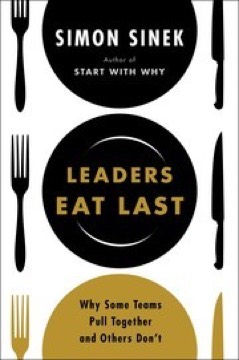
Leaders Eat Last
Simon Sinek's argument that organisational performance depends on whether people feel safe within their own group — framed through a biological account of trust and a military metaphor about who eats first.
- First published
- 2014
- Publisher
- Brilliance Audio
- Pages
- 368
- Shelf
- Leadership
- Level
- Entry
- ISBN-13
- 9781480542570
Record checked against
Catalogue note
- Reads as
- PracticalWritten to be applied, not only understood.
- Level
- Accessible / FoundationalNo prior reading assumed.
- Approach
- Practical
- Written for
- Managers, Newcomers to the subject
- Ideas
Saved in this browser only — no account, nothing sent anywhere. My library
Read this if
- You want to understand what makes people willing to follow a decision.
- You want something to apply, not only something to think about.
- You are starting from scratch here and want a way in that assumes no prior reading.
The Circle of Safety
Sinek's organising concept: a group in which members do not have to defend themselves from each other can direct their energy outward at external threats and opportunities.
His argument is that most organisational dysfunction comes from people protecting themselves internally — from managers, from colleagues, from process — which consumes the capacity that should be aimed at the work.
Energy spent defending yourself from colleagues is energy not aimed at anything outside the building.
Devmark’s reading — not a quotation from the book
The title's origin
The image comes from a practice in some military units in which the most junior eat before the most senior — presented as a demonstration that authority carries obligation rather than privilege.
Sinek uses it as a test: whether a leader's position is understood by everyone as a set of responsibilities or as a set of entitlements, and whether the answer is visible in small routine behaviours.
The four chemicals
His biological framework: endorphins and dopamine as the selfish chemicals that drive achievement and persistence, and serotonin and oxytocin as the selfless ones that drive status recognition and trust.
This is the book's weakest element. It is a considerable oversimplification of neurochemistry, the mappings are much cleaner than the science supports, and the argument does not depend on it — the organisational observations stand without the biology.
Cortisol and organisational anxiety
His more defensible physiological claim: chronic workplace stress produces sustained cortisol, that sustained cortisol has documented costs, and that much of the stress in organisations is generated internally rather than by the market.
The observation that layoffs, opaque decisions and arbitrary authority produce a physiological state incompatible with good work is sound, whatever one makes of the chemical framing.
Against the numbers-first culture
A substantial section arguing that the shift toward managing by abstract metrics distanced decision-makers from the people affected by their decisions.
His point about scale is genuinely useful: at a certain organisational size, the people whose lives are affected become numbers, and the moral calculation changes without anyone deciding that it should.
Past a certain size the affected people become numbers, and the moral calculation changes with nobody deciding it.
Devmark’s reading — not a quotation from the book
Layoffs as the test case
His most pointed material contrasts organisations that protect employment through downturns with those that reduce headcount to protect quarterly results.
His argument is about the subsequent decade rather than the immediate quarter — that the second approach purchases a short-term number with a long-term loss of the willingness to extend effort.
Where the evidence is weak
The book is built on selected organisational stories with no comparison cases, and the causal claims are asserted throughout.
The neuroscience is, as noted, considerably overstated. Readers who know the underlying literature find this section hard to take, and it undermines confidence in the rest even where the rest is reasonable.
Where it is genuinely useful
The Circle of Safety concept gives teams a vocabulary for something real and otherwise hard to name: the difference between an environment where admitting a problem is safe and one where it is not.
That distinction connects to a much better-evidenced literature — psychological safety, as studied by Amy Edmondson — and a reader interested in the substance should go there.
The Sinek register
Repetitive, warmly delivered, and structured around anecdote rather than argument. He is a very effective speaker and the book reads throughout like an extended version of a talk, with the same points returned to in slightly different clothing.
Readers wanting rigour or evidence will be frustrated by it. Readers wanting a shared vocabulary for a leadership conversation with colleagues will find it does that particular job well enough to justify the time.
What to take from it
The safety framing, applied as a diagnostic: does raising a problem here cost the person raising it anything? The answer is usually knowable and usually unflattering.
And the scale observation about decisions made at a distance from their consequences, which is the most transferable idea in the book.
What to take away
- 01Internal defence consumes external capacityEnergy spent protecting yourself from colleagues is not available for anything outside the organisation.
- 02Authority as obligationThe test is whether a leader's position is understood as responsibility or entitlement, visible in small routines.
- 03Distance changes the calculationPast a certain scale, affected people become numbers and the moral arithmetic shifts with nobody choosing it.
- 04Ignore the neurochemistryIt is substantially overstated and the organisational argument does not depend on it.
- 05Go to Edmondson for the evidencePsychological safety is the well-researched version of what this book describes anecdotally.