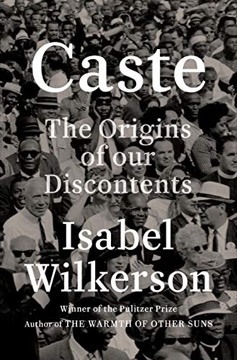
Caste
Isabel Wilkerson's argument that American racial hierarchy is better understood as a caste system, compared directly with India's and with Nazi Germany's.
- First published
- 2020
- Publisher
- Ediciones Paidós
- Pages
- 496
- Shelf
- History
- Level
- Core
- ISBN-13
- 9780593427965
Record checked against
Catalogue note
- Reads as
- ReflectiveChanges how you see rather than what you do.
- Level
- Core / BuildingAssumes general familiarity with the subject.
- Approach
- Theoretical
- Written for
- Readers of history, Readers with some grounding
Saved in this browser only — no account, nothing sent anywhere. My library
Read this if
- You want to know how we got here.
- You want to think harder about what is actually right.
- You want a book that changes how you see things rather than what you do tomorrow.
- You know roughly how the subject works and want the fuller account.
The argument
Wilkerson's move is terminological and consequential. Race, she argues, is the visible signal; caste is the underlying structure that assigns rank at birth and enforces it through a set of mechanisms that outlast any particular prejudice.
She identifies eight pillars common to caste systems: divine or natural justification, heritability, endogamy, purity and pollution, occupational hierarchy, dehumanisation, terror as enforcement, and inherent superiority.
Race is what you see; caste is the structure doing the work underneath it.
Devmark’s reading — not a quotation from the book
The comparison
The three-way comparison with India and the Third Reich is the book's most discussed feature. Wilkerson documents Nazi jurists studying American segregation law while drafting the Nuremberg statutes, which is a matter of record rather than rhetoric.
Her Indian material comes from travel and from Dalit scholarship, particularly Ambedkar, whose correspondence with W. E. B. Du Bois she uses to show the comparison is not hers originally.
Reception
The book was widely praised and seriously criticised. Historians and sociologists have argued that caste and race differ in ways the framework flattens, and that the analogy imports as much confusion as clarity.
Wilkerson writes as a journalist, and the book is structured around narrative and metaphor — the house with a bad foundation — rather than around systematic evidence. It is best read as an argument to test, and the objections are substantive.
The three-way analogy is the book's power and its main scholarly objection, simultaneously.
Devmark’s reading — not a quotation from the book
The eight pillars
Wilkerson defines caste operationally rather than by analogy, listing the structural features she says all three of her cases share: a divine or natural justification, heritability, control of marriage and reproduction, a purity taboo, an occupational hierarchy, dehumanisation, terror as enforcement, and an assumption of inherent superiority. The list is what turns a metaphor into a framework that can be checked.
What the Nazis studied
Among the most disturbing material is the documented interest of German jurists in American segregation law while drafting racial legislation in the 1930s, including debate over whether the American approach to defining racial membership was too harsh to adopt. Wilkerson uses it to unsettle the assumption that the influence ran the other way.
They read the American statutes as a working model, and in one respect found them too severe.
Devmark’s reading — not a quotation from the book
Ambedkar
The Indian half of the comparison runs through the Dalit jurist who led the drafting of India's constitution, and through the mutual recognition between Dalit activists and Black Americans — including the exchange in which an American civil rights leader, introduced to Dalit students, understood himself to be described as an untouchable. The affinity was noticed by the people inside both systems long before it was theorised.
Anecdote as method
Wilkerson works through scenes rather than statistics: a plumber who refuses to see the problem until her house's history is mentioned, an encounter on a plane, an incident at a conference. The choice is deliberate — she is arguing that caste is enacted in ordinary interactions — and it is also the method most vulnerable to the objection that a scene is not evidence of a system.
What it costs the body
A later section argues that occupying a subordinated position produces measurable physiological harm through chronic stress, and connects this to documented health disparities. The general relationship between chronic stress and health is well established; the specific causal weight Wilkerson places on it is stronger than the cited literature supports.
The scholarly objection
Historians and sociologists of both societies have pushed back seriously: that caste in South Asia has a religious, endogamous and occupational specificity that does not map cleanly, that American race was constructed through chattel slavery and its afterlife rather than through ritual purity, and that substituting one term for the other loses analytic precision while gaining rhetorical force. The book does not engage this in depth.
What to take from it
Its contribution is the reframe from attitude to architecture: asking not who is prejudiced but what the structure requires, who maintains it, and what happens to people who step outside their assigned position. Hold the comparison as an illuminating lens rather than an established equivalence, and read one of the critical responses alongside it.
What to take away
- 01Caste under raceThe visible marker distinguished from the structure that assigns rank.
- 02Eight pillarsHeritability, endogamy, purity, occupation, dehumanisation, terror and more.
- 03Nazi jurists and Jim CrowDocumented study of American segregation law while drafting Nuremberg.
- 04Ambedkar and Du BoisThe comparison predates Wilkerson and she shows its lineage.
- 05Contested frameworkHistorians object that the analogy flattens real differences.