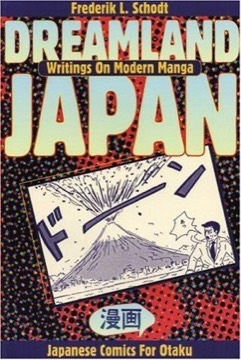
Dreamland Japan
Frederik L. Schodt's 1996 sequel to Manga! Manga!, surveying the industry in the 1990s with substantial attention to individual artists and magazines.
- First published
- 1996
- Publisher
- Stone Bridge Press
- Pages
- 360
- Shelf
- Anime
- Level
- Core
- ISBN-13
- 9781880656235
Record checked against
Catalogue note
- Reads as
- ReflectiveChanges how you see rather than what you do.
- Level
- Core / BuildingAssumes general familiarity with the subject.
- Approach
- Theoretical
- Written for
- Readers of comics, and anyone curious how the form works, Readers with some grounding
- Ideas
Saved in this browser only — no account, nothing sent anywhere. My library
Read this if
- You want to know how we got here.
- You want a book that changes how you see things rather than what you do tomorrow.
- You know roughly how the subject works and want the fuller account.
What it is
A survey of manga as it stood in the mid-1990s, covering the major magazines, a set of artist profiles, the industry's economics, and the beginnings of international distribution.
It is organised more loosely than its predecessor, functioning as a set of connected essays rather than a systematic history.
Thirteen years after the first book, a second look at an industry that had transformed.
Devmark’s reading — not a quotation from the book
The magazines
The account of the weekly and monthly magazines — their circulations, editorial cultures, reader survey systems and relationships to their audiences — is the book's most useful material.
Circulation figures of several million per week were genuinely startling to English readers and remain the clearest illustration of the medium's scale in Japan.
Artist profiles
Substantial chapters cover Tezuka, Ishinomori, Shirow, and several alternative figures, combining biography with critical assessment.
The profiles are the book's most readable sections and function well independently, and the selection extends well beyond the commercially dominant. The chapter on Yoshihiro Tatsumi in particular introduced a figure who would not be properly translated into English for another decade.
Alternative manga
Schodt gives considerable attention to Garo and to the avant-garde tradition, which had almost no English presence at the time.
This material introduced several artists who were subsequently translated, and the book's advocacy had measurable effects on what became available. Garo itself was in financial difficulty by the time Schodt wrote, and the chapter functions partly as a record of a magazine that shortly afterwards effectively ended.
Industry economics
The book explains the tankōbon model, the magazine-to-volume pipeline, and the way serialisation risk is managed, in terms that remain broadly accurate.
The structural account has aged better than the specific figures, and it is still a reasonable introduction to how the business works. He also explains why a serialised chapter makes almost no money and the collected volume makes all of it, which is the single most important fact about the business.
International reception
Written as manga was beginning to reach English-language markets seriously, the book discusses translation, flipping, censorship and the early publishers.
The account is a primary source on a transition that Schodt was personally involved in, and its position at that moment is part of its value.
Controversy and censorship
Chapters cover obscenity law, the debate following a notorious criminal case, and the pressure on publishers in the early 1990s.
Schodt handles the material carefully and is neither dismissive of the concerns nor supportive of the responses, which is a difficult position to hold well.
Tone
Warm, curious and frank, with Schodt's own opinions clearly marked as opinions.
He is willing to say that a great deal of manga is poor, which is unusual in advocacy writing and makes the enthusiasm credible. He is also honest about his own position as an outsider with three decades of involvement, and about what that does and does not qualify him to say.
What has dated
It predates digital distribution, the collapse of several magazines, the rise of webtoons and the current international market.
The specific industry picture is now historical. The structural explanations and the artist profiles remain useful. Several of the magazines he describes as dominant have since closed or shrunk dramatically, which makes the book a useful snapshot of a peak that was not recognised as one.
Compared to its predecessor
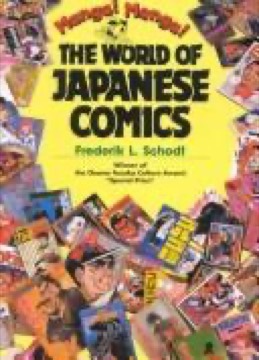
Manga! Manga! is the more important book historically; this is the more useful one for understanding the industry, since it has more detail and less introductory obligation.
Readers reading only one should choose based on whether they want the founding document or the better survey.
The title
It refers to Schodt's argument that manga functions as a collective dream space for Japanese society, a claim he makes lightly rather than systematically.
The framing is looser than the material and is the least persuasive thing in the book, though it does no harm.
Who it is for
Readers who want the industry explained by someone with three decades inside it, and readers interested in the 1990s as a period.
It is out of date as a survey and remains among the best English-language writing on how manga publishing actually functions. Readers who want only one Schodt book should probably take this one, since it contains more usable information even though the earlier book matters more.
What to take away
- 01Magazines as the unitCirculations in the millions, editorial cultures and reader surveys are the clearest illustration of the medium's scale in Japan.
- 02Advocacy with consequencesSchodt's attention to Garo and the avant-garde introduced artists who were subsequently translated.
- 03The business explained structurallyThe magazine-to-volume pipeline and how serialisation risk is managed remain broadly accurate decades later.
- 04A primary source on a transitionWritten as manga reached English markets, by someone personally involved in making that happen.
- 05Willing to say work is poorThe frankness about quality is unusual in advocacy writing and is what makes the enthusiasm credible.
- 06A loose central metaphorThe dream-space framing is lighter than the material and is the least persuasive element, though harmless.