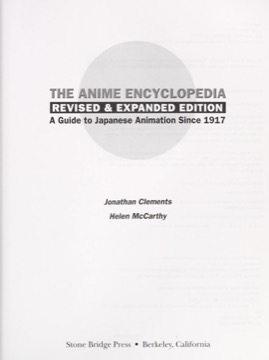
The Anime Encyclopedia
Jonathan Clements and Helen McCarthy's reference work, first published in 2001 and revised since, cataloguing Japanese animation with production credits and critical commentary.
- First published
- 2001
- Publisher
- Stone Bridge Press
- Pages
- 867
- Shelf
- Anime
- Level
- Core
- ISBN-13
- 9781880656648
Record checked against
Catalogue note
- Reads as
- ReferenceBuilt to be consulted rather than read straight through.
- Level
- Core / BuildingAssumes general familiarity with the subject.
- Approach
- Practical
- Written for
- Readers of comics, and anyone curious how the form works, Readers with some grounding
- Ideas
Saved in this browser only — no account, nothing sent anywhere. My library
Read this if
- You want to know how we got here.
- You want something to keep nearby and return to, rather than read once.
- You know roughly how the subject works and want the fuller account.
What it is
An alphabetical reference covering thousands of anime titles — series, films, original video releases and shorts — with credits, running times, production companies, release dates and a critical note on each.
The later editions run past a thousand pages and represent the most comprehensive English-language catalogue of the medium available.
A thousand pages of credits, dates and short verdicts, covering most of what has been made.
Devmark’s reading — not a quotation from the book
The entries
Each entry gives the production data and then a paragraph or several of commentary, which is frequently opinionated and occasionally very funny.
The commentary is what distinguishes it from a database. Clements and McCarthy have plainly watched the material, and their verdicts are specific rather than descriptive.
Coverage
The inclusion criteria are broad, taking in obscure direct-to-video work, children's programming and pornographic titles alongside the canonical films.
The comprehensiveness is the point. A reference that covered only what is respectable would misrepresent an industry whose economics depend on volume. The later editions also add short-form and streaming-era material, though the sheer volume of recent production makes complete coverage increasingly unrealistic.
Cross-references
Entries connect to one another through staff, studios and source material, so it is possible to follow a director or a writer across decades of work.
This is the feature that makes it usable for research rather than only for lookup, and it supports exactly the kind of production-history work Clements argues for elsewhere.
Thematic essays
Interspersed among the entries are longer pieces on subjects such as censorship, early history, the pornographic industry and specific genres.
These are among the best short introductions available on their topics, and several are substantial enough to be read independently of the reference material. The censorship essay in particular explains the legal framework that shapes what can be shown, which almost nothing else in English does at this length.
Accuracy and revision
The work has been revised across multiple editions with corrections and substantial additions, and the authors are candid about earlier errors.
Readers should ensure they have the most recent edition available, since the coverage difference between editions is considerable. The third edition in particular expanded coverage substantially and revised a large number of entries, and it is the one worth owning.
Tone
The commentary is frequently dismissive of bad work and does not pretend otherwise, which some readers find refreshing and others find uncharitable.
The willingness to say a title is poor is unusual in reference writing and is part of why the book has a readership beyond people looking things up.
Limitations
It is a print reference in a field where online databases are continuously updated, and its currency is necessarily limited by publication date.
Its value is therefore in the commentary, the essays and the production credits rather than in comprehensiveness about recent releases. The production credits are also more reliable than the release information for recent titles, which is where a print reference is least able to compete.
How to use it
It is not a book to read through, and attempting to is a mistake. It rewards browsing, following cross-references, and consulting after watching something.
Several readers describe using it as a discovery mechanism, working outward from a known title through shared staff. The index and the studio listings support that approach directly, and the book is designed to be entered at any point rather than read from the beginning.
Its position
It has been the standard English-language reference for the medium since publication and is cited in academic work as well as used by general readers.
Nothing else in English approaches its scope, and the gap has not narrowed substantially despite the growth of online resources.
McCarthy's contribution
Helen McCarthy was among the earliest British writers on anime and has written separately on Miyazaki and on the industry's history.
Her presence gives the book a longer institutional memory than a purely recent survey would have, and several entries draw on first-hand experience. She attended screenings and conventions in Britain from the earliest period of organised fandom there, and several entries reflect that direct observation.
Who it is for
Readers who want a reference, and readers who enjoy opinionated criticism delivered in very small units.
It is an expensive object and a genuinely useful one. Readers who watch casually will not need it; readers who watch seriously will use it continuously. It also functions well as a browsing object for someone who simply wants to discover unfamiliar work, which is not what a reference is usually good for.
What to take away
- 01Commentary, not a databaseEach entry carries an opinionated verdict, which is what distinguishes it from an online listing.
- 02Deliberately unselectiveObscure video releases and pornographic titles are included, because covering only the respectable would misrepresent the industry.
- 03Cross-references enabling researchFollowing staff and studios across decades makes it usable for production history rather than only for lookup.
- 04Essays worth reading aloneLonger pieces on censorship, genre and early history are among the best short introductions available.
- 05Willing to call work badThe dismissiveness is unusual in reference writing and is part of why it has readers beyond lookups.
- 06Browsed, never read throughIt rewards following cross-references outward from something known, and reading it linearly is a mistake.