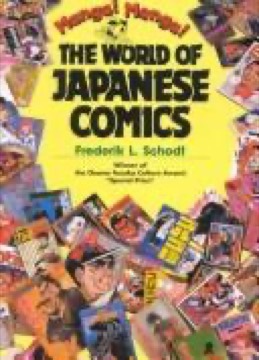
Manga! Manga! The World of Japanese Comics
Frederik L. Schodt's 1983 book, the first substantial English-language account of manga, which introduced the medium to readers who had never encountered it.
- First published
- 1983
- Publisher
- Distributed in the U.S. by Kodansha International/USA through Harper & Row
- Pages
- 260
- Shelf
- Anime
- Level
- Core
- ISBN-13
- 9780870115493
Record checked against
Catalogue note
- Reads as
- ReflectiveChanges how you see rather than what you do.
- Level
- Core / BuildingAssumes general familiarity with the subject.
- Approach
- Theoretical
- Written for
- Readers of comics, and anyone curious how the form works, Readers with some grounding
Saved in this browser only — no account, nothing sent anywhere. My library
Read this if
- You want to know how we got here.
- You care why some things are obvious to use and others are not.
- You want a book that changes how you see things rather than what you do tomorrow.
- You know roughly how the subject works and want the fuller account.
What it is
A survey of manga covering its history, its major genres, its industrial structure and its social role, written for an English-language readership that had essentially no exposure to the medium.
It includes extended sample chapters from four manga in translation, which at the time was almost the only such material available.
The book that explained manga to English readers before any of it had been translated.
Devmark’s reading — not a quotation from the book
Its position
When it appeared, virtually no manga had been published in English and the medium was unknown outside a small circle.
The book is therefore a founding document, and a substantial proportion of the English-speaking manga readership can trace its existence to this book or to people who read it.
Tezuka's foreword
Osamu Tezuka contributed an introduction, and Schodt had worked as his translator and interpreter.
The access is evident throughout. Schodt was inside the industry rather than observing it from outside, and the book carries first-hand material that later surveys cannot. Schodt had also translated Phoenix for an edition that was prepared but not published at the time, and his working relationship with Tezuka lasted until the artist's death.
Historical account
The historical chapters cover scroll painting, Edo woodblock work, the influence of Western cartooning, the wartime period and the post-war explosion.
The long-view framing — that manga has antecedents in Japanese visual tradition — has been contested by later scholars but remains the standard popular account.
Genre survey
Schodt covers boys' comics, girls' comics, adult work, gekiga and economic manga, explaining the market segmentation that English readers found surprising.
The account of manga for adult professional audiences was particularly startling for a readership accustomed to comics as children's material. He also covers manga produced for specific professions and for corporate training, which remains the detail English readers find hardest to believe about the medium.
The sample chapters
Translated excerpts from Phoenix, Ghost Warrior, The Rose of Versailles and Barefoot Gen were included, presented right-to-left in some cases.
For many readers these were the first manga pages they had seen, and the selection is notably ambitious rather than commercial. The inclusion of Barefoot Gen in particular signalled that the book was not treating manga as light entertainment, and that selection did a great deal to set expectations.
Social function
Schodt is interested in why manga occupies the cultural position it does: readership demographics, circulation figures, commuting habits and the absence of the disposability stigma Western comics carried.
The sociological material is what makes the book more than an introduction. He is also attentive to the physical economics of the magazines: cheap paper, enormous print runs, and an object designed to be read once and discarded.
What has dated
Written in 1983, it predates the digital era, the international market, and most of what readers now think of as manga.
Its statistics are historical and several of its predictions were wrong. Readers should treat it as a document of its moment rather than as a current survey.
Schodt's later work
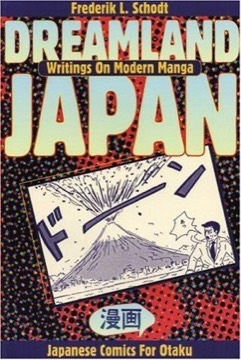
Dreamland Japan updates the account for the 1990s, and The Astro Boy Essays is his study of Tezuka.
The three together form a substantial body of work by the person most responsible for manga's English-language reception. He has also translated a substantial amount of manga professionally, including Astro Boy and Ghost in the Shell, and the translation work informs the criticism throughout.
Tone
The writing is enthusiastic, clear and free of both academic apparatus and fan defensiveness.
Schodt writes as someone explaining something he finds genuinely interesting to people who have not heard of it, and the register has aged well. There is also no attempt to claim the medium is uniformly excellent, and Schodt is straightforward that most of what is published is disposable by design.
Its influence
It has been credited by numerous translators, publishers and creators as their introduction to the medium, and its role in establishing the English market is difficult to overstate.
It won an Eisner award decades after publication in recognition of that role. Several of the people who built the English-language manga publishing industry have described reading it as students, which is about as direct a line of influence as a book can have.
Who it is for
Readers interested in how manga arrived in English, and readers who want the medium's history from someone who was present for a great deal of it.
It is no longer a useful current survey and remains a genuinely important book. Readers wanting an introduction to contemporary manga should look elsewhere.
What to take away
- 01A founding documentPublished when virtually no manga existed in English, it introduced the medium to the readership that became its market.
- 02Written from insideSchodt worked as Tezuka's translator, and the first-hand access is evident throughout.
- 03Market segmentation as the surpriseComics for adult professionals startled a readership that assumed the form was for children.
- 04Sample chapters as first exposureTranslated excerpts from four manga were, for many readers, the first pages of the medium they had seen.
- 05Sociology beyond introductionCirculation figures, commuting habits and the absence of stigma explain manga's cultural position rather than merely describing it.
- 06A document of 1983It predates the digital era and the international market, and its value is now historical rather than current.