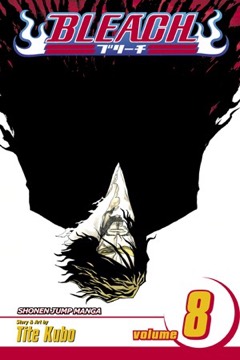
Bleach
Tite Kubo's series, begun in 2001, about a teenager who acquires the powers of a death god and is drawn into the bureaucracy of the afterlife.
- First published
- 2001
- Publisher
- BleachCenter1
- Pages
- 189
- Shelf
- Anime
- Level
- Entry
- ISBN-13
- 9781591169246
Record checked against
Catalogue note
- Reads as
- ReflectiveChanges how you see rather than what you do.
- Level
- Accessible / FoundationalNo prior reading assumed.
- Approach
- Theoretical
- Written for
- Readers of comics, and anyone curious how the form works, Newcomers to the subject
Saved in this browser only — no account, nothing sent anywhere. My library
Read this if
- You read for the writing as much as for the argument.
- You care why some things are obvious to use and others are not.
- You want a book that changes how you see things rather than what you do tomorrow.
- You are starting from scratch here and want a way in that assumes no prior reading.
What it is
Ichigo Kurosaki can see ghosts. When a soul reaper is injured protecting his family, she transfers her powers to him, and he inherits the job of guiding the dead and destroying the corrupted spirits that prey on them.
The series expands into the politics of the afterlife's governing organisation and a long sequence of wars between factions of the dead.
He inherits a job in the afterlife's civil service and discovers it has an army.
Devmark’s reading — not a quotation from the book
Design as the primary appeal
Kubo's visual sense is the series' defining quality: distinctive silhouettes, elaborate weapon designs, a strong sense of fashion, and page compositions that frequently prioritise a striking image over narrative economy.
Few manga are as consistently concerned with looking good, and the series is frequently praised and criticised for exactly the same reason.
Panel composition
Kubo uses white space unusually aggressively, with large empty areas, isolated figures and pages carrying a single line of dialogue.
The technique makes the series very fast to read and gives individual moments enormous weight. It also means the volumes contain considerably less material than their page count suggests.
The Soul Society arc
The extended rescue mission into the afterlife's capital is generally considered the series' peak: a large cast introduced efficiently, a political conspiracy, and a sequence of duels each given its own character.
It is the arc most often recommended to readers deciding whether to continue, and the series never quite reaches the same level again.
Power systems
Each soul reaper's weapon has two escalating released forms with individual names and abilities, which supplies both variety and a reliable structure for escalation.
The system is a good engine for fights and a poor one for tension, since a character in difficulty can nearly always reveal a further stage.
The cast problem
The series introduces a very large number of characters with distinctive designs and then struggles to give many of them anything to do.
Several fan-favourite figures effectively disappear for dozens of volumes, and the later arcs repeatedly restate the same roster without developing it. The result is a series that feels populated rather than plotted, with dozens of designs waiting for roles that never arrive.
Ichigo
He is capable, reluctant and fundamentally decent, and his motivation is consistently protective rather than ambitious.
He is less distinctive than the cast around him, which is partly deliberate — he functions as a stable point in a series whose appeal is the invention happening at its edges.
Death and its administration
The underlying conceit is bureaucratic: the afterlife is a governed jurisdiction with ranks, districts, a legal code, prisons and a research division.
The idea is stronger than the series' use of it. The administrative texture is consistently interesting and consistently subordinated to the fighting. A version of this series more interested in its own premise than in its duels would be a considerably stranger and better book.
The final arc
The concluding war was serialised under evident pressure and resolves several long-running threads abruptly, with a number of characters given very little.
Kubo has spoken about the constraints involved, and a later anime adaptation has expanded the material considerably, which most readers consider an improvement.
Prose and chapter poems
Each volume opens with a short free-verse poem attributed to a character, and Kubo's chapter titles are unusually literary for the genre.
These small gestures are characteristic. The series consistently reaches for a mood beyond its plot, and readers who respond to it are usually responding to that reach rather than to the story.
Its standing
For much of the 2000s it was grouped with Naruto and One Piece as the magazine's three central properties, and its visual influence on subsequent action manga is substantial.
Its critical reputation is the weakest of the three, chiefly on plotting, and its defenders make their case almost entirely on style.
Who it is for
Readers who want striking design and fast, dramatic action and can tolerate a plot that loses its way for long stretches.
Readers who need narrative discipline should be warned. The best argument for the series is the Soul Society arc, and a reader unconvinced by it is unlikely to be won over by the seventy volumes that follow.
What to take away
- 01Style as the governing valueSilhouettes, weapon design and page composition are prioritised over narrative economy, which is both the appeal and the complaint.
- 02White space as weightLarge empty areas and single-line pages make the series fast to read and give individual moments enormous emphasis.
- 03An escalation system without tensionTwo released weapon forms per character supply variety, but a character in trouble can nearly always reveal another stage.
- 04A bureaucratic afterlifeRanks, districts, prisons and a research division make a genuinely good conceit that the series keeps subordinating to fights.
- 05More designs than rolesA very large cast is introduced distinctively and then left with nothing to do for dozens of volumes.
- 06Reaching past its plotChapter poems and literary titles signal a mood the story does not deliver, and its defenders respond to that reach.