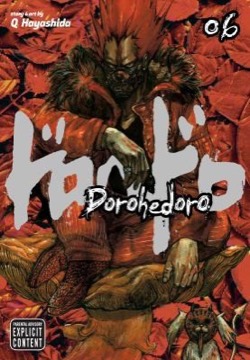
Dorohedoro
Q Hayashida's series, begun in 2000, set between a ruined city and a world of sorcerers, following a man with a reptile head who cannot remember his own face.
- First published
- 2000
- Publisher
- Viz Media
- Pages
- not established
- Shelf
- Anime
- Level
- Core
- ISBN-13
- 9781421533803
Record checked against
No page count is recorded, so no reading estimate is shown for the book itself.
Catalogue note
- Reads as
- ReflectiveChanges how you see rather than what you do.
- Level
- Core / BuildingAssumes general familiarity with the subject.
- Approach
- Theoretical
- Written for
- Readers of comics, and anyone curious how the form works, Readers with some grounding
Saved in this browser only — no account, nothing sent anywhere. My library
Read this if
- You read for the writing as much as for the argument.
- You care why some things are obvious to use and others are not.
- You want a book that changes how you see things rather than what you do tomorrow.
- You know roughly how the subject works and want the fuller account.
What it is
Caiman has a lizard's head, no memory of his life before, and a man's face living inside his mouth. He hunts sorcerers, who travel into the Hole to practise magic on its residents, and puts their heads between his teeth to see whether the face recognises them.
Alongside this runs the sorcerers' own world, its criminal organisation, and a very large amount of cooking.
He puts sorcerers' heads in his mouth to find out which one did this to him.
Devmark’s reading — not a quotation from the book
The world
Two connected settings: the Hole, a decaying industrial city used by sorcerers as a practice ground, and the sorcerers' realm, which is bureaucratic, hierarchical and organised around a crime family.
The structure lets the series run two casts in parallel, and the eventual convergence is prepared across many volumes.
Hayashida's drawing
Dense, grimy, heavily textured and completely distinctive, with an architectural attention to rubble, pipework and rotting infrastructure.
Her character design is exceptional — masks, prosthetics, improvised medical equipment — and the world feels used in a way very few comics achieve. She has spoken about drawing the backgrounds from photographs of industrial areas, and the specificity is what stops the Hole reading as generic post-apocalyptic scenery.
Tone
It is violent, grotesque and extremely funny, with the comedy arising mainly from characters treating appalling circumstances as routine.
The gangsters are affectionate with each other, the cannibalism is casual, and the register never resolves into either horror or farce. There is also a persistent strand of body horror that the comedy does nothing to soften, and the series is content to leave both operating at once.
Food
An enormous amount of page space is given to eating: gyoza, mushrooms, noodles, elaborate meals prepared by killers.
The food is not a gag. It is how the series establishes intimacy between characters and how it marks the passage of ordinary time between atrocities, and it is drawn with real appetite.
Structure
The plot is genuinely complicated, with identity puzzles, time loops and a large cast whose relationships are disclosed slowly.
Readers frequently report being confused for several volumes and then finding that the series has been fair throughout, which is a reasonable summary of the experience.
The ensemble
Shin and Noi, two enforcers for the crime family, are as central as Caiman, and the series distributes attention across at least a dozen characters with their own arcs.
Noi in particular — enormous, cheerful, effectively unkillable — is among the strongest character designs in this section.
Identity
The central question is who Caiman was, and the answer is considerably stranger and better prepared than the premise suggests.
The series is consistently interested in bodies that are not what they appear, in transformation as a mundane fact, and in the difficulty of establishing who anyone is.
Pace
Twenty-three volumes, published over eighteen years, with a plot that advances in irregular bursts and long comic digressions between them.
The digressions are much of the appeal. A version of this series that stuck to its plot would be considerably less enjoyable. The series also changed magazines partway through its run, which accounts for some of the structural irregularity in the middle volumes.
The ending
It resolves the identity question and the central conflicts, and the final volumes are surprisingly warm given everything preceding them.
Hayashida brings it to a genuine conclusion, which is not something every long series in this section manages. Several long-running questions about the Hole itself are answered in the final volumes, and the answers are stranger than most readers will have guessed.
The adaptation
A 2020 computer-animated series adapts the early volumes with a distinctive visual approach and is generally well regarded.
It captures the tone well and necessarily smooths Hayashida's texture, which is one of the source's main pleasures. It covers roughly the first six volumes and stops, so readers who enjoyed it have a substantial amount of the story still ahead of them.
Who it is for
Readers who want something genuinely unlike anything else, and who can accept grotesque violence alongside affectionate comedy about lunch.
It is complete, long, and rewards patience with its confusion. Readers who need to understand a plot as it happens will find the first several volumes difficult.
What to take away
- 01Two worlds run in parallelThe ruined Hole and the bureaucratic sorcerers' realm carry separate casts that converge across many volumes.
- 02Atrocity treated as routineThe comedy comes from characters finding appalling circumstances unremarkable, and the register never settles.
- 03Food as intimacyElaborate meals prepared by killers establish relationships and mark ordinary time between horrors.
- 04A world that looks usedHayashida's rubble, pipework and improvised prosthetics give the setting a density very few comics achieve.
- 05Confusion that proves fairReaders are lost for volumes and then find the disclosures were prepared throughout.
- 06Digression as the appealThe plot advances in irregular bursts, and a version that stayed on track would be considerably worse.