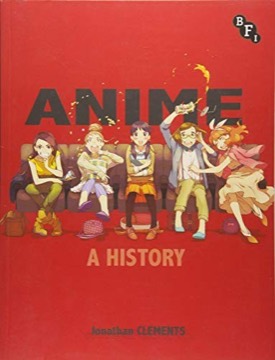
Anime: A History
Jonathan Clements's 2013 study, which treats Japanese animation as an industry with a documented business history rather than as a set of texts to be interpreted.
- First published
- 2013
- Publisher
- Bloomsbury Publishing Plc
- Pages
- 356
- Shelf
- Anime
- Level
- Deep
- ISBN-13
- 9781844573905
Record checked against
Only one source carried a publication date for this work, so the year is uncorroborated.
Catalogue note
- Reads as
- ReflectiveChanges how you see rather than what you do.
- Level
- Advanced / AdvancedAssumes you have read around the subject already.
- Approach
- Theoretical
- Written for
- Readers of comics, and anyone curious how the form works, Specialists and serious readers
Saved in this browser only — no account, nothing sent anywhere. My library
Read this if
- You want to know how we got here.
- You care why some things are obvious to use and others are not.
- You want a book that changes how you see things rather than what you do tomorrow.
- You have read around this already and want a book that assumes it.
What it is
A history of Japanese animation from its earliest surviving films through to the digital era, organised around production conditions: who financed the work, who was employed to make it, under what contracts, and for which distribution channel.
Clements draws extensively on Japanese-language trade sources, company records and labour histories rather than on the films themselves.
A history of anime told through contracts, budgets and employment records rather than through films.
Devmark’s reading — not a quotation from the book
The argument
Clements's central claim is that anime's aesthetic and narrative conventions are consequences of industrial arrangements, and that explaining them any other way is a category error.
Limited animation, the episode length, the reliance on adaptation, the character-goods economy and the studio system's labour practices are all traced to specific financial pressures rather than to artistic preference.
Against auteur criticism
The book is explicitly sceptical of criticism organised around named directors, arguing that it imports assumptions from film studies that the production reality does not support.
This is a genuine intervention rather than a pose. Much anime scholarship in English had been textual and director-centred, and Clements's sources make that approach look considerably less secure.
Early history
The opening chapters cover the pre-war and wartime periods in detail, including propaganda production and the state's involvement, which most English-language accounts skip entirely.
This material is the book's most valuable contribution for a general reader, since it establishes that the industry had a substantial history before the television era that shaped everything after it.
Television economics
The account of the 1960s shift to television is central: the price at which the first series was sold, the losses this locked in, and the merchandising model that emerged to cover them.
Clements is careful about the popular story that one studio single-handedly depressed industry rates, and he complicates it with evidence rather than repeating it.
Labour
The book is consistently attentive to who actually does the work: in-between animators, subcontracted overseas studios, and the wage structures that have made the industry notoriously difficult to survive in.
This is the material most absent from celebratory accounts, and Clements treats it as central rather than as a footnote.
Sources
Much of the evidence is from Japanese trade publications, company histories and interviews that have not appeared in English elsewhere.
The bibliography is a resource in itself, and the book's authority rests substantially on it. Readers should expect a citation density closer to academic history than to popular criticism.
Style and difficulty
The prose is clear but the organisation is dense, and the book assumes a reader willing to follow financial and institutional detail across decades.
It is not an introduction to anime as a viewing experience. A reader looking for recommendations or for interpretation of particular works will find very little of either.
Corrections
Clements spends considerable effort correcting received accounts, particularly origin stories that circulate widely in English and turn out to rest on a single unreliable source.
The corrective function is one of the book's main uses, and it changes how several familiar claims about the industry should be stated.
Scope
It covers roughly a century and does so at a consistent level of detail, with the post-1990s material somewhat thinner than the earlier chapters.
The compression toward the present is understandable and is worth noting, since a reader interested chiefly in contemporary production will find the book strongest on periods they may care about less.
Clements's other work
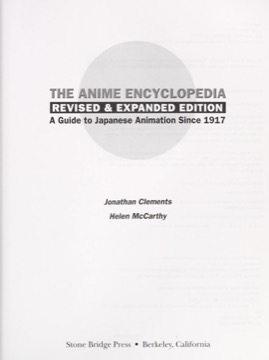
He co-wrote The Anime Encyclopedia, and the two books are complementary: one a reference, the other an argument.
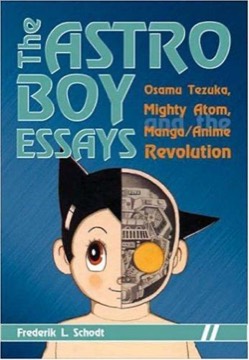
He has also written extensively on Japanese history and on the practical business of translation, and the industrial focus here is consistent across his output. He has also published a study of Tezuka's Astro Boy and translated a substantial amount of Japanese material, and the range gives the history unusual source depth.
Who it is for
Readers who want to understand why anime looks and works as it does, and who are prepared to accept an economic explanation.
It is the single most useful book in this section for a reader who already watches a great deal and wants to know how it is made. Readers looking for appreciation should start with Napier instead.
What to take away
- 01Aesthetics as industrial consequenceLimited animation, episode length and the goods economy are traced to financial pressures rather than to artistic choice.
- 02Scepticism about auteursDirector-centred criticism imports film-studies assumptions that the documented production reality does not support.
- 03A pre-war history most accounts skipPropaganda production and state involvement established conditions that shaped everything in the television era.
- 04Labour treated as centralIn-between animators, overseas subcontracting and wage structures are the book's subject rather than a footnote.
- 05Received accounts correctedSeveral widely repeated origin stories are shown to rest on single unreliable sources.
- 06Sources unavailable in EnglishThe evidence comes from Japanese trade publications and company histories, and the bibliography is itself a resource.