Appleseed
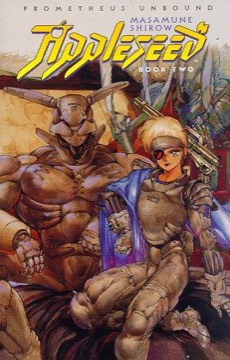
Masamune Shirow's series, begun in 1985, following two soldiers recruited into a planned utopian city run partly by artificial intelligence and populated partly by engineered humans.
- First published
- 1985
- Publisher
- Manga Books
- Pages
- 146
- Shelf
- Anime
- Level
- Core
- ISBN-13
- 9781560600824
Record checked against
Catalogue note
- Reads as
- ReflectiveChanges how you see rather than what you do.
- Level
- Core / BuildingAssumes general familiarity with the subject.
- Approach
- Theoretical
- Written for
- Readers of comics, and anyone curious how the form works, Readers with some grounding
Saved in this browser only — no account, nothing sent anywhere. My library
Read this if
- You read for the writing as much as for the argument.
- You want a thought experiment you can live inside for a while.
- You want to understand how power is taken, kept and lost.
- You want a book that changes how you see things rather than what you do tomorrow.
- You know roughly how the subject works and want the fuller account.
What it is
After a global war, Deunan Knute and her cyborg partner Briareos are brought from the wasteland into Olympus, a rebuilt city administered by a central computer and populated substantially by bioroids — engineered humans designed with reduced emotional range.
They join the city's paramilitary police, and the series concerns the political stability of a place designed to remove the causes of conflict.
A city engineered so that nobody would want to fight, policed by two people who only know how to.
Devmark’s reading — not a quotation from the book
The political question
Olympus works by reducing the human capacity for the emotions that produce war, which raises the obvious objection that it has solved conflict by removing part of what people are.
Shirow gives that objection real weight. Several characters argue it forcefully, and the series does not conclude that the city is correct.
Bioroids
The engineered population is designed to be calm, cooperative and incapable of certain kinds of ambition, and the series treats their legal and moral position seriously.
The question of whether a being designed to be content can meaningfully consent to anything runs underneath most of the plot.
Deunan and Briareos
Their partnership — she human, he almost entirely mechanical — is the emotional centre, and the series lets it be domestic as well as operational.
Briareos's design, with its distinctive sensor array, is among the more recognisable in the medium, and the relationship is written without the tragedy the setup invites.
The density problem
As in Ghost in the Shell, Shirow annotates heavily, with extended margin notes on politics, hardware and terminology that frequently overwhelm the page.
Later volumes become progressively harder to follow. The information is genuinely interesting and the presentation makes sustained reading difficult. Readers are entitled to skip the notes entirely; the narrative survives without them, which is arguably an indictment of their placement.
The art
Mechanical design is the strength: powered armour, vehicles and weapons drawn with engineering plausibility and a clear sense of mass.
The human figures are less distinctive and the backgrounds vary, but the hardware has been widely imitated and has aged well. Shirow's powered armour in particular has been copied so widely that the originals now read as familiar rather than as inventions.
Action
The combat sequences are tactical rather than spectacular, with attention to cover, communication and the coordination of a small unit.
Shirow is interested in how a squad actually operates, which places the series closer to military procedural than most of its contemporaries. Firefights are resolved by positioning and suppression rather than by individual heroics, which is rare in the medium even now.
Incompleteness
Four volumes were published and a fifth was begun and abandoned, leaving the series unfinished.
Shirow moved on to other projects and the story's larger political arc is never concluded, which readers should know before committing. What exists is coherent and can be read with satisfaction, but the questions the first volume raises are never answered, and readers should treat it as a fragment.
Its place in his work
It preceded Ghost in the Shell and established his method: dense political science fiction with heavy annotation and exceptional mechanical design.
Readers who liked one generally like the other, and Appleseed is the more optimistic of the two, though not by a wide margin. Appleseed is the earlier and rougher of the two, and the one where his political interests are stated most directly rather than buried in annotation.
Adaptations
Several animated films have been made, and they typically keep the characters and hardware while discarding the political argument almost entirely.
None is a good substitute for the manga, and the 2004 computer-animated version in particular bears little relation to Shirow's concerns. The 1988 direct-to-video version is closest in spirit, though it covers only a fraction of the first volume.
What has dated
The computing is of its period and the gender dynamics are uneven, with several sequences that exist mainly for the reader's benefit.
The political material has aged considerably better, and questions about engineered contentment and algorithmic governance read as more current now than when they were written.
Who it is for
Readers who want political science fiction in comics form and are willing to work through annotation to get it.
Readers who want a completed narrative or a clean reading experience should be warned on both counts. This is a work of ideas with a story attached rather than the other way round.
What to take away
- 01Peace by subtractionOlympus removes the emotional capacities that produce war, and the series takes the objection to that seriously.
- 02Consent from designed contentmentWhether a being engineered to be satisfied can meaningfully agree to anything runs underneath the whole plot.
- 03A partnership without tragedyThe human-and-cyborg pairing is written as domestic and operational rather than as the doomed setup it invites.
- 04Annotation that overwhelmsShirow's margin notes carry real substance and make sustained reading progressively harder.
- 05Tactical rather than spectacularCombat attends to cover, communication and squad coordination, closer to military procedural than to action.
- 06Unfinished ideasFour volumes and an abandoned fifth leave the political arc unresolved, which is worth knowing before starting.