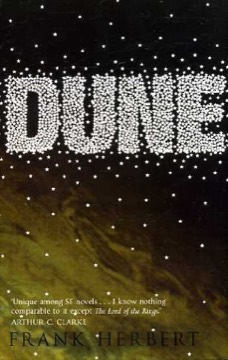
Dune
Frank Herbert's 1965 novel of desert ecology, dynastic politics and religious manipulation on a single arid planet — a book usually described as a hero's journey, which is close to the opposite of what its author said he was doing.
- First published
- 1965
- Publisher
- Ace Books, Inc.
- Pages
- 607
- Shelf
- Fiction
- Level
- Core
- ISBN-13
- 9788373017238
Record checked against
Catalogue note
- Reads as
- ReflectiveChanges how you see rather than what you do.
- Level
- Core / BuildingAssumes general familiarity with the subject.
- Approach
- Theoretical
- Written for
- Readers of literature, Readers with some grounding
Saved in this browser only — no account, nothing sent anywhere. My library
Read this if
- You want a thought experiment you can live inside for a while.
- You want to understand how power is taken, kept and lost.
- You want a book that changes how you see things rather than what you do tomorrow.
- You know roughly how the subject works and want the fuller account.
The premise
Arrakis is a desert world, worthless except that it is the only source of the spice melange, which extends life and makes interstellar navigation possible. Control of the planet is therefore control of the empire's circulatory system.
House Atreides is given stewardship of Arrakis, displacing their enemies the Harkonnens. The arrangement is not what it appears. Beyond that setup this summary will not go, since the novel's construction depends on what the reader does not yet know.
Ecology as the real subject
Herbert came to the novel through research on the stabilisation of coastal sand dunes, and ecology is the book's organising discipline rather than its backdrop.
Arrakis is worked out as a system: how water is conserved, how the sandworms and the spice depend on each other, how a population adapts its technology and its religion to scarcity. The novel treats the planet as a set of interlocking constraints, and most of the plot is downstream of them.
The planet is not the setting. It is the system every other element of the book is a consequence of.
Devmark’s reading — not a quotation from the book
Against the charismatic leader
Herbert stated repeatedly that his intention was a cautionary tale about charismatic leaders, and that the superhero was the danger rather than the solution. He wrote the sequel in part because readers had not taken the warning.
Read with that in mind, the novel is considerably darker than its reputation. The protagonist's rise is shown as the activation of a machinery built long in advance, and the book is quite explicit about what will follow it.
Religion as engineered infrastructure
The most sophisticated element is the Bene Gesserit's Missionaria Protectiva: prophecies deliberately seeded into vulnerable populations centuries ahead, so that an agent arriving later can be received as foretold.
This makes the novel's religious material something other than world- building colour. Belief is depicted as an instrument that can be manufactured and used, and the people it is used on are not stupid — they are working correctly from evidence that was planted.
Prescience as a trap
Herbert's treatment of foresight is one of the few genuinely original science-fiction conceits. Seeing the future is not power but constraint: each vision narrows what can still be chosen, and the clearer the sight the narrower the corridor.
It is a coherent working-out of what prophecy would actually do to a person, and it is the mechanism by which the novel makes its warning structural rather than moral.
Politics without a clean side
The imperial system is an explicit balance between the Emperor, the Great Houses, the Spacing Guild's navigation monopoly and the Bene Gesserit's breeding programme. Every faction is playing a long game, and none of them is good.
Herbert is unusual among writers of his period in granting competence to everyone. The antagonists are not stupid, the protagonists are not clean, and outcomes turn on information and leverage rather than on virtue.
The Fremen problem
A serious criticism worth stating. The Fremen are drawn heavily on Arabic and Islamic culture and on Bedouin desert life, and the novel uses that material without much interest in the people it came from.
The structure is also a recognisable outsider-becomes-the-chosen-one narrative, which the book complicates but does not escape. A modern reader should hold both facts: the depiction is more respectful than most of its period, and the borrowing is still extractive.
How it reads
It is dense and slow to start. Herbert uses extensive interior monologue, invented vocabulary, epigraphs from in-world texts, and frequent shifts of viewpoint within a scene — including into the minds of antagonists, which removes suspense deliberately in favour of dread.
The appendices on ecology, religion and the imperial houses are not optional padding; they contain material the narrative assumes. Readers who bounce off the first hundred pages usually do so because the book declines to explain itself, which is a choice rather than a flaw.
Its influence
Enormous and mostly indirect. The idea that a science-fiction setting should be worked out as an interlocking ecological, economic and religious system rather than as a backdrop begins in large part here, and almost every subsequent large-scale world in the genre owes something to it.
It is also the case that its imitators mostly took the surface — desert planets, prophecies, feudal houses — and left the argument, which is why so much that resembles Dune does not resemble it at all.
What to take from it
Read it as a book about systems and manipulation rather than a chosen-one story, and the whole thing reorganises. The questions it presses are about what makes a population ready to be led and who benefits from a belief.
If the reputation as heroic fantasy is what draws you in, the useful thing is to notice how carefully Herbert undermines it, and how uncomfortable the ending is once you have.
What to take away
- 01The ecology is the plotWater, worms and spice form a system; most of the story is a consequence of its constraints.
- 02Belief can be manufactured in advanceProphecies seeded centuries early mean the believers are reasoning correctly from planted evidence.
- 03Foresight narrows rather than empowersEach vision of the future removes options, making prescience a trap rather than an advantage.
- 04Herbert was warning, not celebratingHe said so repeatedly, and wrote a sequel because readers had taken the hero at face value.
- 05Everyone is competentOutcomes turn on information and leverage rather than on virtue, which is rare for the period.