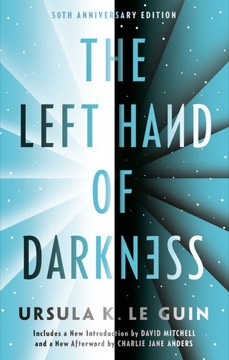
The Left Hand of Darkness
Ursula K. Le Guin's novel of an envoy sent to a frozen world whose inhabitants have no fixed sex — an anthropological science fiction that treats gender as a variable and watches what a society looks like without it.
- First published
- 1969
- Publisher
- Raig Verd
- Pages
- 304
- Shelf
- Fiction
- Level
- Core
- ISBN-13
- 9780441478026
Record checked against
Catalogue note
- Reads as
- ReflectiveChanges how you see rather than what you do.
- Level
- Core / BuildingAssumes general familiarity with the subject.
- Approach
- Theoretical
- Written for
- Readers of literature, Readers with some grounding
Saved in this browser only — no account, nothing sent anywhere. My library
Read this if
- You want a thought experiment you can live inside for a while.
- You want to think about how gender shapes a life, including your own.
- You want a book that changes how you see things rather than what you do tomorrow.
- You know roughly how the subject works and want the fuller account.
The premise
Genly Ai arrives on the planet Gethen as a single envoy from an interstellar federation, tasked with persuading its nations to join. The Gethenians are ambisexual: for most of the month they are sexually latent, and during a periodic phase they become male or female, not predictably the same one.
Any Gethenian can bear a child. Any Gethenian can father one. The novel's subject is what a society built on that fact does not have.
Any of them can bear a child and any can father one. The novel is about what such a society lacks.
Devmark’s reading — not a quotation from the book
The thought experiment
Le Guin described the book as a thought experiment rather than a prediction. Remove the permanent division of a species into two sexes, and observe which social structures turn out to have depended on it.
Her conclusions are specific: no war in the form humans practise it, no division of labour by sex, no rape, and a relationship between parents and children organised differently because everyone can be either.
Genly's blindness
The envoy spends most of the novel misreading the people around him, persistently assigning them to categories they do not occupy and finding them untrustworthy for behaviour he has misinterpreted.
His failure to understand Estraven, the one person consistently acting in his interest, is the novel's engine. The reader sees the misreading before he does, which makes the book a study in the difficulty of perceiving outside one's own categories.
Shifgrethor
The Gethenian concept the novel makes most use of: something like prestige, face, or the standing that permits a person to act, governed by elaborate indirection.
Genly cannot read it, and most of the political failure in the first half follows from that. It is one of the better pieces of invented social machinery in science fiction because it is specific enough to produce consequences.
The journey across the ice
The novel's final third: Estraven and Genly crossing an ice sheet on foot, hauling a sledge, over eighty days.
It is where the novel becomes personal rather than political. Two people who have failed to understand each other for a year are reduced to absolute mutual dependence, and the understanding they reach is the book's actual subject.
Two people who have misread each other for a year, reduced to complete mutual dependence on an ice sheet.
Devmark’s reading — not a quotation from the book
The structure
The narrative alternates Genly's report with Estraven's journal, and between them Le Guin inserts Gethenian myths, folk tales and field notes from an earlier investigator.
The interleaving builds a culture rather than describing one, and the myths frequently prefigure the plot. The device has been widely imitated since and was unusual when the book was written.
The pronoun problem
Le Guin used the masculine pronoun for Gethenians throughout, and later wrote publicly that she regarded this as a mistake — that defaulting to masculine undercut the premise and made the characters read as men who occasionally become women.
She experimented with alternatives in later work. Her willingness to criticise her own most celebrated book, in print, is characteristic and is part of why the criticism is now standard in discussions of it.
Its place in the argument about gender
It was published in 1969 and was immediately influential on feminist science fiction, and has been criticised since for not going far enough — for the male-default pronouns, for the largely male-coded characters, and for the near-absence of Gethenians in the female phase.
The fairer assessment is that it opened a line of inquiry that later writers pursued further, and that its own limitations are visible partly because it established the terms.
As a novel
The prose is precise and cold in a way that suits the setting, and the world-building is unusually disciplined — the climate, the technology and the politics all follow from stated conditions.
Its pace is slow by genre standards and the first half is largely political manoeuvring the reader cannot fully interpret, which is deliberate and costs some readers their patience.
What it established
That science fiction could conduct a serious social thought experiment rather than an adventure with unusual scenery, and that anthropology rather than physics could be the governing discipline.
Le Guin's Hainish books, of which this is the best known, are the main source of that tradition, and its influence on subsequent speculative fiction about gender and society is extensive.
What to take away
- 01Remove the variable and see what collapsesNo war as humans practise it, no sexual division of labour, no rape — presented as consequences, not hopes.
- 02The reader sees before the narrator doesGenly's misreading of Estraven is visible long before he recognises it, which is the novel's method.
- 03Shifgrethor produces consequencesInvented social machinery specific enough to cause real political failure when misread.
- 04Le Guin criticised her own pronounsShe wrote publicly that defaulting to masculine undercut the premise, and experimented afterwards.
- 05Anthropology as the governing disciplineIt established that serious social thought experiment was available to the genre.