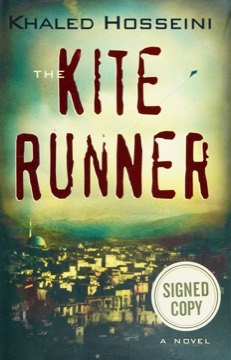
The Kite Runner
Khaled Hosseini's first novel, about a boy in 1970s Kabul, the servant's son who is his closest companion, and a betrayal he spends the rest of his life trying to answer for.
- First published
- 2003
- Publisher
- Intishārāt-i Nīlūfar
- Pages
- 371
- Shelf
- Fiction
- Level
- Core
- ISBN-13
- 9780385670968
Record checked against
Catalogue note
- Reads as
- ReflectiveChanges how you see rather than what you do.
- Level
- Core / BuildingAssumes general familiarity with the subject.
- Approach
- Theoretical
- Written for
- Readers of literature, Readers with some grounding
Saved in this browser only — no account, nothing sent anywhere. My library
Read this if
- You read for the writing as much as for the argument.
- You want to know how we got here.
- You want a life told honestly, at full length.
- You want a book that changes how you see things rather than what you do tomorrow.
- You know roughly how the subject works and want the fuller account.
The premise
Amir is the son of a wealthy Pashtun merchant in pre-Soviet Kabul. Hassan is the son of their Hazara servant, illiterate, loyal, and the better person by every measure the novel offers. They fly kites together in a city that is about to stop existing in the form they know.
Something happens that Amir witnesses and does not intervene in. The remaining two-thirds of the book — exile in California, the Soviet withdrawal, the Taliban, a return — is the consequence of that failure to act.
The betrayal happens early. Everything after it is the bill.
Devmark’s reading — not a quotation from the book
How it is built
Amir narrates as an adult, opening with the line that he became what he is at twelve, which frames the whole novel as confession rather than recollection. That framing is doing work: the reader is being asked to judge, and told so.
Hosseini structures the book as a rhyme. Situations from the Kabul section recur in the American and Taliban-era sections with the roles altered, so that Amir is repeatedly offered the choice he failed the first time.
Themes
The engine is guilt and the possibility of atonement, which the novel takes seriously as a religious as well as a psychological question. Hosseini is interested in whether a wrong can be paid for at all, and gives a qualified answer rather than an easy one.
Underneath sits the ethnic hierarchy between Pashtun and Hazara, which the boys' friendship cannot escape. The novel is clear that Amir's advantage over Hassan is structural, and that his cowardice is made possible by it.
The friendship is unequal before either boy does anything, and the book never lets that go.
Devmark’s reading — not a quotation from the book
Its reception
It was the book that brought Afghan fiction to a mass Western readership, published two years after 2001, and its timing is part of its history.
It has been criticised for melodrama and for how the ethnic politics are handled, and those objections are worth carrying. What is not in doubt is that it made a large audience read about Afghanistan as a country with an interior rather than a news item.
Hazara and Pashtun
The friendship at the centre of the book crosses an ethnic and sectarian divide the novel is careful to establish early: Hassan and his father are Hazara, a historically subordinated and frequently persecuted minority, while Amir and Baba are wealthy Pashtuns whose servants they are. Almost every betrayal in the novel, including the one the whole plot turns on, is only fully legible through that asymmetry of power.
The tournament
The kite-fighting sequence is the novel's best writing and its structural hinge: a competition with glass-coated string, a runner who retrieves the fallen kite, and a promise about what he will do to get it. Everything after it proceeds from what happens in an alley a few minutes later.
Fathers
The novel is at least as much about Amir and Baba as about the two boys: a son who is not the child his father wanted, a father whose own conduct turns out to be more complicated than his moral certainty suggested, and a long displacement in California where their positions reverse entirely.
The father who lectures him about theft has committed the one theft that matters.
Devmark’s reading — not a quotation from the book
California
The middle section in Fremont — the flea market, the diminished patriarch pumping petrol, the courtship conducted under strict community rules — is the most quietly observed part of the book and the least discussed. It is an immigrant novel embedded in a redemption narrative.
The return
The final act's journey back into Taliban-era Afghanistan is where the novel is most criticised: the antagonist's reappearance is a coincidence the plot needs rather than earns, and the confrontation is closer to melodrama than the earlier chapters. The emotional logic holds; the mechanics strain visibly.
What it did and what was said about it
It introduced an enormous Western readership to Afghanistan shortly after 2001 and has been criticised for that position — for how the Hazara characters are written, for an ending that offers American rescue, and for supplying a sympathetic account at a politically convenient moment. The criticism is substantial and does not dissolve the book.
What to take away
- 01Confession, not memoryAmir narrates to be judged, and says so on the first page.
- 02A structure that rhymesEarly situations recur later with the roles reversed.
- 03Unequal from the startPashtun and Hazara: the friendship sits on a hierarchy neither boy chose.
- 04Atonement, qualifiedThe novel takes seriously whether a wrong can be paid for, and does not answer easily.
- 05TimingPublished in 2003, it became many readers' first Afghan novel, which shaped how it was read.