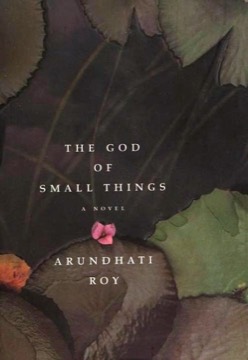
The God of Small Things
Arundhati Roy's Booker-winning first novel about twins in Kerala, a death in a river, and the caste rules that decide who may be loved. Told in fragments, circling the events rather than narrating them.
- First published
- 1997
- Publisher
- Flamingo
- Pages
- 357
- Shelf
- Fiction
- Level
- Deep
- ISBN-13
- 9783442724680
Record checked against
Catalogue note
- Reads as
- ReflectiveChanges how you see rather than what you do.
- Level
- Advanced / AdvancedAssumes you have read around the subject already.
- Approach
- Theoretical
- Written for
- Readers of literature, Specialists and serious readers
Saved in this browser only — no account, nothing sent anywhere. My library
Read this if
- You read for the writing as much as for the argument.
- You want to know how we got here.
- You want a life told honestly, at full length.
- You want a book that changes how you see things rather than what you do tomorrow.
- You have read around this already and want a book that assumes it.
The premise
Rahel and Estha are fraternal twins in Ayemenem, Kerala. In 1969, when they are seven, their English cousin visits and something happens that separates them for twenty-three years. The novel opens with their reunion as adults and works backwards and forwards around the event.
The family is Syrian Christian, formerly prosperous, running a pickle factory. Velutha, an untouchable carpenter, works for them, and the love that involves him is the transgression the book is built on.
The novel tells you what happened almost immediately. It spends itself on how, and on why it was inevitable.
Devmark’s reading — not a quotation from the book
How it is built
Roy writes in fragments, with invented compounds, capitalised phrases and a child's logic applied to adult events. The style is divisive and entirely deliberate: the twins' perception is the lens, so the prose behaves the way seven-year-olds understand things.
Chronology is deliberately broken. The reader assembles the sequence, which means the dread is structural — you know the shape of the catastrophe long before you see it.
The prose is a child's grammar applied to what adults did, which is why it hurts.
Devmark’s reading — not a quotation from the book
Themes
The phrase the novel keeps returning to is the love laws: who should be loved, and how, and how much. Caste, in this book, is not background but the mechanism, and Roy shows it operating through people who consider themselves decent.
Politics runs alongside — Kerala's communist movement is present and is treated sceptically, as another structure that leaves the untouchable carpenter unprotected.
Its place
It won the Booker in 1997 and made Roy internationally known; she published no second novel for twenty years, writing political non-fiction instead.
The book also drew an obscenity case in Kerala over its final section, which is a fact about how directly it addresses caste and desire rather than an aside about its reception.
The ending comes first
The novel tells you what happened in its opening pages — a death, a family broken, twins separated — and then circles it for three hundred pages. The tension is not what but how, and the circling is the form: memory returning repeatedly to the same event and approaching a little closer each time.
The Love Laws
Roy's recurring phrase names the book's actual subject: the rules that govern who should be loved, and how, and how much. Caste prohibition, marriage convention, family hierarchy and the treatment of a divorced daughter are all treated as expressions of the same machinery rather than as separate problems, and every catastrophe in the novel follows from somebody crossing a line that machinery had drawn.
Who should be loved, and how, and how much. Every disaster here is a breach of that.
Devmark’s reading — not a quotation from the book
Two children's English
The prose invents words, reverses them, capitalises phrases for emphasis and repeats them later as refrains, because a great deal of the novel is filtered through the perception of seven-year-old twins who are learning English and playing with it. Readers who find the style mannered are responding to a deliberate and sustained effect rather than to carelessness, and it tightens considerably in the sections narrated from adulthood.
Kerala politics
The setting is specific: a communist-governed state where the party is both genuinely powerful and complicit in maintaining caste, a Syrian Christian family, and a pickle factory. The local political texture is not background — the party's response to what happens is the mechanism of the tragedy.
Velutha
The Dalit carpenter is the novel's moral centre and is granted the least agency by the world around him. Roy makes the reader love him and then shows the entire apparatus — family, church, party, police — converging on him with procedural calm. The violence is described directly and is difficult.
What happened afterwards
It won the Booker and made Roy internationally famous, and she published no second novel for twenty years, turning instead to political essays and activism in India. She also faced obscenity proceedings at home over the book's final section, which is worth knowing as context for that silence.
What to take away
- 01The love lawsRoy's phrase for the rules governing who may be loved, and by how much.
- 02A child's grammarInvented compounds and capitalised phrases render seven-year-old perception.
- 03Broken chronologyYou learn the outcome early; the dread comes from assembling the route.
- 04Caste as mechanismNot background: the specific machinery by which the catastrophe occurs.
- 05Communism, doubtedKerala's party is present and offers the carpenter no protection.