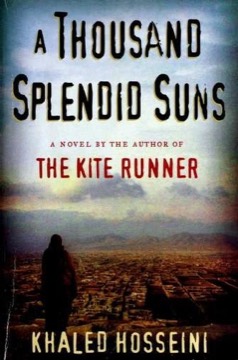
A Thousand Splendid Suns
Khaled Hosseini's novel about two Afghan women, a generation apart, married to the same man, across thirty years of Soviet occupation, civil war and Taliban rule. A book about a friendship formed with no other option.
- First published
- 2007
- Publisher
- Amsterdam
- Pages
- 406
- Shelf
- Fiction
- Level
- Core
- ISBN-13
- 9781428142763
Record checked against
Catalogue note
- Reads as
- ReflectiveChanges how you see rather than what you do.
- Level
- Core / BuildingAssumes general familiarity with the subject.
- Approach
- Theoretical
- Written for
- Readers of literature, Readers with some grounding
Saved in this browser only — no account, nothing sent anywhere. My library
Read this if
- You read for the writing as much as for the argument.
- You want to know how we got here.
- You want to think about how gender shapes a life, including your own.
- You want a book that changes how you see things rather than what you do tomorrow.
- You know roughly how the subject works and want the fuller account.
The premise
Mariam is the illegitimate daughter of a wealthy Herat businessman, married off at fifteen to Rasheed, a shoemaker in Kabul thirty years older. Laila is born a generation later to educated, progressive parents in the same city.
War brings Laila into Rasheed's house as a second wife. The two women begin as rivals in an impossible arrangement and become the only protection either has.
The love story in this book is between the two wives.
Devmark’s reading — not a quotation from the book
How it is built
Hosseini structures it as two biographies that converge, giving each woman her own opening act so that neither is introduced as the other's complication.
The history is delivered through household consequence rather than exposition: which roads are passable, what schools are open, what a woman may do outside without an escort. Regimes change and the novel measures it in domestic terms.
Thirty years of Afghan history, told through what is permitted in one house.
Devmark’s reading — not a quotation from the book
Themes
The book is about endurance and, in its last movement, about a choice deliberately made. Hosseini has been criticised for melodrama, and the plotting is unashamedly emotional; what holds it is the specificity of the domestic detail.
It is also a corrective to a particular Western image of Afghan women as undifferentiated victims. Mariam and Laila have different classes, educations, expectations and tempers, and the novel insists on that throughout.
Two openings
Hosseini gives each woman her own extended act before the plot forces them together, so neither is introduced as the other's complication. Mariam's childhood as an illegitimate daughter and Laila's as the child of educated progressive parents establish two entirely different Afghanistans a generation apart.
Thirty years, measured domestically
Soviet occupation, mujahideen factional war, Taliban rule and the American intervention all arrive as changes in what is permitted inside one house: which roads are passable, whether a school is open, what a woman may do outside without an escort. The political history is delivered entirely through household consequence.
The regime changes are measured in what a woman may do outside her own front door.
Devmark’s reading — not a quotation from the book
Rasheed
The husband both women are married to is drawn with more care than a simple monster requires: his grievances, his humiliations, his own losses, and the way the wider collapse licenses what he was already inclined toward. He is not excused, and he is explained.
From rivals to allies
The central relationship begins in outright hostility, because the arrangement the two women are placed in demands that they compete, and the novel takes its time converting that into something much closer to mother and daughter than to friendship. The love story in this book is between the two wives, not between either of them and any man, and Hosseini structures every other element of the plot around protecting that.
Mariam's trial
The legal proceeding late in the book is the novel's clearest statement of its argument. A woman is judged by a court that does not permit her account to count as evidence, by men applying rules correctly, with an outcome that follows logically from those rules. Hosseini writes it without raising his voice, and it is more frightening than any of the domestic violence that precedes it.
Nobody in the room breaks a rule. That is precisely what makes the scene unbearable.
Devmark’s reading — not a quotation from the book
The law as a weapon
Specific legal changes drive the plot: a woman's inability to travel or seek help alone, the treatment of a wife's testimony, what the authorities do with a woman who leaves her husband. The most frightening sequence in the novel involves no violence at all, only a police station behaving correctly according to the rules then in force.
The melodrama question
Hosseini has been criticised, not unreasonably, for emotional manipulation: the plotting is unashamedly engineered to produce a response, coincidences arrive when they are needed, and the reversals are timed for maximum effect. What carries the book anyway is the specificity of its domestic detail — the food, the rooms, the rules, the small negotiations of a shared household. Readers who resist the machinery generally still concede the texture.
What to take away
- 01Two lives, then one houseEach woman gets her own act before the novel forces them together.
- 02History as domestic factPolitical change is measured in what a woman may do outside her door.
- 03Rivals to alliesThe central relationship begins in hostility because the arrangement requires it.
- 04Melodrama, acknowledgedThe plotting is frankly emotional; the domestic specificity is what carries it.
- 05Against a flat imageMariam and Laila differ in class, schooling and temperament, and the book insists on it.