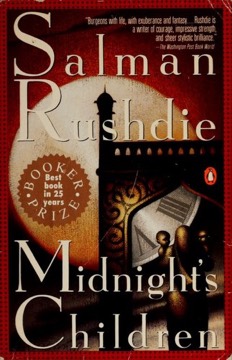
Midnight's Children
Salman Rushdie's novel about Saleem Sinai, born at the exact moment of Indian independence and telepathically linked to the thousand other children born in that hour. Winner of the Booker, and twice voted the best of all Booker winners.
- First published
- 1981
- Publisher
- Atlas-Contact
- Pages
- 580
- Shelf
- Fiction
- Level
- Deep
- ISBN-13
- 9781283999816
Record checked against
Catalogue note
- Reads as
- ReflectiveChanges how you see rather than what you do.
- Level
- Advanced / AdvancedAssumes you have read around the subject already.
- Approach
- Theoretical
- Written for
- Readers of literature, Specialists and serious readers
Saved in this browser only — no account, nothing sent anywhere. My library
Read this if
- You read for the writing as much as for the argument.
- You want to know how we got here.
- You want a book that changes how you see things rather than what you do tomorrow.
- You have read around this already and want a book that assumes it.
The premise
Saleem is born at midnight on 15 August 1947. So are 1,001 others, each with a power, strongest in those born closest to the hour. Saleem's is telepathy; he convenes the others in his head.
He narrates as a man in his thirties, physically falling apart, racing to finish before he does, while a woman called Padma interrupts and complains about the digressions.
A man whose body is literally cracking apart tries to tell the story of a country born the same minute he was.
Devmark’s reading — not a quotation from the book
How it is built
The novel's method is to make national history personal to the point of absurdity: Saleem claims responsibility for wars, partitions and elections, and the reader is left to weigh megalomania against metaphor.
Rushdie mixes Bombay street idiom, Hindi and Urdu vocabulary and the cadence of oral storytelling into English, a fusion that reshaped what an English-language novel could sound like.
Saleem takes personal credit for national catastrophes, and the book will not say how seriously to take him.
Devmark’s reading — not a quotation from the book
Themes
Memory is the explicit subject. Saleem repeatedly admits error, then declines to correct it, on the grounds that what he remembers is the truth of his life whatever the records say.
The Emergency is where the comedy stops. Rushdie's treatment of Indira Gandhi's government led to a successful defamation action over one sentence, which is worth knowing as a fact about the book's reception.
Reading it
It is long, digressive and deliberately overloaded — the prose does not settle, and that is the intention rather than a failure of editing.
Some knowledge of Indian and Pakistani history from 1915 to 1978 helps a great deal. The novel does not explain, on principle.
The conceit
Every child born in the hour of Indian independence has a gift, and the ones born nearest midnight have the strongest. Saleem, born on the stroke, can convene the others telepathically. The device lets Rushdie write the nation's first decades as a single crowded consciousness rather than as a chronicle.
Handcuffed to history
Saleem insists his life and the country's are causally linked, claiming responsibility for wars, elections and riots. The claim is preposterous and the novel knows it; the joke and the grief both come from a man who cannot distinguish between what happened to him and what happened to everyone.
He believes he caused the wars. The novel never tells you whether to laugh.
Devmark’s reading — not a quotation from the book
An unreliable narrator who admits it
Saleem gets dates wrong, misremembers an assassination, and says so, then declines to correct the record on the grounds that his version is what he has. Rushdie builds the errors in deliberately, making the book an argument about memory rather than a history with mistakes in it.
The telling
Saleem narrates aloud to Padma each evening while working in a pickle factory, and she interrupts constantly — complaining about his digressions, disbelieving the supernatural claims, and demanding that he get on with the story. She is the reader's representative installed inside the book, and she is the single reason its enormous, deliberately excessive digressions remain tolerable rather than exhausting.
The Emergency
The final section covers the suspension of civil liberties in the mid-1970s, the slum clearances and the sterilisation programme, and it is written with open fury. A passage concerning Indira Gandhi led to a successful legal action and its removal from later editions — the novel's politics had immediate consequences.
The language
Rushdie writes an English deliberately crowded with Hindi and Urdu, with exclamation, repetition, compound coinages, wordplay and long accelerating lists, and refuses throughout to flatten any of it for the convenience of a foreign reader. It is the book's largest and most consequential claim: that the language of the coloniser can be occupied, bent and remade from inside rather than merely used correctly by permission.
What to take away
- 01Born with a countrySaleem's life and India's are the same event, taken literally.
- 02An unreliable and unrepentant narratorHe admits mistakes and refuses to fix them.
- 03A reshaped EnglishBombay idiom and oral cadence pushed into the literary novel.
- 04History as personal claimSaleem takes credit for national events; the book keeps the ambiguity.
- 05It does not explainSubstantial historical knowledge is assumed, by design.