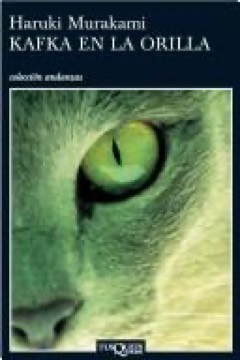
Kafka on the Shore
Haruki Murakami's novel about a fifteen-year-old runaway and an elderly man who can talk to cats, in two narratives that converge without ever quite explaining themselves.
- First published
- 2002
- Publisher
- Naxos of America
- Pages
- 576
- Shelf
- Fiction
- Level
- Deep
- ISBN-13
- 9789724616469
Record checked against
Catalogue note
- Reads as
- ReflectiveChanges how you see rather than what you do.
- Level
- Advanced / AdvancedAssumes you have read around the subject already.
- Approach
- Theoretical
- Written for
- Readers of literature, Specialists and serious readers
Saved in this browser only — no account, nothing sent anywhere. My library
Read this if
- You read for the writing as much as for the argument.
- You want a book that changes how you see things rather than what you do tomorrow.
- You have read around this already and want a book that assumes it.
The premise
Kafka Tamura leaves home on his fifteenth birthday to escape a prophecy his father laid on him, and takes refuge in a private library in Takamatsu. In alternating chapters, Nakata — an old man who lost his literacy and memory in a childhood incident during the war, and gained the ability to speak to cats — travels in the same direction without knowing why.
The two lines approach each other. They do not meet in the way the structure trains you to expect.
Two journeys converge on the same place, and the novel declines to complete the arithmetic.
Devmark’s reading — not a quotation from the book
How it works
Murakami runs an Oedipus structure openly — prophecy, flight, unavoidable fulfilment — while refusing to let cause and effect operate normally. Events in one strand take effect in the other with no mechanism supplied.
The novel repeatedly tells you it will not explain. Characters discuss the impossibility of what is happening and then continue. Readers who need the mechanism find this maddening; readers who accept the terms find it his most complete book.
Themes
Metaphor is treated as literally operative: things that would be figurative in another novel happen. Murakami's own comment was that the book contains several riddles and no solutions, and that solutions are produced by combining them.
Underneath the surrealism the subject is ordinary — a boy with an absent mother and a hostile father, and an old man who has lost most of himself and is content.
Metaphors are not metaphors here. They occur.
Devmark’s reading — not a quotation from the book
Where to start
This is one of the two usual entry points to Murakami, the other being Norwegian Wood, and they are almost opposite books. If the surrealism is the appeal, begin here.
Content note: it contains graphic violence involving animals in one extended scene, which is the part most readers are unprepared for.
Two narratives
Odd chapters follow a fifteen-year-old who has run away from home; even chapters follow an elderly man who lost the ability to read after a wartime incident and can talk to cats. The two never quite meet, and Murakami's structure asks the reader to hold a connection the book declines to draw explicitly.
Nakata
The old man who cannot read, lives on a small disability stipend from the prefecture, and supplements it by finding lost cats for neighbours is the novel's best creation by a considerable margin. His plainness, his politeness and his absolute literalness are the counterweight to everything symbolic happening around him, and readers who find the Kafka chapters overwrought almost always stay for his.
He cannot read a road sign. He is the most reliable person in the book.
Devmark’s reading — not a quotation from the book
The library
A small private library in Takamatsu, its collection, its staff and its reading room is the still point the whole novel orbits. Murakami treats it as a place with rules and an atmosphere rather than a setting, and the decision to make a library the site of a metaphysical crisis is doing real work.
The oracle
The plot is arranged around a prophecy the boy has been told, and its shape is borrowed openly from Greek tragedy. Murakami does not disguise the source; the interest is in whether a prediction fulfilled in a dream, or by someone else, still counts — a question the novel puts directly and does not resolve.
Reading the unexplained
Fish fall from the sky, a stone must be turned, an entrance is opened, and none of it is accounted for. Murakami's stated position is that the reader should let the images work without decoding them, and the book is considerably more enjoyable read that way than as a puzzle with an answer.
Where it is uncomfortable
The sexual content involving a teenage protagonist, including scenes framed by the prophecy, is genuinely difficult and has drawn sustained criticism. So has the treatment of the female characters more generally, which is a recurring objection to Murakami and is at its most visible here.
What to take away
- 01Two converging strandsA runaway boy and an old man, approaching the same point.
- 02Oedipus, run openlyThe prophecy structure is stated rather than concealed.
- 03No mechanism suppliedCause and effect cross between strands without explanation.
- 04Literal metaphorWhat would be figurative elsewhere simply happens.
- 05Riddles without solutionsMurakami's own description of the design.