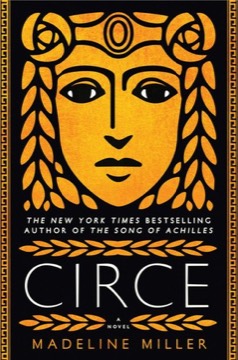
Circe
Madeline Miller's retelling of the witch from the Odyssey, told from her side across the centuries she spends exiled on an island. A book about a minor figure in someone else's story deciding to have her own.
- First published
- 2018
- Publisher
- Thorndike Press Large Print
- Pages
- 404
- Shelf
- Fiction
- Level
- Entry
- ISBN-13
- 9781526612519
Record checked against
Catalogue note
- Reads as
- ReflectiveChanges how you see rather than what you do.
- Level
- Accessible / FoundationalNo prior reading assumed.
- Approach
- Theoretical
- Written for
- Readers of literature, Newcomers to the subject
Saved in this browser only — no account, nothing sent anywhere. My library
Read this if
- You read for the writing as much as for the argument.
- You want to think about how gender shapes a life, including your own.
- You want a book that changes how you see things rather than what you do tomorrow.
- You are starting from scratch here and want a way in that assumes no prior reading.
The premise
Circe is the daughter of the sun god Helios, born without the beauty or power her family respects. She discovers she can work transformation — a craft rather than an inherited divinity — and is exiled to the island of Aiaia for it.
There she is visited by the myths: Daedalus, the Minotaur, Medea, and eventually Odysseus, whose crew she famously turns into pigs. The novel tells all of it from inside her long solitude.
In the Odyssey she is an episode. Here the Odyssey is an episode in her life.
Devmark’s reading — not a quotation from the book
How it is built
Miller was a classicist and teaches Latin and Greek, and the novel's pleasure is partly in how carefully it fits the surviving material — Circe does what the sources say she does, and the book supplies a reason that makes her legible rather than contradicting the myth.
The pacing is unusual: centuries pass in paragraphs, and single conversations take chapters. Immortality is written as duration rather than as power.
The famous pigs are still turned into pigs. The novel only asks what the woman doing it wanted.
Devmark’s reading — not a quotation from the book
Themes
The book's argument is about craft against inheritance. Circe's power is learned and laborious, which is precisely why her family despises it and why it lasts.
It is also unblinking about what the myths contain. The violence done to women in these stories is not softened, and Miller's retelling refuses to present Odysseus as uncomplicatedly heroic.
An episode becomes a life
In the Odyssey she occupies a few hundred lines and exists to be overcome. Miller's inversion is structural rather than corrective: the famous encounter arrives very late in the novel, occupies a small proportion of its length, and is over comparatively quickly, because from where Circe is standing it was one visit among many across several centuries of exile. The proportions are the argument.
In the original she is an episode. Here the original is an episode in her.
Devmark’s reading — not a quotation from the book
Craft against birthright
Her power is witchcraft, which is learned, laborious and improvable, rather than the inherited divinity her family possesses and cannot increase. Miller makes this the novel's central distinction: her relatives despise the work precisely because it can be acquired, and it is the only power in the book that grows.
Exile as a workshop
The island is a punishment that quietly becomes a laboratory. Centuries of uninterrupted, unsupervised time allow her to catalogue plants, test their properties, refine her transformations and become genuinely formidable at something nobody thought worth learning. Miller's suggestion is precise and satisfying: the sentence handed down to silence and contain her is the exact condition that made her dangerous.
Time written as duration
Centuries pass in a single paragraph while one conversation can occupy an entire chapter, and the unevenness is deliberate. Immortality is rendered throughout as duration rather than as power: the loneliness of outliving everyone you have cared about, the strangeness of a life in which a decade counts as a short absence, and the difficulty of taking any single day seriously when there have been so many.
The pigs
Miller does not soften what Circe does to sailors. The transformations happen, they are deliberate, and the novel supplies a reason that fits the source rather than contradicting it. It is the clearest demonstration of her method: keep the myth's events, supply the interiority the myth omitted.
Motherhood
The long central section on raising Telegonus alone on the island — sleeplessness, constant low-grade terror, the physical exhaustion, the impossibility of protecting a child from a hostile sea god — is the least mythological writing in the book and the most widely praised. It is also the place where the novel travels furthest from anything in its source material, which is presumably why it feels the most alive.
Where she takes liberties
Miller trained as a classicist and taught Latin and Greek, so the divergences here are choices rather than errors: compressing chronology, combining or omitting minor figures, and reading Odysseus a great deal less generously than the epic invites. Readers who know the sources well should expect a deliberate argument with them rather than a faithful retelling, and the argument is usually worth having.
What to take away
- 01A minor character's interiorThe novel takes an episode from the Odyssey and makes it a life.
- 02Craft over birthrightCirce's witchcraft is learned work, which is why her divine family holds it in contempt.
- 03Time as textureCenturies pass in a sentence; a single conversation fills a chapter.
- 04The myths, unsoftenedMiller keeps the violence the sources contain rather than tidying it.
- 05Odysseus, reassessedSeen from the island, the hero of the Odyssey looks considerably less heroic.