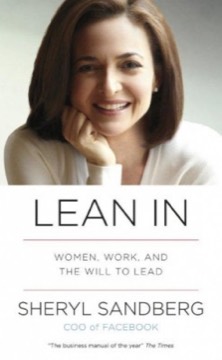
Lean In
Sheryl Sandberg's 2013 argument that women hold themselves back in ways that compound external barriers, and that the response should include individual action as well as structural change. One of the most discussed and most criticised business books of its decade.
- First published
- 2013
- Publisher
- Zhong xin chu ban she
- Pages
- 292
- Shelf
- Business
- Level
- Entry
- ISBN-13
- 9789862417607
Record checked against
Catalogue note
- Reads as
- StrategicAbout choosing between options under uncertainty.
- Level
- Accessible / FoundationalNo prior reading assumed.
- Approach
- Applied
- Written for
- Founders and operators, Newcomers to the subject
Saved in this browser only — no account, nothing sent anywhere. My library
Read this if
- You are asking what you should be doing with your working life.
- You want to think about how gender shapes a life, including your own.
- You want to understand what makes people willing to follow a decision.
- You are weighing options and want a way to think about the trade-offs.
- You are starting from scratch here and want a way in that assumes no prior reading.
The argument
Sandberg, then Facebook's COO, argues that the leadership gap persists partly through internal mechanisms: women underestimate themselves, leave before they leave by planning around a family they do not yet have, and negotiate less because the social penalty for doing so is real.
Her recommendation is to sit at the table, pursue the next role, and choose a partner who genuinely shares the domestic load — which she identifies as the single most consequential career decision.
Her sharpest and least contested point is that the partner you choose matters more to your career than any employer.
Devmark’s reading — not a quotation from the book
What it got right
The research on the likeability penalty — that success and likeability correlate positively for men and negatively for women — is well supported and the book made it widely known.
Its treatment of how women's ambition is read differently, and of the specific double bind in negotiation, holds up.
The criticism
The book was substantially criticised, most influentially by bell hooks and by Michelle Obama's later comment on the phrase itself, for locating too much of the problem in individual behaviour and for generalising from an unusually privileged position.
Sandberg has since acknowledged that the book underestimated how much harder this is without money, partner support or flexible work — a point she made directly after her husband's death.
Its author later conceded the central limitation: the advice assumes resources many readers do not have.
Devmark’s reading — not a quotation from the book
The likeability penalty
The research finding the book rests on most solidly is that competence and likeability correlate positively for men and negatively for women, so that the same assertive behaviour produces opposite social consequences. It is well replicated and it reframes a great deal of advice about self-presentation as a genuine double bind rather than a confidence problem.
The same behaviour makes him respected and her disliked. That is a finding, not an impression.
Devmark’s reading — not a quotation from the book
Leaving before you leave
Sandberg's most-quoted argument is that women begin scaling back ambitions years ahead of any actual constraint — declining a stretch role in anticipation of a family that does not yet exist — and thereby arrive at the decision point with a weaker position than they needed to have. As individual advice it is sound; as an explanation of the aggregate gap it is doing far more work than it can carry.
The partner chapter
The most substantively supported chapter concerns domestic labour: the argument that the single largest career variable for a woman in a heterosexual partnership is how the unpaid work is divided, and that this is negotiable and usually never negotiated. The supporting evidence on the division of housework and childcare is strong.
Sitting at the table
A cluster of observations about meeting behaviour — women sitting at the edges of rooms, understating contributions, attributing success to luck and help — are presented as correctable habits. They are real and documented; the difficulty is that correcting them runs directly into the likeability penalty the book itself establishes.
What the criticism said
The most influential objections came from feminist writers who argued the book addresses a narrow population — women with education, capital, childcare and partners — and converts a structural problem into a personal deficiency, so that the remedy asks the disadvantaged party to adapt to conditions it leaves unchallenged. That critique is substantive and has largely held.
What happened to it
The book's reputation has shifted considerably since 2013, affected both by the structural critique and by later scrutiny of the author and the company she led. The research it cites remains valid; the framing has aged into an example of a genre — individual optimisation offered in place of structural change — that its own evidence partly refutes.
What to take from it
Take the likeability research and the chapter on domestic division, both of which are well supported and useful. Treat the central injunction as advice that works for a specific and fortunate population, and read one of the major critical responses alongside it rather than after.
What to take away
- 01The likeability penaltySuccess reads as likeable in men and unlikeable in women; well evidenced.
- 02Leaving before you leavePlanning a career around a family that does not yet exist.
- 03Choose your partner carefullyPresented as the highest-leverage career decision, and the least disputed claim.
- 04Individual versus structuralThe main criticism: it locates too much in personal behaviour.
- 05Revised by its authorSandberg later acknowledged the book assumed resources many lack.