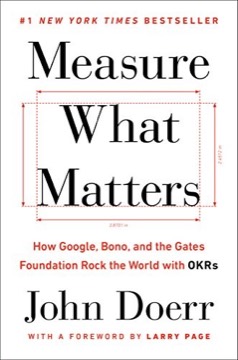
Measure What Matters
John Doerr's account of Objectives and Key Results — the goal-setting system he learned from Andy Grove at Intel and carried into the companies he backed — told largely through case studies from organisations that adopted it.
- First published
- 2017
- Publisher
- Portfolio/Penguin
- Pages
- 320
- Shelf
- Business
- Level
- Entry
- ISBN-13
- 9780241290873
Record checked against
Only one source carried a publication date for this work, so the year is uncorroborated.
Catalogue note
- Reads as
- PracticalWritten to be applied, not only understood.
- Level
- Accessible / FoundationalNo prior reading assumed.
- Approach
- Practical
- Written for
- Founders and operators, Newcomers to the subject
Saved in this browser only — no account, nothing sent anywhere. My library
Read this if
- You are responsible for other people's work as well as your own.
- You want to change what you do repeatedly, not just what you intend.
- You want something to apply, not only something to think about.
- You are starting from scratch here and want a way in that assumes no prior reading.
What an OKR is
An Objective is a qualitative statement of what is to be achieved: memorable, significant, action-oriented. Key Results are the quantitative measures that determine whether it was — typically three to five, each with a number.
The structure's discipline is that key results are not activities. "Launch the redesign" is a task; "reduce time-to-first-action from 90 to 30 seconds" is a key result. This distinction is where most implementations fail.
If a key result can be completed by doing a task, it is not measuring an outcome.
Devmark’s reading — not a quotation from the book
The inheritance from Grove
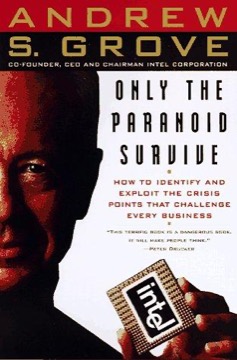
Doerr is explicit that he is transmitting rather than inventing. The system came from Andy Grove's management practice at Intel, which Doerr experienced as a young employee and later introduced to companies he invested in.
Grove's original framing — measure output, not activity; make the goals public; keep them few — is the substance, and Doerr's contribution is packaging and evidence of transfer.
The four superpowers
His organising claims for what OKRs do. Focus: a short list forces decisions about what not to do. Alignment: making objectives public lets teams connect their work to others' without a hierarchy mediating it. Tracking: regular check-ins with explicit grading. Stretching: goals set beyond comfortable reach.
The alignment argument is the strongest. Doerr's evidence that transparency of goals reduces duplicated and contradictory work is the most convincing part of the book.
Committed versus aspirational
A distinction that matters more than it is usually given credit for. Committed OKRs are expected to be fully achieved; aspirational ones are deliberately set so that roughly 70 per cent attainment is a good outcome.
Mixing them without labelling is the most common implementation failure — a team punished for missing an aspirational goal will never set one again, and the stretching superpower is lost permanently.
Separating OKRs from compensation
Doerr is firm on this and the reason is structural. If bonuses depend on attainment, everyone sets goals they know they can hit, and the system becomes a negotiation about targets rather than a tool for ambition.
This is the single recommendation organisations most often ignore, and ignoring it reliably converts OKRs into a more elaborate version of what they replaced.
The moment attainment drives pay, everyone sets goals they already know they can hit.
Devmark’s reading — not a quotation from the book
CFRs — the continuous performance half
Conversations, Feedback, Recognition: Doerr's argument that OKRs need a replacement for the annual performance review, not an addition to it.
His case against annual reviews — that they are backward-looking, recall- biased and too infrequent to change anything — is well made, and this section is the part of the book most relevant to organisations that already have goal-setting and still have a management problem.
The case studies
The bulk of the book is accounts from organisations that adopted OKRs, including technology companies, a foundation and a school network.
They are useful as demonstrations of range and weak as evidence. Every case is a success told by a participant, there is no organisation that adopted OKRs and failed, and the counterfactual is never examined.
Where it is weak
It reads in places like a promotional document, and Doerr's position as an investor in several featured companies is disclosed but not really grappled with.
Substantively, the book is much better at explaining what OKRs are than at the hard part: what to do when objectives across teams genuinely conflict, when the right key result is not measurable, or when the strategy the OKRs are meant to serve does not exist. OKRs are an execution instrument and cannot supply a strategy — the book does not say this clearly enough.
Common failure modes
Worth naming, because the book under-covers them. Too many OKRs. Key results that are task lists. Cascading rigidly top-down so that lower teams have no authorship. Setting them quarterly for work that does not move quarterly. And using them to measure business-as-usual rather than change.
Most organisations that report OKRs "not working" are doing at least three of these.
What to take from it
The outcome-versus-activity discipline is the core and transfers immediately: if a key result can be completed by finishing a task, rewrite it. So does the committed/aspirational split, which costs nothing to adopt and prevents the most common way the system dies, and the rule about keeping attainment away from compensation.
Read it for the mechanics and get strategy from somewhere else. OKRs are an execution instrument; they will faithfully and efficiently execute a bad plan, and the tidiness of the quarterly grading can disguise for a long time that the plan was the problem.
What to take away
- 01Key results measure outcomesIf it can be completed by finishing a task, it is an activity wearing a metric's clothes.
- 02Label committed versus aspirationalA team punished for missing a stretch goal stops setting stretch goals, permanently.
- 03Keep attainment away from payTie bonuses to OKRs and goal-setting becomes target negotiation.
- 04Transparency does the aligningPublic objectives let teams resolve conflicts directly instead of routing them through hierarchy.
- 05OKRs cannot supply a strategyThey are an execution instrument and will faithfully execute a bad plan.