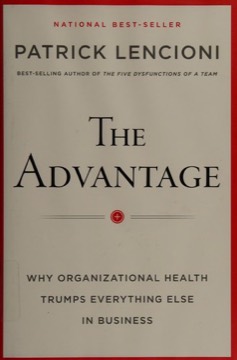
The Advantage
Patrick Lencioni's argument that organisational health — coherence, clarity and minimal politics — is a larger and more accessible competitive advantage than strategy or technology, and is almost universally neglected because it is unglamorous.
- First published
- 2012
- Publisher
- Brilliance Audio
- Pages
- 240
- Shelf
- Leadership
- Level
- Core
- ISBN-13
- 9781118147856
Record checked against
Catalogue note
- Reads as
- PracticalWritten to be applied, not only understood.
- Level
- Core / BuildingAssumes general familiarity with the subject.
- Approach
- Practical
- Written for
- Managers, Readers with some grounding
- Ideas
Saved in this browser only — no account, nothing sent anywhere. My library
Read this if
- You are responsible for other people's work as well as your own.
- You want something to apply, not only something to think about.
- You know roughly how the subject works and want the fuller account.
Health versus smart
Lencioni divides organisational effort into two categories. The smart side is strategy, marketing, finance and technology. The healthy side is minimal politics, minimal confusion, high morale and low turnover.
His claim is that almost all executive attention goes to the first, that the second is a larger and more available source of advantage, and that this asymmetry persists because health has no vocabulary that sounds sophisticated in a boardroom.
Executives spend their attention on the smart side because the healthy side does not sound impressive.
Devmark’s reading — not a quotation from the book
Discipline one: build a cohesive leadership team
The foundation, and essentially a restatement of *The Five Dysfunctions*: vulnerability-based trust, productive conflict, commitment, accountability, and attention to collective results.
His addition here is about size and composition — that a leadership team above roughly eight or nine people cannot sustain the required candour, and that membership should be based on contribution to the whole rather than on functional seniority.
Discipline two: create clarity
His most practically useful contribution: six questions a leadership team must answer identically. Why do we exist? How do we behave? What do we do? How will we succeed? What is most important right now? Who must do what?
His insistence that the answers be identical rather than merely compatible is the demanding part, and the exercise of getting there reliably exposes disagreements that had been invisible.
The thematic goal
His answer to the fifth question, and his sharpest single idea: a single qualitative rallying objective for a defined period, shared by the whole leadership team, owned collectively rather than assigned to a function.
His argument is that functional goals produce functional optimisation, and that a shared thematic goal is the only mechanism that makes executives genuinely interested in each other's problems.
Functional goals produce functional optimisation. One shared objective is what makes executives care about each other's problems.
Devmark’s reading — not a quotation from the book
Discipline three: overcommunicate clarity
His position that leaders dramatically underestimate the repetition required — his figure is roughly seven times before a message is believed, which he offers as a rule of thumb rather than a finding.
His related point is that the discomfort of repeating yourself is felt entirely by the speaker, while the audience is hearing it for the second or third time at most.
Discipline four: reinforce clarity
His final discipline is structural: embed the answers to the six questions into hiring, onboarding, performance management, meetings and compensation, so that the system carries the message rather than the leader.
His argument is that clarity which depends on continuous personal reinforcement will not survive the leader's attention moving elsewhere, and that institutionalisation is what makes it durable.
Meetings
His chapter arguing that most organisations have too few meetings of the wrong kinds. He proposes four distinct types — daily check-in, weekly tactical, monthly strategic, and quarterly off-site review — each with a different purpose and duration.
His central diagnosis is that bad meetings result from mixing tactical and strategic content, which guarantees the urgent crowds out the important every time.
Where it is limited
There is no research base. Lencioni is a consultant generalising from client work, the case material is anonymised and selected, and the effectiveness claims are assertions with no comparison group.
The model also presumes a leadership team with the authority and the appetite to do this work. Where the dysfunction originates above the team doing the exercise, the framework has little to offer.
Where it is genuinely useful
The six questions are a good afternoon's work for any leadership team, and the exercise of answering them independently before comparing answers is where the value is.
The gap between what executives believe is agreed and what is actually agreed is consistently larger than anyone expects, and this is a cheap way to measure it.
What to take from it
Run the six questions with your leadership team, separately and then together. The disagreement surfaced is the product; the document is a by-product.
And the thematic goal, which is the most effective available antidote to the functional silo, because it changes what each executive is measured on rather than exhorting them to cooperate.
What to take away
- 01Health is the neglected advantageIt gets no attention because it lacks vocabulary that sounds sophisticated, not because it matters less.
- 02Answer six questions identicallyNot compatibly — identically. Getting there exposes disagreements that were previously invisible.
- 03One shared thematic goalThe only mechanism that makes executives genuinely interested in a colleague's problem.
- 04Repetition is felt only by the speakerYou are bored of saying it long before anyone has heard it more than twice.
- 05Institutionalise or it decaysClarity dependent on personal reinforcement disappears when the leader's attention moves.