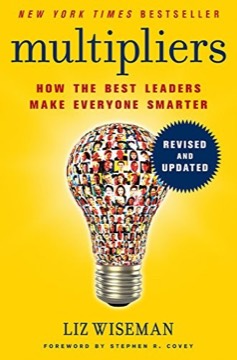
Multipliers
How the Best Leaders Make Everyone Smarter
Liz Wiseman's research into why some leaders extract far more capability from the same people than others — distinguishing Multipliers, who amplify the intelligence around them, from Diminishers, who suppress it while usually believing they are doing the opposite.
- First published
- 2010
- Publisher
- HarperCollins
- Pages
- 288
- Shelf
- Leadership
- Level
- Core
- ISBN-13
- 9780062663078
Record checked against
Catalogue note
- Reads as
- PracticalWritten to be applied, not only understood.
- Level
- Core / BuildingAssumes general familiarity with the subject.
- Approach
- Practical
- Written for
- Managers, Readers with some grounding
- Ideas
Saved in this browser only — no account, nothing sent anywhere. My library
Read this if
- You are responsible for other people's work as well as your own.
- You want to understand what makes people willing to follow a decision.
- You want something to apply, not only something to think about.
- You know roughly how the subject works and want the fuller account.
The core finding
Wiseman's research compared leaders whose teams consistently performed above expectations with leaders whose teams did not, controlling as far as possible for the quality of the people involved.
Her reported result is a substantial difference in how much of each person's capability was actually used — her estimate is that Diminishers access roughly half of what their people can do, while Multipliers access nearly all of it. The claim is striking and the measurement behind it is softer than the number implies.
The same people, under different leaders, deliver substantially different amounts of what they are capable of.
Devmark’s reading — not a quotation from the book
The accidental Diminisher
Her most useful contribution, and the reason the book lands with people who consider themselves good managers. Most diminishing is unintentional and arises from genuinely good intentions.
Her catalogue is uncomfortable: the idea guy whose enthusiasm crowds out everyone else's thinking, the always-on leader whose energy exhausts the room, the rescuer who steps in before anyone has struggled productively, and the rapid responder who answers before the team has formed a view.
The five disciplines
Her framework pairs each Multiplier behaviour against its Diminisher counterpart. Talent Magnet against Empire Builder. Liberator against Tyrant. Challenger against Know-It-All. Debate Maker against Decision Maker. Investor against Micromanager.
The pairing is what makes the framework usable, because each Diminisher pattern is a recognisable and often admired leadership style rather than an obvious failing.
Liberator
The discipline she treats most carefully: creating an environment that demands people's best thinking, which requires both safety and pressure rather than either alone.
Her distinction is that a liberator makes space and then insists it is used — permission without expectation produces comfortable underperformance, and expectation without permission produces compliance. Both halves are required and most leaders supply one.
Challenger
Her argument that Multipliers extend people beyond what they believe they can do, by framing hard questions rather than supplying answers.
Her observation that a Know-It-All leader's team stops bringing problems — because the leader will simply solve them — is the practical consequence, and it explains why capable leaders often find their teams strangely passive.
A team that has learned you will solve the problem stops bringing you problems. The passivity is downstream of competence.
Devmark’s reading — not a quotation from the book
Debate Maker and Investor
Debate Maker: making decisions through rigorous debate that people participate in, so that execution does not require persuasion afterwards.
Investor: giving genuine ownership with accountability attached, including letting people experience the consequences of their decisions. Her rule about returning the pen — refusing to take back a problem someone has brought you — is the concrete version.
Where the evidence is soft
This needs saying plainly. The research is interview-based and retrospective, the performance comparison relies substantially on self-report and observer estimate, and the widely quoted 2x figure is not derived from controlled measurement.
The framework is a well-articulated set of observations from a practitioner researcher rather than a demonstrated finding, and it should be held that way.
Where it is genuinely useful
The accidental-Diminisher material is the part with real practical value, because it gives capable, well-intentioned managers a specific vocabulary for behaviours they would never otherwise examine.
The self-recognition is uncomfortable in a productive way, which is rare in leadership writing and is why the book has the readership it has.
How to use it
The five disciplines work better as a diagnostic than as a programme. Reading the Diminisher column and honestly identifying which one you do under pressure produces more change than attempting to adopt all five Multiplier behaviours.
Wiseman's own recommendation — pick one diminishing habit and one multiplying experiment — is the right scale.
What to take from it
The reframing that your intelligence, applied directly, can reduce the total intelligence available to a problem. That is counter-intuitive and survives the methodological objections.
And the question worth asking after any meeting you led: how much of the thinking in that room was done by other people?
What to take away
- 01Diminishing is usually accidentalIt comes from good intentions — enthusiasm, energy, rescuing, answering fast — which is why it goes unexamined.
- 02Each Diminisher pattern is an admired styleDecisive, energetic, knowledgeable, helpful. That is what makes the framework uncomfortable and useful.
- 03Permission plus expectationSafety alone produces comfortable underperformance; pressure alone produces compliance. Liberating needs both.
- 04Return the penRefusing to take back a problem someone brought you is the concrete version of investing ownership.
- 05Your intelligence can reduce the totalApplied directly, it crowds out the thinking of everyone else in the room.