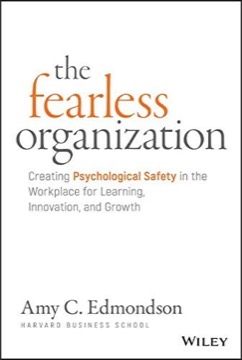
The Fearless Organization
Amy Edmondson's account of psychological safety — the shared belief that a team is safe for interpersonal risk — and the research showing it predicts learning and error reporting rather than comfort.
- First published
- 2018
- Publisher
- Wiley & Sons, Incorporated, John
- Pages
- 256
- Shelf
- Leadership
- Level
- Core
- ISBN-13
- 9781119477266
Record checked against
Only one source carried a publication date for this work, so the year is uncorroborated.
Catalogue note
- Reads as
- PracticalWritten to be applied, not only understood.
- Level
- Core / BuildingAssumes general familiarity with the subject.
- Approach
- Practical
- Written for
- Managers, Readers with some grounding
- Ideas
Saved in this browser only — no account, nothing sent anywhere. My library
Read this if
- You are responsible for other people's work as well as your own.
- You want to understand what makes people willing to follow a decision.
- You want something to apply, not only something to think about.
- You know roughly how the subject works and want the fuller account.
Where the concept came from
Edmondson's original finding was accidental. Studying medication errors in hospitals, she found that better teams reported more errors, not fewer. The difference was not competence but whether people could speak without penalty.
Psychological safety is her term for that condition, and the book is careful that it means candour is survivable — not that expectations are low.
Better teams reported more errors. That inversion is where the whole field started.
Devmark’s reading — not a quotation from the book
What it is not
The most common misreading is that psychological safety means being nice, or that it lowers the performance bar. Edmondson's model has two axes: safety and standards. High safety with low standards produces a comfort zone; the target is high on both.
She is equally clear that it is a group property rather than a personality trait. The same person is candid in one team and silent in another.
It is a property of a team, not of a person. The same individual goes quiet in the wrong room.
Devmark’s reading — not a quotation from the book
How it is built
Case studies run from Volkswagen's emissions fraud and Wells Fargo's account scandal — both presented as safety failures, where people knew and did not speak — to Pixar's braintrust and hospital units that improved.
The practical section gives leaders three moves: frame the work as a learning problem, acknowledge your own fallibility, and model curiosity by asking real questions.
The finding that looked wrong
Edmondson's original data appeared to show that better hospital teams made more medication errors. The resolution is the origin of the whole concept: they were not making more, they were reporting more, because the climate made admission survivable. Every subsequent claim in the field follows from that one measurement problem being correctly diagnosed.
The good teams did not make more mistakes. They were the ones willing to say so.
Devmark’s reading — not a quotation from the book
What silence costs
The case studies trace catastrophes back to information that existed inside the organisation and never travelled upward: emissions fraud, accounts opened without customers, a handset maker whose engineers knew the platform was failing. In each the knowledge was present and the cost of voicing it exceeded the perceived cost of staying quiet.
Safety and standards together
Her two-by-two is the corrective to the common misreading. Psychological safety without demanding standards produces a comfort zone; standards without safety produce anxiety and concealment; neither alone produces learning. The target is explicitly the demanding-and-safe quadrant, which is why this is not an argument for a gentler workplace.
Framing the work
The first of her leader behaviours is to establish what kind of problem the team is facing — routine, complex, or genuinely novel — because the appropriate error rate differs and people calibrate their willingness to speak against it. A leader who frames uncertain work as routine has guaranteed that bad news will arrive late.
Asking, not inviting
Her practical material concentrates on the difference between inviting contribution and actively soliciting it. That means acknowledging one's own fallibility out loud and specifically, asking narrow questions that are hard to answer with nothing rather than issuing a general invitation to speak up, and building structures — speaking rotations, pre-mortems, scheduled rounds — that make contributing the default behaviour rather than an individual act of courage performed against the grain of the meeting.
Responding without punishing
The behaviour that determines whether any of it holds is what happens the first time someone says something unwelcome. Edmondson is clear that the response must be appreciation regardless of whether the concern was correct, and equally clear that this is compatible with sanctioning genuine violations — safety is not immunity.
Where the evidence sits
The construct has substantial support, including from large-scale internal research at a major technology firm that set out to find what distinguished effective teams and arrived at this. The book itself is case-led rather than quantitative, and measurement remains contested: it is assessed by survey, and surveys about whether it is safe to speak have an obvious circularity.
What to take away
- 01More errors, better teamsThe finding that started the field: reporting rises when speaking is safe.
- 02Safety and standardsTwo axes; comfort is the failure mode of high safety with low expectations.
- 03A team propertyNot a trait — the same person is candid in one team and silent in another.
- 04Scandals as silenceVolkswagen and Wells Fargo are read as failures to speak, not failures to know.
- 05Three leader movesFrame work as learning, admit fallibility, ask genuine questions.